Fresh Milk is pleased to share a reflection by one of our inaugural Bocas Lit Fest Scholarship awardees, Cyndi Celeste, who alongside fellow Barbadian writer Connor Harris attended the 2026 edition of the festival in Trinidad & Tobago from April 30th – May 3rd.
This scholarship was made possible with the generous support of Peter Lewis as part of our 2026 Slow Reading Programme. This programme serves to activate Fresh Milk’s Colleen Lewis Reading Room (CLRR), and commemorate Colleen Lewis’s legacy on the 20th anniversary of her passing.
Read Cyndi’s reflection below!
On Isolation, Exile, and Re-Membering…
Reflections from Bocas Lit Fest 2026
by Cyndi Celeste


Sometimes, it takes a step away to find words for the questions you are carrying in your subconscious.
I had always watched the Bocas Lit Fest starry-eyed and from the short yet somehow ever-uncrossable distance between Barbados and Trinidad. The twin-island republic is home to many of the poets who shaped my early days as a ‘serious’ spoken word artist – one who didn’t just perform for the sake of it, but mobilised the work to help others, one who thought and cared deeply beyond themselves. I was only 21 when I first encountered the likes of regional spoken word powerhouse Derron Sandy and the quiet storm that came to be known to me most affectionately as my ‘Twini’, Deneka Thomas.
When Fresh Milk named me one of the scholars, I rushed to notify them both – Derron, who I had seen by chance earlier this year as a workshop facilitator, guest judge, and keynote speaker at the Frank Collymore Literary Endowment Award Ceremony; Twini, who I hadn’t seen in person since 2018 but with whom I’d somehow managed to stay connected. I was overjoyed to finally be able to immerse in the landscape I’d for so long watched from a distance.
But there was something else.
Over the last nearly 13 years as a spoken word artist, three ideas have circled my practice with increasing urgency: isolation, exile, and re-membering. It was poetic, then, that the theme of the year I would finally attend Bocas Lit Fest would be “All Together Now”.
Isolation has often appeared in unexpected ways. As an artist rooted in oral tradition, I frequently experience an insidious form of imposter syndrome within literary spaces oriented toward print publication. Surrounded by those whose primary relationship to language lives on the page, I have sometimes felt as though my work occupies an uncertain category – neither fully literary nor fully performance. This tension produces a particular loneliness, a subtle dislocation where I feel simultaneously present within the literary community and unsure of my placement inside of it.
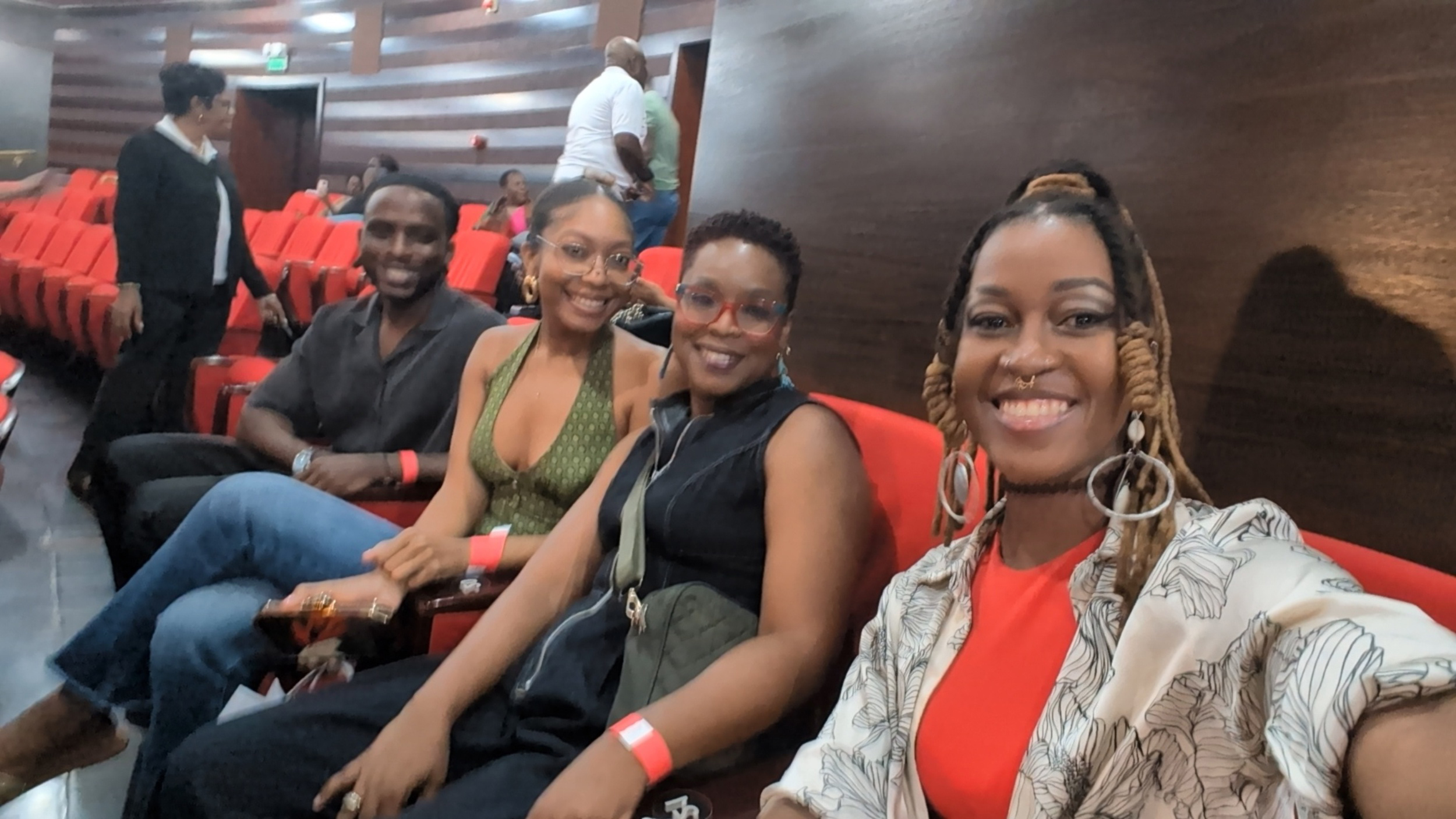
I sit in the Bocas award ceremony, listening to Canisia Lubrin read an excerpt from her Bocas Poetry Prize winning publication, The World After Rain, and the language is so visceral that my chest constricts and tears pool in my eyes. I whisper to Ayesha Gibson-Gill (there on behalf of FCLE) beside me:
“How could people ever call me a writer? I’m nowhere near her realm…”
Consequently, my foray into print is far newer – a mere four or five years. That means eight years of talking myself out of the ‘when are you going to publish a book?’ question with varying degrees of creativity. Eight years of trying and failing to convince myself that my legitimacy is historical, ancestral.
In the departure lounge of the Grantley Adams International Airport, Connor and I speak as though we have known each other forever. We talk about her work, my work, our aversions to very specific textures, our game plan for the festival, and something that has been sitting with me in quiet moments so much recently: exile.
As Caribbean readers and writers, we inherit a canon shaped by migration. How many of our writers existed in this specific isolation of leaving their country of birth and writing from beyond its borders? Connor asks me if I’m excited to perform. I say I am nervous, because I am. I tell her it is the first time in eight years that Deneka and I will see each other perform live. I tell her about how Trinidad is the mecca of spoken word in the Caribbean. I do not realise there is a longing sadness in my voice until hours later, as I’m rushing through the front doors of Kapok Hotel to speed to the performance venue.


After I perform, exile begins to speak to me in a different tongue. Twini somehow arranged for me to perform at BackChat, an LGBTQIA+ performance showcase and open mic. It is the first time I have ever touched a stage in Trinidad, and yet I experience a disorienting sense of belonging. I feel like someone who is already understood. The reception unsettles me precisely because it feels so natural.
Until now, isolation had been a familiar terrain. The community in Barbados exists as one still figuring itself out, and at some point dedication alone is no longer enough to overcome its structural limitations. I wondered if this feeling of “home, but elsewhere” was the same motivation that moved the greats. Throughout my festival experience, I run unsuspectingly into people reaffirming my BackChat performance.
“You are a juggernaut,” says Linzey Corridon, a Vincentian poet who resides in Canada. In his collection, West of West Indian, he writes:
There are no real words
only culpable emotions
funny bodies made into magic
pilgrims without (home)lands
our ancestor vagabonds
until now
(“Origins”)
Sitting beside him in Objects of Memory, my notion of exile transforms itself into an attempt to resist another form of isolation: remaining within a community that exists, yet often cannot meet the evolving needs of the artist. Exile begins to feel more like possibility than abandonment.


Onstage, Nicholas Laughlin explains the anatomy of the theme: All Together Now. He talks about how writing is so often a solitary process, about the need to be reminded that community exists and is here to hold us, and about why this particular moment when the world seems to want to devolve into chaos is so urgent. After the session, Linzey and I talk more about his doctoral work on the ‘nuance of the Queeribbean quotidian’. He asks what themes interest me.
“Isolation and exile,” I say initially, resisting the urge to elaborate my imposter syndrome. Then, as an afterthought: “And remembering.”
He mentions that it would make for interesting research if I ever decided to take that path. Later, I buy his book from the PaperBased bookstore stall. The title ties my sense of isolation in knots: West of West Indian.
Admittedly, of all the events I was curious about, I was most enthralled by the notion of finally getting to witness the National Poetry Slam live. In the foyer of the National Performing Arts Centre, there is barely room to turn around. The glass ceiling is probably 200 feet above my head and still feels as though it can barely contain the excitement.
In the auditorium, the energy for every performer rivals the crowd support of T20 cricket. As each of the ten poets performs, I am reminded of an earlier version of myself. The excitement of discovering the art form. The way that spoken word can reshape a room, or a life. The possibility. I am passionately invested in each performer – those I’d seen before, and those entirely new to me.
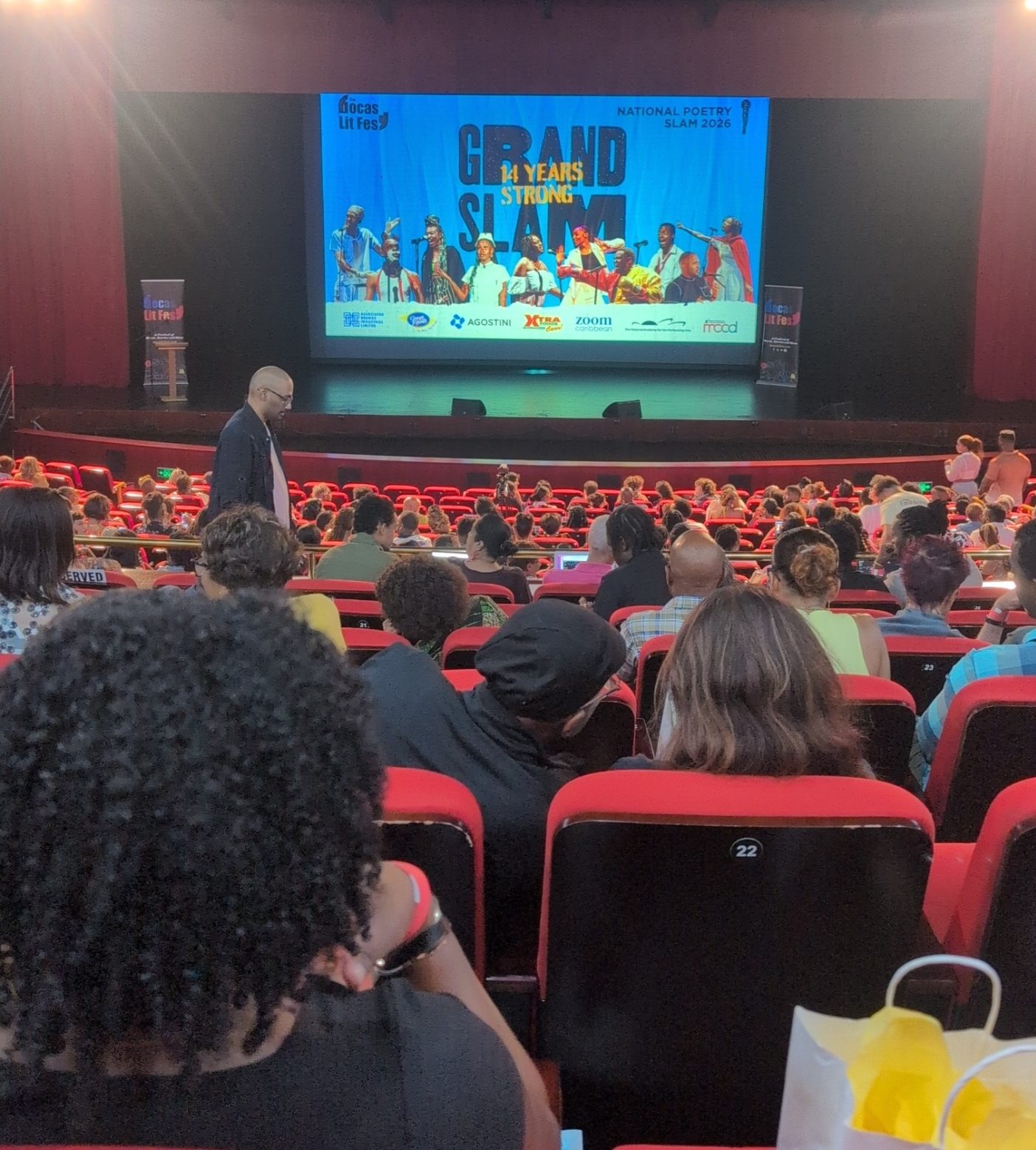
After the top three are announced, another Trinidadian poet who I’d met in France in 2023 asks me to give him a rundown of my thoughts. Twini would eventually do the same via text the next morning while I am waiting for my flight. Sipping on hot chai from Rituals in Piarco Airport, I feel simultaneously filled and bereft.
Filled, because a four-day trip 45 minutes across the water by plane put me back together in ways I hadn’t realised I needed – reconstructed me, re-membered me. Bocas helped me to gather back my creative self piece by piece, restoring the emotional and imaginative coherence that artistic survival sometimes fractures.
Bereft, because I wasn’t ready for it to be over just yet. All Together Now ultimately became less of a festival theme and more of a quiet reassurance: ‘We are glad you came, you are all together now”.
The Fresh Milk team and the Colleen Lewis Slow Reading Programme recognised a need I had forgotten – the need for artists to step outside of their immediate environment and encounter their practice anew. I leave the experience recognising that isolation, exile, and re-membering are stages within an ongoing artistic cycle. Isolation produces the work; exile seeks the conditions for its growth; and re/membering restores the artist to themselves.

