
Frantz Fanon & the Pursuit of ‘the White Girl’ – #CCF

Photo by Sølve Sundsbø

Photo by Sølve Sundsbø

The objectification of the white woman immediately caught my attention. She was to be used: for sexual gratification, to fulfill a ‘ritual of initiation into “authentic manhood”’ (Fanon 52), to ‘de-racialize’ the black man. Wait…what? De-racialize the black man? Fanon’s socio-economic background meant a white partner would have gone a considerable way in establishing his status in society. As for me, while still an ignorant youngster, I always knew that the fairer a girl’s complexion, the prettier she was. It was a fact, but I didn’t know why—just like how Jeun Veneuse, as Fanon noted, didn’t know why he loved Andreé. However, unlike Veneuse and Fanon, I wasn’t acutely aware that there was a problem with my skin colour that needed correcting.

The above excerpt is from Ronald Williams’ review of the chapter ‘The Man of Colour and the White Woman’ in Frantz Fanon’s Black Skin, White Masks, this week’s addition to the Fresh Milk Books Tumblr – the online space inviting interaction with our collection in the Colleen Lewis Reading Room.

For new Critical. Creative. Fresh reviews every week, look out for our #CCF Tuesdays  and see the good reads we have available at Fresh Milk!
Wangechi Mutu’s Family Tree – #CCF

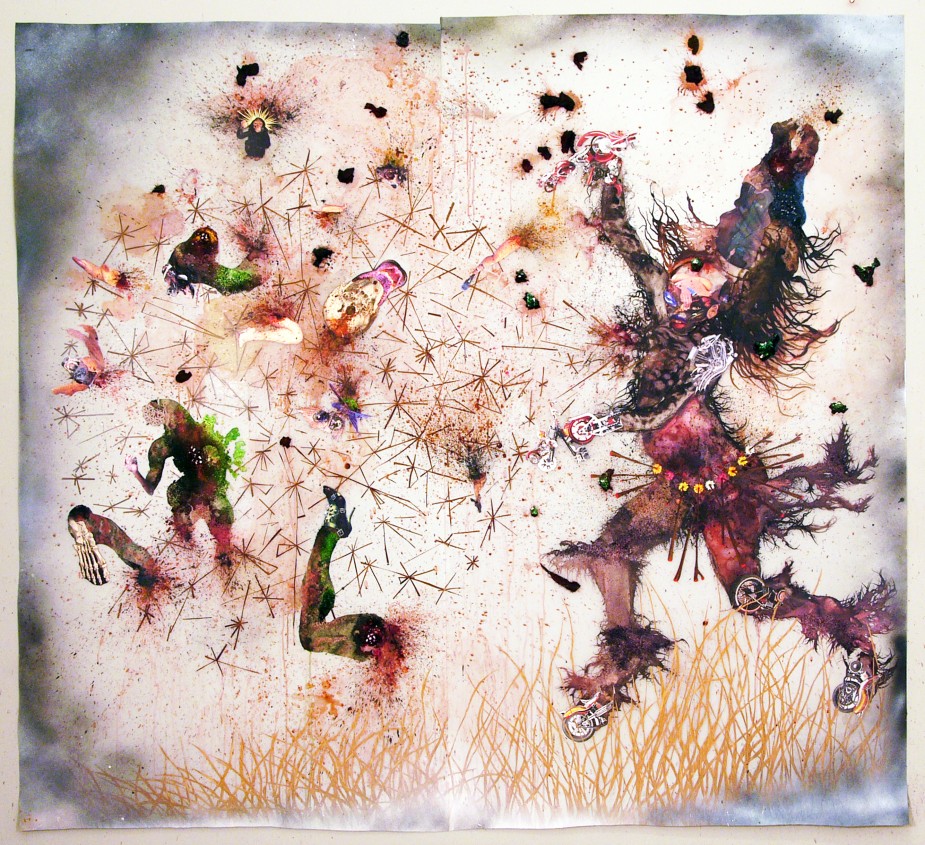
Wangechi Mutu, Try Dismantling the Little Empire Inside You, Ink, Mylar, pigment, photocollage with mixed media on Mylar and wall, 95 1/2 x 104”, 2007

Wangechi Mutu, Try Dismantling the Little Empire Inside You, Ink, Mylar, pigment, photocollage with mixed media on Mylar and wall, 95 1/2 x 104”, 2007

Definitions have always been my go-to method for gathering my thoughts; when you define something, it becomes clear and finite, manageable and straightforward. It creates a singular approach to a topic. After reading Kristine Stiles’ essay Wangechi Mutu’s Family Tree in the stunning exhibition catalogue for ‘Wangechi Mutu: A Fantastic Journey’, I felt saturated by the full sensory experience- from Stiles’ words, to Mutu’s salient images, to the gorgeous, smooth matte cover of the book. So, I retreated to my comfort zone of definitions to decompress. The corner I managed to back myself into with this, is that seeking a tidy, singular trajectory for something which in itself embodies plurality felt inadequate, especially with the much wiser and nuanced voices in the essay colouring my interpretations.

The above excerpt is from Katherine Kennedy’s review of the essay ‘Wangechi Mutu’s Family Tree’ by Kristine Stiles in the exhibition catalogue Wangechi Mutu: A Fantastic Journey, this week’s addition to the Fresh Milk Books Tumblr – the online space inviting interaction with our collection in the Colleen Lewis Reading Room.

For new Critical. Creative. Fresh reviews every week, look out for our #CCF Tuesdays  and see the good reads we have available at Fresh Milk!

mutu book 1200

The Cyprus Dossier 00 – #CCF

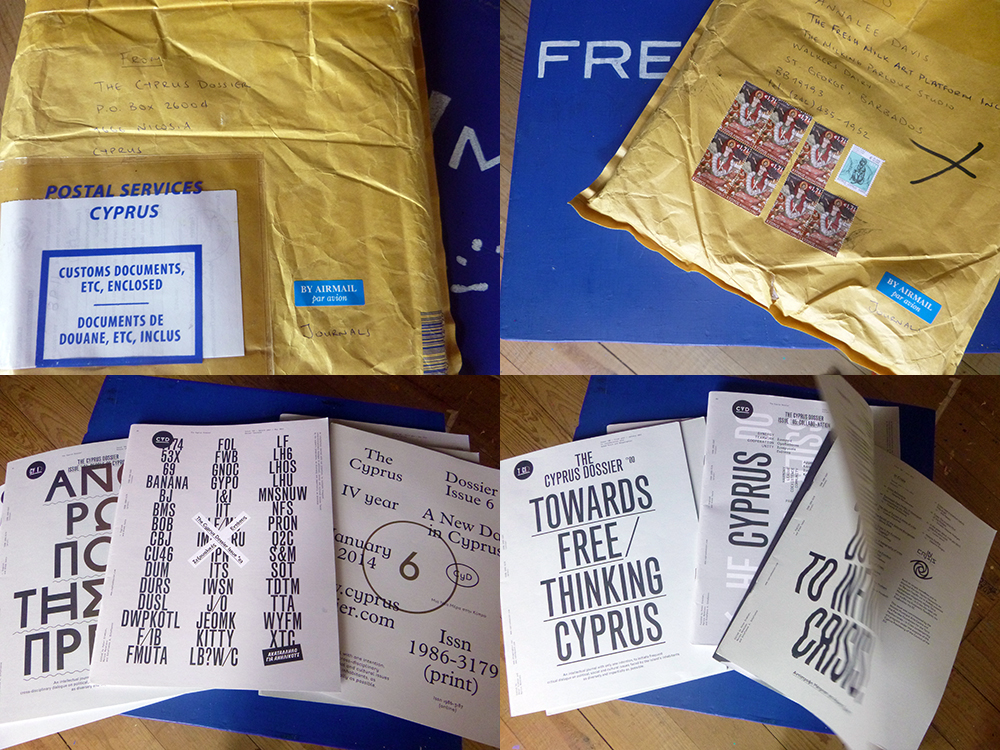
cyprus dossier compilation

…By the time I reached the end of the journal’s 39 pages, I was floored. Cyprus, I thought, how can this be somewhere I know nothing about? While concepts such as enosis (union with Greece) and takism (in relation to Turkish support of partition e.g. separate Turkish state) are embolic of Cyprus space, these themes and motifs look all too familiar: an island divided between two nations (e.g. Haiti & the Dominican Republic and Sint Maarten & Saint-Marteen), identity crisis, colonialism, imperialism, corrupt politics, arts/cultural activism, historical brainwashing, the cultural memory of physical spaces, white supremacist ideology…nationalism.

The above excerpt is from Amanda Domalene Haynes’ review of The Cyprus Dossier Issue 1: Towards Free Thinking Cyprus,  this week’s addition to the Fresh Milk Books Tumblr, the online space inviting interaction with our collection in the Colleen Lewis Reading Room.

For new Critical. Creative. Fresh reviews every week, look out for our #CCF Tuesdays  and see the good reads we have available at Fresh Milk!

cyprus compilation

Thanks to the Cyprus Dossier for donating a selection of their issues to Fresh Milk as we approach the International Artist Initiated Project being organised by the David Gale Gallery in Scotland, in which both entities will participate. The event will be a part of the Glasgow 2014 Cultural Programme corresponding with the Commonwealth Games this summer.

Look Beyond What you See – #CCF

mmx24x

Look at the nearest clock. With a lazy glance you see numbers, perhaps hands, a circle or maybe a square-shaped face. Pay closer attention and you may determine the time. Be even more attentive and you begin to appreciate the design of your clock face. Imagine the technology that enables the hands to move, the numbers to change. Everything that happens behind what you see gives you a better understanding of how that clock portrays time. Now, take this principle and apply it to your perception of life. This is the message of Sufi Master Pir Vilayat Inayat Khan.

The above excerpt is from Versia Harris’ review of That which Transpires Behind that which Appears: The Experience of Sufism by Pir Vilayat Inayat Khan, this week’s addition to the Fresh Milk Books Tumblr, the online space inviting interaction with our collection in the Colleen Lewis Reading Room.

For new Critical. Creative. Fresh reviews every week, look out for our #CCF Tuesdays and see the good reads we have available at Fresh Milk!
The Fact of Blackness – #CCF

Black Skin, White Masks by Frantz Fanon (1952). Photograph by Dondré Trotman.

Black Skin, White Masks by Frantz Fanon (1952). Photograph by Dondré Trotman.

“Who am I?/ I am a black man, of that I’m sure. / I am a black man…I’m sure. After all, the colour of my skin proves that fact. / So I am a black man, but I’m not sure of much more” states Frantz Fanon, a leading black intellectual of the 20th century. What I liked about Fanon’s essay “The Fact of Blackness” was his autobiographical address of the ‘black identity issue’- a topic that is still a major refrain of popular culture.

The above excerpt is from Ronald Williams’ review of Fanon’s essay ‘The Fact of Blackness’, which is the first piece to be featured on our newly launched Fresh Milk Books Tumblr, the online space inviting interaction with our collection in the Colleen Lewis Reading Room.

For new Critical. Creative. Fresh reviews every week, look out for our #CCF Tuesdays and see the good reads we have available at Fresh Milk!