Thais Francis’ Residency – Week 1 Blog Post

Trinidad-born, Brooklyn based multi-disciplinary performance artist and writer, and current artist in the Fresh Milk International Residency Programme, Thais Francis reflects on the first week in Barbados. She writes about her hesitation to confront her “quarter life identity issues” with a group of eager students from Workmans Primary School. After an eventful time with the children, she focuses on the challenges and rewards of writing her first feature screenplay. Read more below:

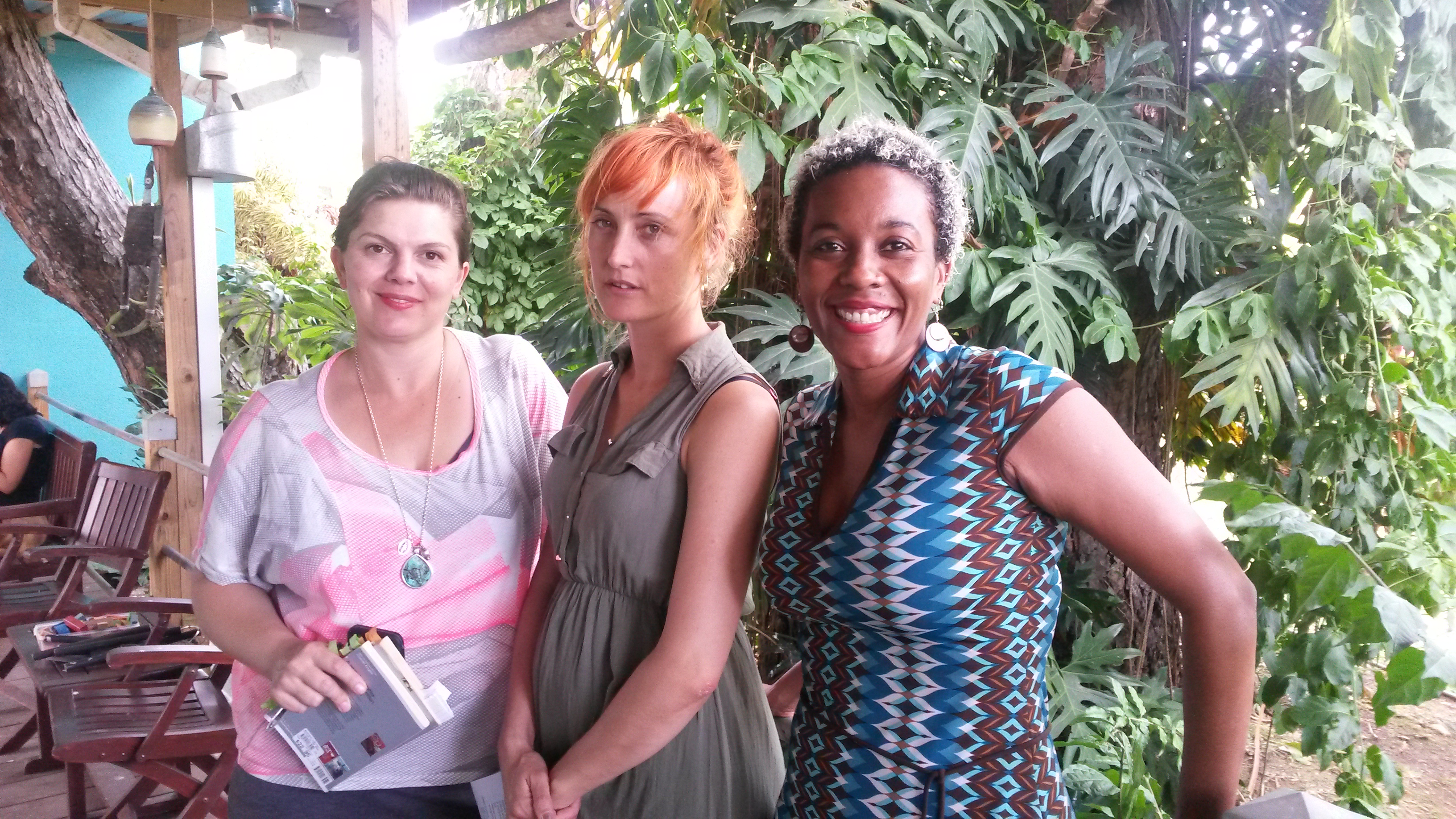
IMG_2194

“You look like my auntie!”

“I look like your aunt?”

“I like how you does say Auntie…say it again?”

“Ummm…aunt?”

“Where you from?”

Their names are Nyesha and Ramaya- one is bedecked in her brownie outfit, the other wears her school uniform topped with three plaits and ribbons. Nyesha thinks I look like her aunt, and Ramaya has picked up on my accent. She asks me the question that I dread answering. What do I tell her? Do I go into a spiel about emigrating from Trinidad…or do I just say Maryland? My brain goes into overdrive and my “quarter life identity issues” resurface. More classmates join them, and all stare at me expectantly. Innocently invasive brown eyes filled with questions and excitement. They are reminders of the beauty of being 9 years old.

“I live in America”.

They are satisfied with my response. We then all walk over to the open field.

When I first saw the students at Workman’s Primary school, I was elated. The ribbons, uniforms, brown skin-all images of a past life tucked away in the folds of mind. However, it wasn’t hard to remember and transform with them. With Ms. Bradshaw’s class of 17 students I found myself using theater, music and dance to add more color to the kaleidoscope of their lives. We used our bodies to mime and form shapes that were parts of speech; we became a human orchestra, and created a dance to work on focus and memory. They referred to me as “ma’am”. After the class, I thought about that. “What is a ma’am and how did I become one?”

In other news, here in Barbados, I have learned how to light a stove, with a match. Like, I can strike a match and light a stove. I’ll be sure to show my granny this new skill when I visit- she’ll be impressed.

IMG_2239

However, the main reason I am here is to work on my first feature screenplay. It’s actually weird, and frustrating, but sometimes cool, sometimes I like what I’m saying…most times I don’t. Mostly I’m excited to complete it, and then have people read it and rip it to shreds in a few weeks. I’m still figuring out what I’m saying- but I’m really into it the overarching idea, and the realness of the characters. I’m at page 78, luckily I worked on this A LOT in Trinidad and Abu Dhabi a few months ago-so I’m really happy I’m not starting from scratch. It makes this process less overwhelming.

Halcyon Macleod and Willoh S. Weiland’s Residency – Week 4 Blog Post

Australian resident artists Willoh S. Weiland and Halcyon Macleod share their fourth blog post about their Fresh Milk residency. This week Willoh & Halcyon continued their search for the elusive ghost of Jean Rhys, hoping to get clues from the “Queen of Barbados.” Rhys’ life is used as a metaphor for feelings of displacement and as a reminder that the personal voice is indeed political, particularly regarding the validity of art. Read more below:

Jean Rhys & Wide Sargasso Sea

Jean Rhys & Wide Sargasso Sea. Portrait by Teresa Chilton

Our last week in Barbados has seen a wonderful anxiety as the process has been accelerated and we realise that we have only moments left on this island before we fly home. The growing cache of audio files have started to appear in their true form, as an incomplete sketch of a place and people, with some parts coloured-in vividly and the rest remaining an outline.

The week has forced reflections on the interview process and how this is best done. At the end of every hour we spent interviewing, we wished for more. More time, more thought, better questions, less politeness, more anecdotes, and more friction. We have learnt that the peculiar intimacy of the interview is a whole art in itself. Coming to like each other is a quicker process than how we come to disagree.

Writer and journalist Gay Talese, in an interview in New New Journalism talks about ‘the art of hanging out’ and how he followed Frank Sinatra for two years to write his seminal essay Frank Sinatra Has A Cold. This was the art of both constantly reminding the subject that they are being watched, questioned, scrutinised and gently, gently disappearing into the background.

In our last interview we met the Queen of Barbados, a woman in her 80s who regaled us with her adventurous life story whilst sitting amongst an amazing collection of Caribbean modern art. Who can say they have lived in Casablanca? She told us about her mother who, at the turn of the century in Barbados, would jog miles in her swimsuit, and even started a women’s group as an avenue to write plays and look after other women’s children. She was another remarkable Bajan woman, ahead of her time. This same lady had also stayed in Jean Rhys’ house in Dominica. Our ghost hunting continued…

Jean Rhys' house in Roseau, Dominica. Image sourced from The Wander Life Blog

Jean Rhys’ house in Roseau, Dominica. Image sourced from The Wander Life Blog

We have looked for Jean Rhys everywhere. She is inimitable and elusive as ever. Yet she has permeated every interview, beyond questions of race and class. The feeling of being outside life or misplaced evoked the reflective state that we often enter in order to mine our own lives for meaning. As one woman we met this week described, she loved Wide Sargasso Sea because she belonged nowhere. This is so common a feeling to our century. It is what connects being Australian with the migration patterns of the Caribbean and the cultural hybridity of the islands.

What is so important about Rhys’ voice as a writer is the brutal gaze, which she turns on herself and her own experiences. It is the unflinching ability to ask what is this and why?

As we contemplate going back to Australia where the validity of art and, in particular, its ability to be political is being blatantly attacked by our government, we are reminded in these interviews that the personal voice is political. Each of these interviews and the stories they have shared has been individual examples of how each life, on reflection, shows clearly its own courage.

This residency is supported in part by the Australian Broadcasting CorporationThe Alcorso Foundation and Arts Tasmania.


Versia Harris travels to Casa Tomada, Sao Paulo

We are excited to announce that Barbadian artist Versia Harris will be going to Sao Paulo, Brazil for seven weeks on Sunday, May 24, 2015 for a residency with Casa Tomada.

This collaborative programme organized between Fresh Milk and Casa Tomada will see Versia working alongside Brazilian artist Janaina Wagner, interacting with arts professionals, producing and showcasing her work, exploring the Brazilian art scene and looking into the possibility of furthering her studies in Sao Paulo.

Congratulations, Versia! We look forward to keeping up with your residency as it progresses!

About Versia Harris:

 Versia Harris is a Barbadian artist living and working in Weston, St, James, Barbados. She received her BFA in Studio Art in 2012 and was awarded The Lesley’s Legacy Foundation Award, an annual prize given to the top graduate. She participated in her first residency with Projects and Space in 2011 and has since completed a residency with another  local organization called Fresh Milk, followed by a residency at the Vermont Studio Center, and residencies at the Instituto Buena Bista, Curacao and Alice Yard, Trinidad in late 2013. In 2014, Versia’s work was featured in the IV Moscow International Biennial for Young Art themed ‘A Time for Dreams’. She was also apart of the follow up exhibition ‘MOMENTUM_InsideOut screening of ‘A Time For Dreams’, Berlin. Her animation ‘They Say You Can Dream a Thing More Than Once’ was awarded ‘Best New Media Film’ at the Trinidad and Tobago Film Festival, 2014. Versia tackles perceptions of fantasy in contrast to the reality of her invented characters.

About Casa Tomada:

Founded in 2009, Casa Tomada is an independent space for practice, research and reflections of artistic nature. Concerned with the entire process, instead of focusing exclusively on the final work of art, Casa Tomada encourages discussion about emerging contemporary art, not only stimulating the development of artistic and theoretical practices motivated by shared experience, but acting as a catalyst for experiences and connections between artists, researchers, and other independent artistic initiatives. During these years, Casa Tomada organized 8 residences, 2 in partnership with Videobrasil, and one international exchange between São Paulo and London with the Delfina Foundation. Casa Tomada has also run other kinds of programs, all based on young artistic production, connections between different spaces and interdisciplinarity.

Fresh Milk welcomes Thais Francis to the platform

Thais

Fresh Milk is pleased to welcome our next artist-in-residence Thais Francis, a Trinidad-born, Brooklyn based multi-disciplinary performance artist and writer who will be joining us from May 18 – June 12, 2015. Thais will use her time on the platform to write her first feature film, as well as conduct a community outreach project with students of Workmans Primary School.

About Thais Francis:

Thais is an actor, dancer, singer, writer, and instrumentalist born in Trinidad and Tobago, and raised in Maryland. She is an alumna of the Tisch School of the Arts, at New York University where she studied Drama. As an actor, she has toured in theater both nationally and internationally.  Her work has been seen at the Historic Warner Theater in Washington DC and Radio City Music Hall in New York City.  She was honored by the Root Magazine as one of the 25 under 25 Top Innovators in America. Her academic writings have been featured at The Prindle Institute for Ethics at Depauw University, presented before the staff of the White House and awarded by the Congressional Black Caucus. She has been a featured speaker alongside Howard Zinn at NYU and is a recipient of the Lorraine Hansberry Arts, Performance, and Media NIA Award at NYU.

Her original play OUTCRY has been produced throughout the U.S since its debut in 2012 at NYU and most recently featured in American Theater Magazine.  She has written, produced and starred in her first short film LATE EXPECTATIONS. She currently resides in Brooklyn New York and is working on several scripts for both theater and film as well as music

Willoh S. Weiland and Halcyon Macleod’s Residency – Week 3 Blog Post

Australian resident artists Willoh S. Weiland and Halcyon Macleod share their third blog post about their Fresh Milk residency. This week, Willoh explored different sides of Barbados, as she made field recordings around the island including along the rugged East coast. She not only reflects on the island’s multifaceted geography, but on the diversity of the women they have interviewed, and what constitutes the ‘right’ for someone to claim Bajan or Caribbean heritage. Read more below:

20150506_153241

Why do white people like to hunt ghosts?

This Buzzfeed article made me laugh out loud. I think many of us are guilty of at least a few of these, including loving attics and hunting ghosts. Halcyon is right now in Dominica looking for the traces/evidence of Jean Rhys while I have been driving around the island collecting field recordings, including the windmill turning slowly in the dark gardens of St. Nicholas Abbey, village dogs barking at night and the St Matthias Sunday church service. I’ve been listening to Bajan radio all the while, particularly the religious stations, which are clear about how you can get cast out of paradise and for what.

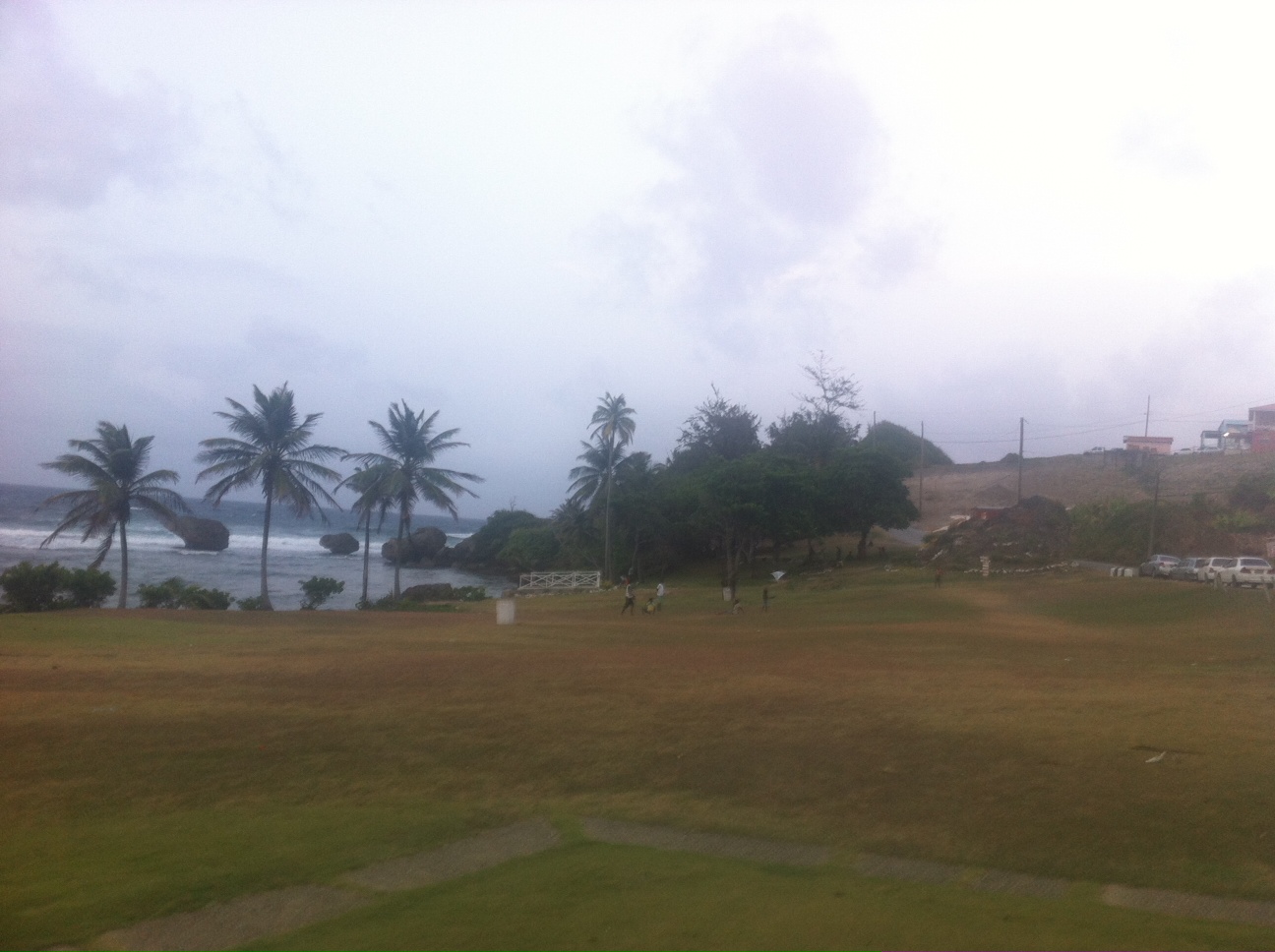
The Bathsheba area is on the East coast. You drive over the high hills in the centre of the island and then you start coming down steep, steep hills towards the Atlantic Ocean. There is nothing between this coast and the West coast of Africa. Named after a biblical adulteress, it is nestled on the wild coast, boulders strewn as if flung out by a giant having a tantrum long ago. It feels like an entirely different country. The challenge of evoking mystery and complex narratives through sound becomes evident. What is Bathsheba if I turn off my eyes?

The Bajan dialect is a pleasure to listen to. The accent is syrupy. You can hear West African, sometimes hints of the Scottish Isles and the humour coming thick and fast. It is so close and yet so completely different to Belizean Kriol. In Belize you ‘suk u teeth’, in Bajan you ‘steupse’.

In both places, the action of making that sucking sound of disdain, anger, indifference, of sexy banter – given there are many ways to ‘suk u teeth’ – relays a whole glorious sense of attitude.

In Belize, I remember my best-friend saying to me when I was talking to my Australian Mum, “why does it take you so long to say anything?” and it’s true. English seems laborious, as though it were made for stiff upper lips and long cloistered afternoons.

I have no Belizean blood and so being Belizean is a negotiation, determined not by me, but by the person I am speaking to. Were you born there? How long did you stay? Do you speak Kriol? All of these questions probe the unspoken right to a place.

photo 2

This week we spoke to women born here in Barbados, but not raised here, who have returned from abroad, with different accents after some time living other lives. In the reverse situation where all your blood is from here, how is it to be treated as if you are foreign. They spoke of the peculiar ‘outsiderness’, of being considered American and sharing the delight of being able to whip back a response in dialect, and of the peculiar and mercurial sadness of leaving and coming home, over and over again.

“I would never be part of anything. I would never really belong anywhere, and I knew it, and all my life would be the same, trying to belong, and failing. Always something would go wrong. I am a stranger and I always will be, and after all I didn’t really care.” – Jean Rhys

One interview this week with a high-ranking member of the cultural sector (cue spy music) was particularly inspirational. She gave an impromptu monologue about the future she saw for islands like Barbados and all small economies that have become utterly dependent on tourism. A bleak scenario, where the supply chains are cut off, the meat from New Zealand is no longer coming, where we are hungry and can’t remember how to plant our own food. The picture she painted was not to instill fear but instead to illuminate what is unique to where we are, the stories we need to keep telling and ways in which we can give back to the places we inhabit. Everyone, quick! Go do something meaningful with your life! Cue dramatic ending.

This residency is supported in part by the Australian Broadcasting CorporationThe Alcorso Foundation and Arts Tasmania.