Nyugen Smith’s Residency – First Blog Post

US-based interdisciplinary artist Nyugen Smith shares his first blog post about his Fresh Milk residency. Nyugen has begun his experience by actively engaging with the site of Fresh Milk, which is located on a former plantation – now a working dairy farm –  and learning the history of this space and Barbados on the whole through conversations with Annalee Davis, exploring the grounds and conducting research in the Colleen Lewis Reading Room. Read more below:

*This blog post may contain language and content that may be unsuitable for children and the prudish. Discretion is advised. 

Day 1 of my residency at Fresh Milk International Artist Residency in St. George, Barbados.

Just prior to leaving home in the USA for this, my third Caribbean island as part of my Leonore Annenberg Arts fellowship, I was struck by the words, actions and accomplishments of peers/contemporaries/family.

It is because of them, I am inspired to approach this month-long residency with a deeper level of introspection, transparency, courage and audacity as it relates to process and reflection on time and work. Thank you.

I don’t know much about Barbados. I spoke with confidence correcting someone back home that Barbados was a larger island than Martinique. I was wrong. The former is 166.4 miles squared, while the latter is 436 miles squared. I was laughed at by a Bajan woman next to me on the plane on the way here when I asked her about the mountains on the island. “Barbados flat!” she said. Prior to coming, I wanted to know a more about the site where the Fresh Milk residency exists and about its founder, Annalee Davis.  Annalee (Fresh Milk) is also a co-creator (together with ARC Magazine) of Tilting Axis, a roving project with a goal of negotiating strategic regional and international alliances for the further development of infrastructure, production and markets for the Caribbean’s visual arts sector. I had followed her 2016 social media posts of her (bush) Tea Services project at the Empire Remains Shop in London, England where she offered to visitors, daily servings of varieties of bush tea collected from the fields of the former sugarcane plantation and adjoining rab lands out of tea-sets containing shards of crockery mined from the ground of her family property in Barbados. I know bush tea. I grew up on it. I picked bush for tea. The history and legacy of empire is of interest to me and this interest informs my work…so I wanted to know more…

Tilting Axis 3: Curating the Caribbean (May 18 -20, 2017) was hosted by the National Gallery of the Cayman Islands and the presentations by arts professionals was live streamed on Facebook and archived for later viewing. I watched three of the presentations so far (including Annalee’s opening address) and they were incredibly engaging. I said to myself, “..this Tilting Axis project is important, necessary and exciting.” So I looked to see what else I could find about Ms. Davis’ work and came across her 2014 essay on ARC magazine’s website titled: Drawing Lines – Counterpoints from inside the plantation, State(s) of Emergence(y) and crises of belonging at home. Here I learned a little about the history of the site of Fresh Milk. 

I could continue by providing references to my work that are related to what Annalee refers to in this essay as the “plantation complex,” however, one can look at my website and or google to see the connections.  So to be here, on a location that is charged with all of this present and living history, is an opportunity that I am blessed to have and grateful to have been accepted to continue in my exploration and make the work that I am called to do.

Nyugen Smith, coat of alms, 2016.

Milk

noun
1.
an opaque white fluid rich in fat and protein, secreted by female mammals for the nourishment of their young.

verb
1.
draw milk from (a cow or other animal), either by hand or mechanically.
synonyms:draw milk from, express milk from

2.
to exploit something to the utmost

Milk

when someone jerks off/ fucks a guy until every drop of cum comes out
http://www.urbandictionary.com/define.php?term=milking
Pleasurable, euphoric, ecstasy.

Today I watched the milking of over 24 cows. The process was systematic and efficient. I watched the area where they stand and feed everyday, be cleaned by what I would call a giant metal squeegee on the back of a tractor. Keshan reversed over and over, pushing all the waste to the end of both aisles, piling it up. I watched the calves in their pens, ears tagged with numbers to identify each, just as the adults were. They produced. They are of value. They are currency.

Not far from where they spend much of their days, stands what Annalee referred to in the aforementioned essay as vestiges of an insidious complex. The remains of a sugar mill and its outposts. Though missing its top and outstretching windmill, it still stands its ground, with baritone breath, holding secrets and long memory. The former mill and nearby trees whisper tales longer than the young vines that hang from their tops, down to hallowed ground, but yet to dig for bones, tobacco pipes and fragmented wares. Evidence of the hand is all over the limestone, wood and metal structure that was the mill. New life springs from the death of her. I touched and listened. The arched orifices are like deep gasps as if to revive. Parts and pieces of her lay strewn about and kept alive still, by the same air that filled lungs there centuries ago.

I thought about the bodies that laboured here, on this site, and how they might have moved, how many were they over time – like if all of their souls were present at once – just standing there to be counted, to be called by name. They produced. They were of value. They were currency.

This was not a moment of gloom for me, but a joyous one – like, YES! You are here, Nyugen. In the mix with all of this history. To make full use of this time and opportunity to engage, share, learn and build. As I walked the grounds in reflection, I began to recall the email introductions made by the FM staff, connecting me with historians, scholars, artists and writers here in Barbados. There was an anxiousness, a ready to burst feeling that ran through me from crown to sole. I then went to the Colleen Lewis Reading Room adjacent to the studio and browsed a portion of the over 3468 items in the collection and pulled a few titles to sit with for a while. 

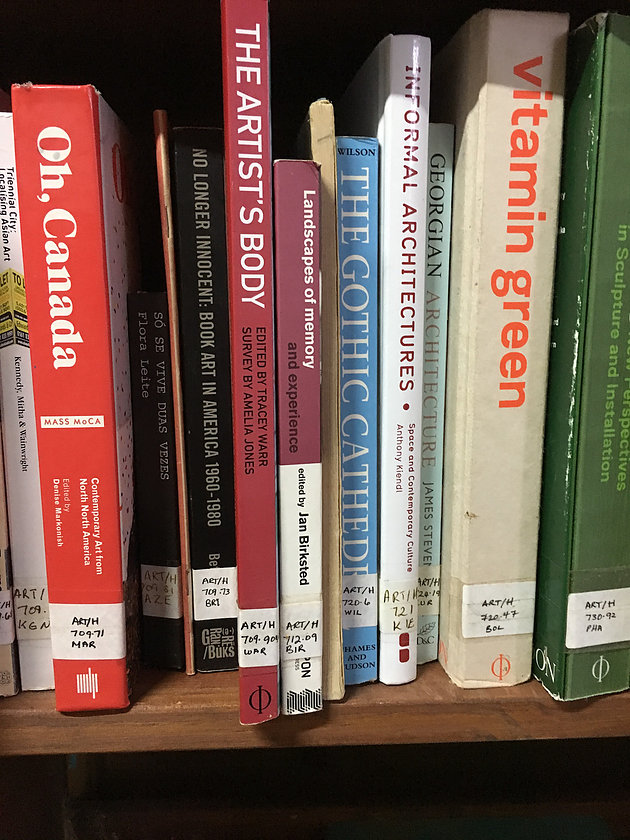
(from the collection)

In the preface to The Artist’s Body, edited by Tracy Warr, Warr writes, “Artists have investigated the temporality, contingency and instability of the body, and have explored the notion that identity is ‘acted out’ within and beyond cultural boundaries, rather than being an inherent quality. They have explored the notion of risk, fear, death, danger and sexuality, at times when the body has been most threatened by these things.” This caused me to reflect on notes I took during my walk around the acres. I thought about the complex notion of identity in the Caribbean and how one’s role or position within the social structure is inextricably linked to the body that ‘act(s) out’ the role(s). Then the questions arise: does the ability to effectively execute a role depend on one inherently possessing the qualities of said role? and if so, how does the threat of fear, death, risk, and sexual violence deepen the commitment to the role. Then one can ask further questions applicable to the plantation model about inherent qualities formed by what Carl Jung referred to as collective unconsciousness.

Warr goes on to write about Dadaist of the 1910s and 1920s making “art in places more real and relevant.” This site, is perhaps more “real and relevant” to my work than any gallery or institution in which I have exhibited or made performances. It is my hope that the work that happens here continues in the trajectory of my time spent in Martinique – (Working form a non-Western cultural perspective), not (so) focus(ing) on a notion of the individual as a central, cumulative point, but rather on an understanding of self as part of a continuum in time, a community, an environment, a cosmos. – Warr 

Read this post on Nyugen’s website here.

___________________

This residency is supported by the Leonore Annenberg Fellowship Fund for the Performing and Visual Arts
Fresh Milk welcomes Nyugen Smith and Letitia Pratt to the platform

Fresh Milk is excited to welcome US-based interdisciplinary artist Nyugen Smith and Bahamian writer Letitia Pratt to the platform for the month of June, 2017.

While in Barbados, Nyugen will be working on a project which  contributes to a multi-part installation titled Lavway. (“Lavway” is Trinidadian patois for “le vrai,”or “the truth” in French, and is the name of a form of calypso that reports the truth as seen by the singer or composer.) Lavway will examine the education system in the Caribbean from late nineteenth century to present day with a focus on systematic omission of histories and contributions of people from the African diaspora. His Fresh Milk residency will be spent in part on research and collecting relevant objects, recordings, and texts in relation to this.

Letitia intends to use the residency to work on an individual poetic project, Melody of a Lost Woman. This series of twelve narrative poems will focus specifically on Bahamian womanhood and the effects of the patriarchy on the feminine existence within the Bahamas. The piece draws strongly on Moya Bailey’s concept of misogynoir, which refers to the violence that black women endure by the hands of black men. Her work and research in Barbados will question the ways Bahamian misogynoir differs from other patriarchal incarnations, and explore commonalities through Caribbean history and folklore to consider these experiences across the African diaspora.

__________________

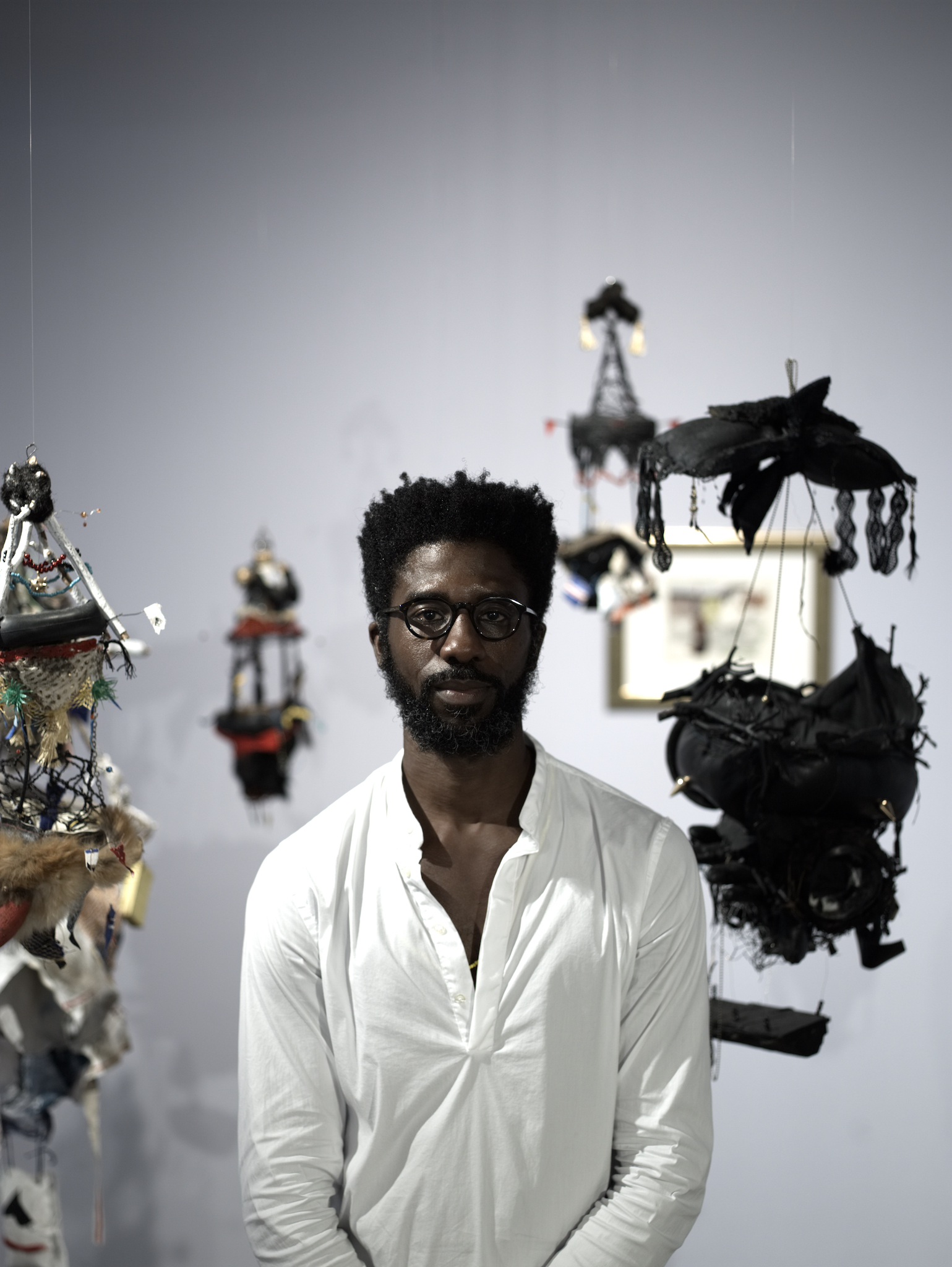
Nyugen Smith (Photo credit: Janice Marin)

Drawing heavily on his West Indian heritage, Nyugen Smith is committed to raising the consciousness of past and present political struggles through his practice which consists of sculpture, installation, video and performance. He is influenced by the conflation of African cultural practices and the residue of European colonial rule in the region. Responding to the legacy of this particular environment, Nyugen’s work considers imperialist practices of oppression, violence and ideological misnomers. While exposing audiences to concealed narratives that distort reality, he destabilizes constructed frameworks from which this conversation is often held.

______________________

About Letitia Pratt:

Letitia Pratt recently obtained her Bachelor of Arts in English Language and Literature from the College of the Bahamas. An avid reader of fantastic fiction, most of her writing navigates the existence of black (feminine) bodies within that genre and draws heavily on stories within Bahamian folklore. Her themes often explore the function of art and literature within the Bahamas, and her most recent published work, ‘A Scene (of Two Lovers Contemplating Suicide)‘ discusses the concept of liminality within artwork, and how it’s the ability to occupy multiple spaces creates an active exchange of ideologies.

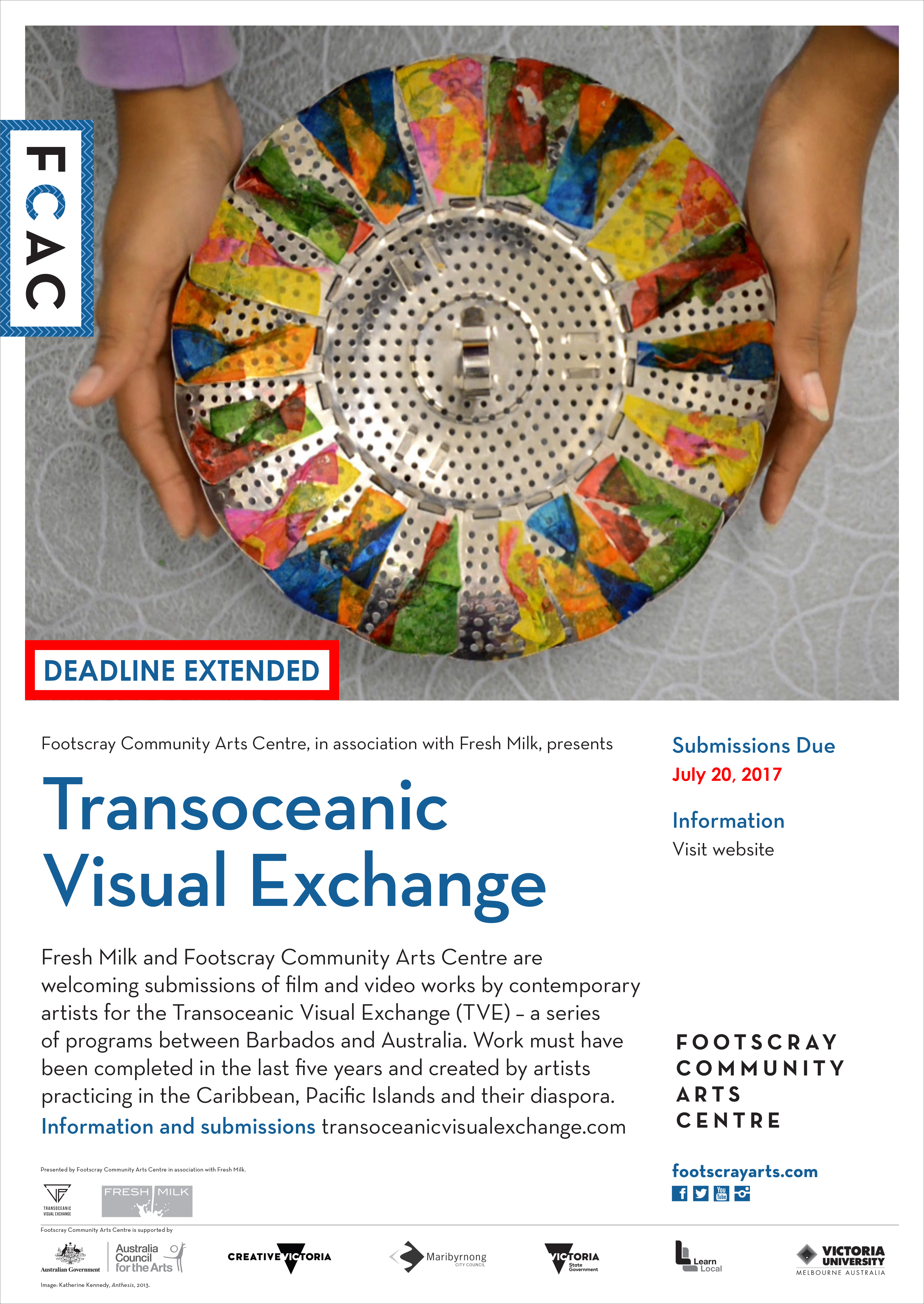
Open Call: TVE 2017 – Deadline Extended

Deadline extended until July 20, 2017

Fresh Milk and Footscray Community Arts Centre are pleased to welcome submissions of recent film and video works – screenings, installations, new media and expanded cinema – by contemporary artists, to be included in the second edition of Transoceanic Visual Exchange (TVE), a series of programmes taking place this year between Barbados and Australia. Submitted works must have been completed in the last five years and must be made by artists practicing in the Caribbean, Oceania and their diasporas.

TVE will be a collection of recent artists’ films and videos from each region. However, the final shape and content of the programme will be informed by a community curatorial process, which aims to involve and promote discussion within the wider arts communities of each participating initiative.

Working between the Caribbean, Oceania (Pacific Islands) and their diasporas, TVE aims to negotiate the in-between space of our cultural communities outside of traditional geo-political zones of encounter and trade. TVE intends to build relations and open up greater pathways of visibility, discourse and knowledge production between the regional art spaces and their communities.

Submission Requirements:  

  • Must be work from artists practicing in the Caribbean, Oceania (Pacific Islands) and their diasporas

  • Must be work that has been completed/made in the last five years.

  • Can be films of any length (shorts, experimental, features and video artworks)

  • Can be in any language (films originally produced in regional languages are welcome)

  • Multiple submissions are welcome

  • Must be accompanied by a description of the work (500 words max), a bio (200 words max) and detail of any technical requirements i.e. audio, installation, equipment required, preferred setting etc.

  • Works must be in the form of mp4 files no larger than 10MB, or private Vimeo / Youtube links

  • Works must not have been submitted to the previous edition of TVE

Deadline for submissions: July 20, 2017

Please send Caribbean submissions to: tveproject.caribbean@gmail.com

Please send Oceania submissions to: tveproject.oceania@gmail.com

For more information on TVE and its first iteration, visit the website transoceanicvisualexchange.com

_________________________

About Fresh Milk:

Fresh Milk is an artist-led, non-profit organisation founded in 2011 and based in Barbados. It is a platform which supports excellence in the visual arts through residencies and programmes that provide Caribbean artists with opportunities for development, fostering a thriving art community.

Fresh Milk offers professional support to artists from the Caribbean and further afield and seeks to stimulate critical thinking in contemporary visual art. Its goal is to nurture artists, raise regional awareness about contemporary arts and provide Caribbean artists with opportunities for growth, excellence and success.

________________________

About Footscray Community Arts Centre:

Footscray Community Arts Centre (FCAC) is a community-engaged, contemporary arts centre working with local, regional and international communities.

We collaborate with artists, communities and organisations to build capacity, create opportunities and drive social change. We are the place where important conversations happen: we then action; we cultivate; we deepen.

Digital copies of RA: Representing Artists now housed on the Fresh Milk website

The quarterly Barbadian and Caribbean arts newsletter RA (Representing Artists) was produced in the early nineties, spearheaded by a group of Barbados-based artists who saw the need to create a forum for more critical writing around contemporary arts in the region.

As part of her Tilting Axis Fellowship that has seen her travel to arts spaces throughout the Caribbean, Jamaican writer and curator Nicole Smythe-Johnson has digitized all six editions of this newsletter to make them available for public access on the Fresh Milk website. This inaugural curatorial fellowship is supported by the British Council.

With so many ongoing conversations about the development and future of Caribbean art today, it is important to know the history of spaces and what has laid the foundations for these discussions. Over the last 24 years, how have things changed? What has remained the same? We hope that these texts can be a source of inspiration, evaluation and critique, both for the state of the creative environment then and for encouraging productive discourse moving forward.

Edited by: Annalee Davis
Designed by: Arthur Atkinson (Issues 1-4) and Kristine Dear (Issues 5 & 6)

Contributors: Annalee Davis, Allison Thompson, Ras Akyem, Ras Ishi, Christopher Cozier, Nick Whittle, Alison Greaves, Roger Lipsey, Ken Corsbie, Dominique Brebion, Stan Kuiperi, Marianne de Tolentino, Dennis Tourbin, Petrona Morrison, Gayle Hermick, Geoffrey MacLean, Elizabeth Barnum and Sharen Carmichael

Click here to access the full issues on our Projects Page.

Dorothea Smartt’s Residency – Final Blog Post

British-Barbadian poet and live artist Dorothea Smartt, who was in residence with Fresh Milk in November-December 2016, led a workshop on poetry and free writing with Class 4 students at St. George Primary School on January 16, 2017. Read more from Dorothea about this experience below. Thanks so much to the staff at St. George Primary for allowing us to host the session, and to the bright and enthusiastic children for embracing it!

20170116_113708

After a return to London to take care of pressing domestics, I reconnected with Fresh Milk in January. We had a good meeting with local St George Primary School in December. Katherine at Fresh Milk followed through, and we were given a date, Monday January 16, to hold an 80 minute session with some of the students.

We met the head teacher before going to the class. A junior class of curious boys and girls greeted us formally, after a brief introduction from their welcoming class teacher. Katherine introduced me as a Fresh Milk International Artist in Residence. I talked a little with the pupils about myself and being a poet.

The class took part in a discussion on people leaving Barbados to go to work building the Panama Canal. I drew a rough map of the Caribbean, and they joined in identifying where Panama was. Some pupils, one boy in particular shared about great grandparents who’d gone to Panama. Some pupils were hearing about it for the first time.

I read them one of the poems about Panama that spoke of some of the men who died. And we spoke about the dangerous working conditions people endured. I guided the pupils in a free-writing exercise with a prompt: ‘In those days…” and they wrote for 3mins. They responded with enthusiasm.

To follow I shared five old black and white photos of the Caribbean. These were from a learning resource pack produced by the (British) National Archive. The pupils worked in five groups with a photo each. First they discussed the image and were asked to imagine how they might relate to Panama workers. For example, they imagined a banana worker was harvesting food for the workers; a large drawing room, a place where bosses would have gathered to relax; and an image of a hut with a canoe outside a place where a worker may have lived and fished for food.

Then each pupil wrote a short poem drawing on our discussion, their free-writes and the photos. We had time to hear some of the pieces produced, which were full of imagination and insight.

I really enjoyed meeting these pupils, they were keen and interested. Their input, questions, and writing added to my own imagination, especially when it came to what the workers would have eaten! Hopefully my workshop is the start of an on-going relationship with Fresh Milk – as they have plans to work with this class on a future project!

I had hoped to connect with the group in Panama again, and present something of my work and process. Time, internet and availability of space weren’t able to come together and after a discussion with Katherine/Fresh Milk, I let this go.

On this residency, the space, time to focus and reflect, discussions with Bajans and others, and the events I attended have enhanced me. I feel encouraged and affirmed on my journey with this research and the poems I written. There’s more to unfold and write, and this residency has definitely resourced me to carry on.

Maferefun Egun. Maferefun Orisha.