Tilting Axis 2: Caribbean Strategies held at the Pérez Art Museum Miami

The inaugural edition of the Caribbean-driven visual arts conference Tilting Axis took place last year at The Fresh Milk Art Platform Inc. in Barbados. This initial encounter saw thirty-two arts professionals spanning the Anglophone, Francophone, Hispanic and Dutch Caribbean convene for the first time on Caribbean soil alongside a number of international participants. Building on this, Tilting Axis 2 took place at the Pérez Art Museum Miami (PAMM) on February 19 and 20, 2016, with more than double the previous number of attendees coming together to discuss this year’s topic ‘Caribbean Strategies’.

Tilting Axis was originally conceived by Fresh Milk and ARC Magazine, who have continued to collaborate with core partners Res Artis and PAMM for the second iteration in Miami. As a city that not only aspires to be a vital art centre in the 21st century, but that also acts as a hub between the Caribbean and the global North with a large diasporic population and, in many ways, a shared history, Miami was a strategic location for the conference to travel to.

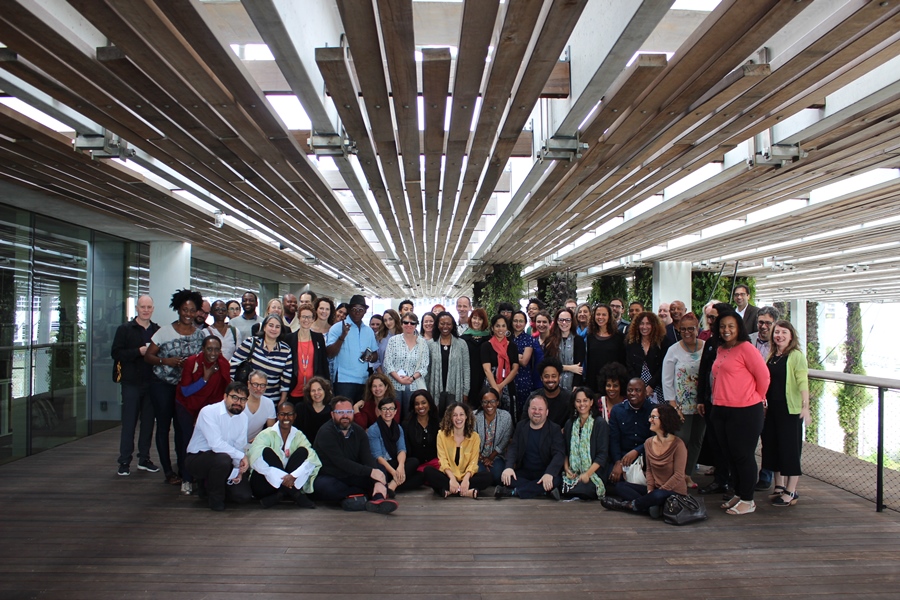
The participants of Tilting Axis 2

The participants of Tilting Axis 2

In her introductory remarks, Annalee Davis, Founding Director of Fresh Milk, emphasized the value of the first meeting having taken place within the region: “This notion of ‘tilting the axis’ refers to shifting the focus of our gaze and harnessing our collective power to make this sector more visible and sustainable in ways that resonate with our lived realities in the Caribbean.”

Although this concurrent gathering happened physically in the USA, it is critical that the heart of Tilting Axis and the commitments made by all those in attendance continue to act “as a counterpoint to many decisions often made about the region from external locations.”

Holly Bynoe, Director and Editor-in-Chief of ARC, reiterated these sentiments, and expressed thanks to the team at PAMM for facilitating a larger conference and making the museum’s network and resources available to the region: “As we work to make new connections with individuals and entities who want to work with the creative Caribbean, figure out our best practices and become more regionally conscious, projects like Tilting Axis can become one of the fertile seeds of this transformation.”
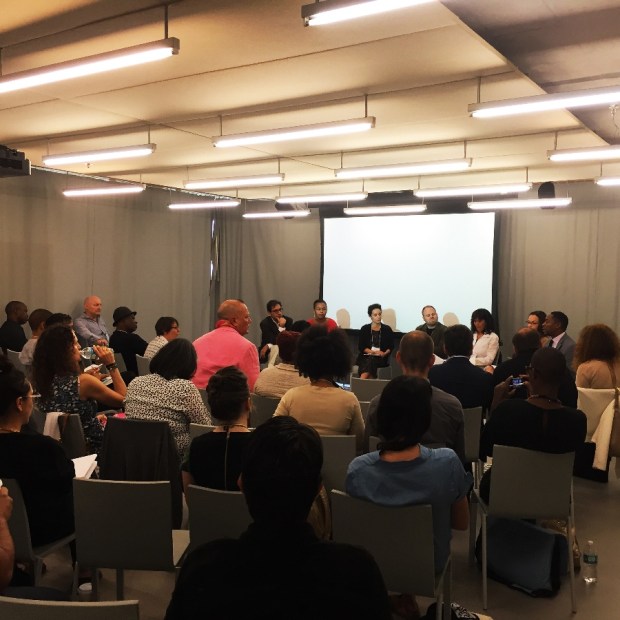
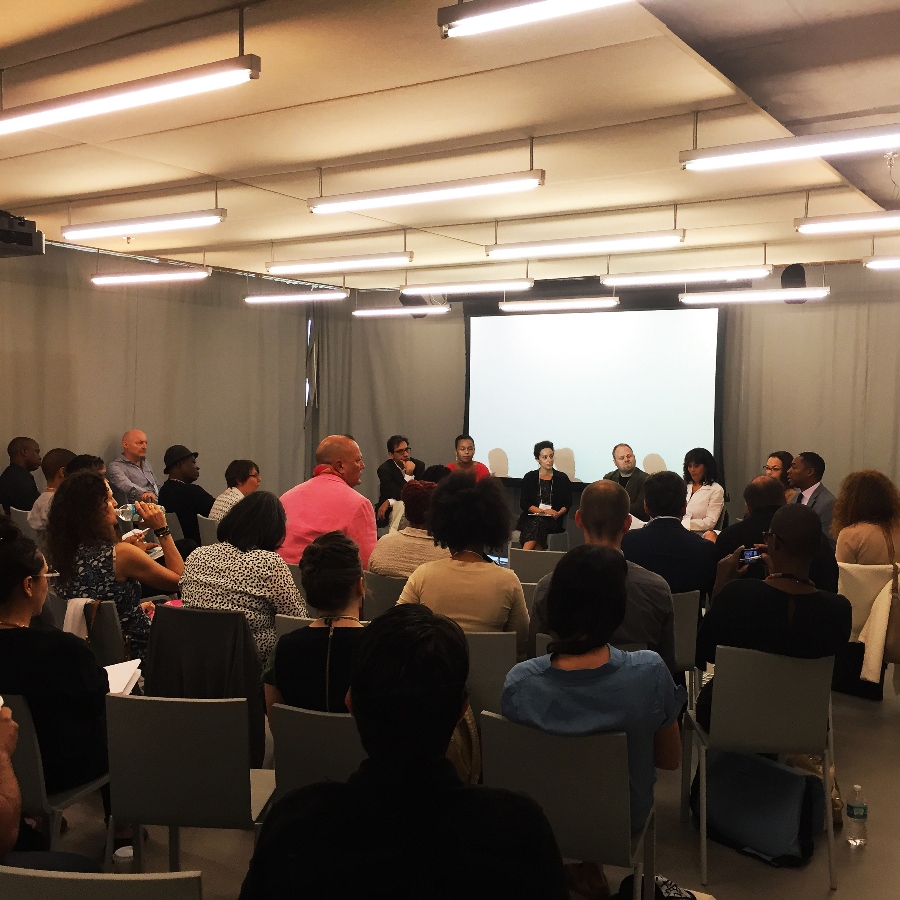
Introductory remarks at Tilting Axis 2

Introductory remarks at Tilting Axis 2

Tilting Axis 2 was anchored by three modules that emerged from the first meeting: exhibitions and programming, artists’ movement and mobility, and education. Table 1 on Exhibitions and Programming was moderated by Holly Bynoe, and looked at curatorial projects that reimagine tropes of the Caribbean. The three presenters were Veerle Poupeye, Director of the National Gallery of Jamaica (NGJ); Art Historian at Northwestern University Krista Thompson; and Johanna Auguiac-Célénice, Director of the Biennale Internationale d’Art Contemporain Martinique (BIAC-Martinique).

Poupeye highlighted the shift in the NGJ’s approach to curating from “teaching a lesson to encouraging conversations,” giving examples of exhibitions the gallery has held in recent years. Thompson spoke about the increasing interest in Caribbean art over the last decade, and how her curatorial projects seek to counter the often monolithic view of the region. Through her work at the BIAC, Auguiac-Célénice expressed the need for us to think about Caribbean culture differently, embracing our differences and favouring a rhizomatic system over hierarchy.
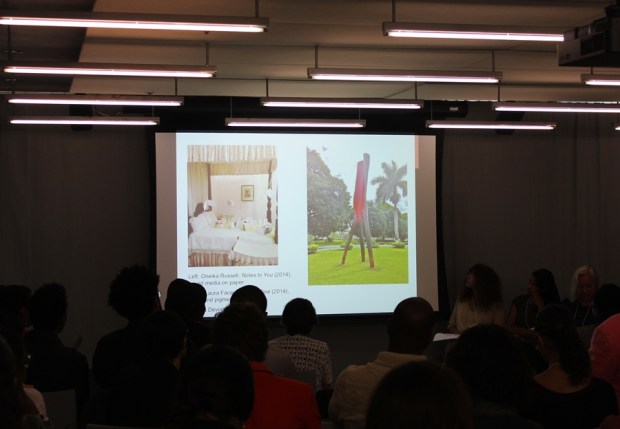
Veerle Poupeye’s presentation about the National Gallery of Jamaica

Veerle Poupeye’s presentation about the National Gallery of Jamaica

Table 2 addressed Artists’ Movement and Mobility, and was moderated by Tobias Ostrander, Chief Curator of PAMM. Presentations were given by Joëlle Ferly, Director of L’Artocarpe in Guadeloupe and Marcel Pinas, Founder of Tembe Art Studio in Suriname about their respective platforms, experimental approaches to residencies and issues in the mobility of artists working in and from the Caribbean. Both speakers see their organizations as fulfilling a necessary role in their countries, with Pinas’ sharing his strong stance on using the arts as a way to generate “awareness and value of ourselves and our culture,” and give back to the community.

Donette Francis, Rene Morales and Gean Moreno in a group discussion at Tilting Axis 2.

Donette Francis, Rene Morales and Gean Moreno in a group discussion at Tilting Axis 2.

Moderated by Annalee Davis, Table 3 looked at alternate models of arts education. Panelists included Gean Moreno, Curator of Programs at ICA, Miami; Pablo Guardiola, Co-director of Beta Local in Puerto Rico; and Paulo Miyada, Director of the Entropic School at Instituto Tomie Ohtake in São Paulo, Brazil.

Moreno discussed the alternate education programming of research.art.dialogue (r.a.d.) in terms of mapping a variety of learning structures and advocating for non-traditional methodologies of knowledge exchange. Guardiola spoke about the importance of alternate education in the arts co-existing alongside cultural institutions and schools to ensure a breadth of experience for students. Beginning his presentation by giving a background in Brazilian art, Miyada went on to outline the Entropic School’s vision of being a space of experimentation and addressed the gap between formal art education and professional placement in Brazil.
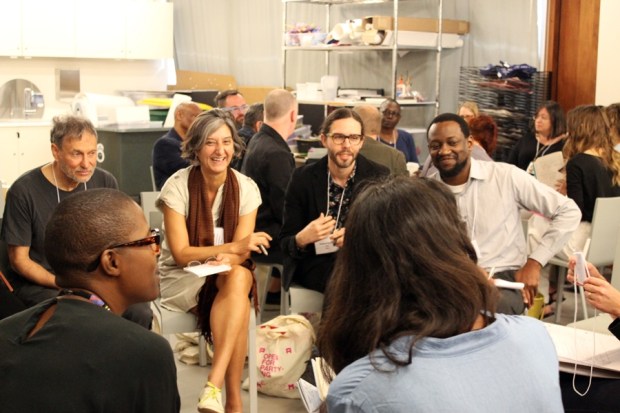
Group discussions at Tilting Axis 2
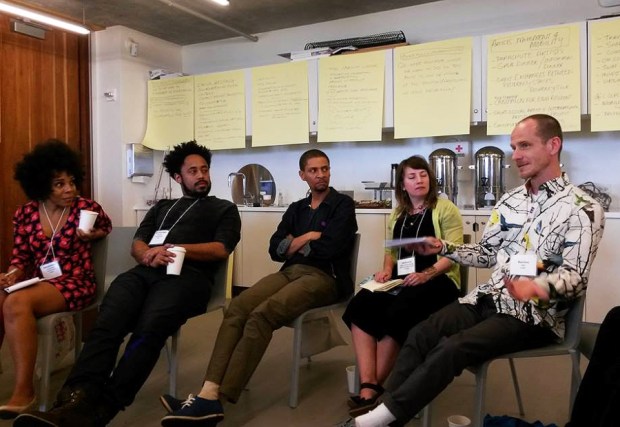
Group discussions at Tilting Axis 2

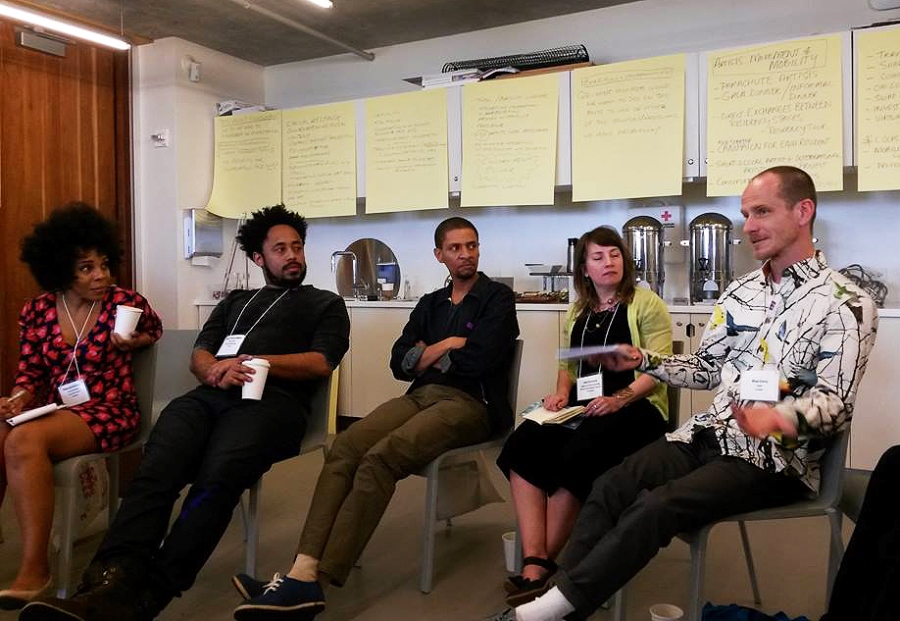
Deborah Anzinger, Jason Fitzroy Jeffers, Tumelo Mosaka, Deb Dormody and Blue Curry in a group discussion at Tilting Axis 2

Deborah Anzinger, Jason Fitzroy Jeffers, Tumelo Mosaka, Deb Dormody and Blue Curry in a group discussion at Tilting Axis 2

Open clinics were held to determine how attendees could realistically use the range of skills and knowledge at the conference to commit to a series of actions around the three target areas. Some of these included co-creating educational programmes; the potential of forming an advocacy group to liaise with governments on behalf of artists; initiating residencies and exchanges between a broad spectrum of cultural professionals; and designing an exhibition programme which could happen simultaneously in a number of territories, while having scholarship on the exhibitions written from within the region and disseminated widely.

Also built into the two-day conference were three ‘artist intermissions’, featuring short presentations by Haitian-born, Miami based artist Adler Guerrier, Bahamian-born, London-based artist Blue Curry and St. Martin-born, Martinique based artist David Gumbs. Interspersing the dialogues with opportunities to see what a few artists connected to the region are producing created a space for rejuvenation and inspiration. Along this same vein, a group visit was organized to Cannonball Studios, where Blue Curry and ARC Magazine’s Senior Arts Writer Marsha Pearce had been taking part in a residency leading up to the meeting.

Adler Guerrier presenting about his art practice at Tilting Axis 2
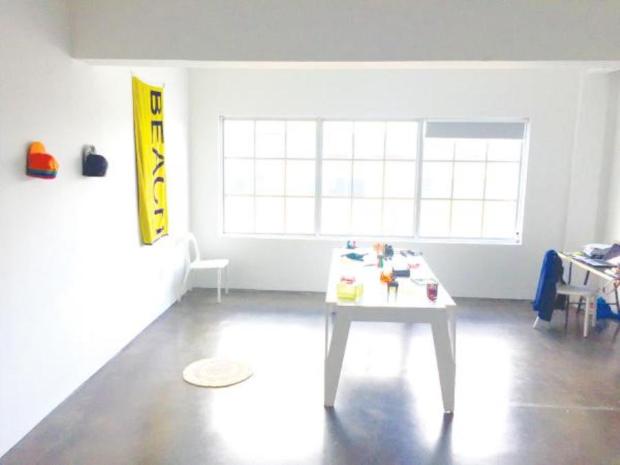
Adler Guerrier presenting about his art practice at Tilting Axis 2

Blue Curry’s studio at Cannonball studios, Miami. Photo courtesy of the artist

Blue Curry’s studio at Cannonball studios, Miami. Photo courtesy of the artist

The closing event of the conference was a public talk given by Pablo León de la Barra, a curator at the Solomon R. Guggenheim Museum for the Latin American phase of the Guggenheim UBS MAP Global Art Initiative. His presentation examined the structure and function of museums in contemporary society. León de la Barra discussed some of his curatorial work which explores different ways of creating agency and visibility for cultures that are often erased from the established canon of art history.

Overall, Tilting Axis 2: Caribbean Strategies made significant strides in its aims to fortify networks through knowledge transfer, provide avenues for critical conversation and form action plans to extend the reach of arts and culture throughout the Caribbean. The next edition of the meeting is slated to take place in early 2017, hosted by the National Gallery of the Cayman Islands (NGCI).

To find out more about the organising institutions and funders visit the ARC, Fresh Milk, PAMM and Res Artis websites.
Fresh Milk and Fresh Art International present Fresh Talk: Caribbean!

Fresh Milk and Fresh Art International are excited to share Fresh Talk: Caribbean, a series of podcasts about creativity in the 21st century with Caribbean artists & those engaging with Caribbean art around the world. This series of conversations is a curated selection from Fresh Art International’s signature project Fresh Talk, which features the platform’s Director/Producer  Cathy Byrd in conversation with more than 100 culture makers worldwide. We were pleased to have connected with Cathy at Tilting Axis 2 at the Pérez Art Museum Miami this year, and are happy to be able to highlight their Caribbean-focused content!

We will be releasing one conversation a week as a feature on our website, and the entire suite will be housed on our Projects Page. Stay tuned for more!

Fresh Talk Caribbean Flyer

About Fresh Art International & Fresh Talk:

Mission: To inform and inspire a world of followers, Fresh Art International’s team shares conversations, commentary, news, and views about contemporary art.

Launched in October 2011, Fresh Art International is an evolving independent media outlet with a global point of view. Our website is the virtual platform for Fresh Talk: Conversations About Creativity in the 21st Century, our signature audio podcast. The site welcomes up to 3,000 monthly visitors. Averaging more than 9,000 feed hits monthly, we welcome new friends and followers every day: Facebook (3,000+ Likes and Friends) and Twitter (5,000+ Followers).

For Fresh Talk, independent curator Cathy Byrd meets with contemporary artists, curators, designers, architects, composers, writers, filmmakers and other cultural producers. Listen to conversations directly on this website, download episodes, or subscribe to the series on iTunes and Stitcher. Fresh Talk is also accessible through Public Radio Exchange at prx.org.

Sonia Farmer’s Residency – Week 4 Blog Post

Bahamian artist and writer Sonia Farmer shares her fourth and final blog post about her residency at Fresh Milk, which took place during March. Continuing her creative journey after the residency – which marked the beginning of a series of new adventures, including a recent workshop hosted by San Diego Book Arts – Sonia looks back on her time in Barbados, realizing that the ideas planted here will continue to grow organically; not tied to a physical space, but to an ongoing process of discovery and dismantling of experiences. Read more here:

1

Just as my time flew by in Barbados, so has the time on my journey post-Barbados. Being my first residency, I was not sure what to expect, but I did believe I had a lot of time at my disposal…which wasn’t entirely true. That is the lesson I’ll carry to any future residencies: you don’t have all the time you think you do while you are there. But—at least in this instance—the piece doesn’t exactly have to live within the confines of the residency itself.

I am barely halfway through my erasure project of Ligon’s A True and Exact History of the Island of Barbadoes. I harbored some anxiety about finishing the entire erasure within the environment of its origin, but I also knew the desire was unrealistic, given my major commitment to teach a four part workshop during my time there, which took up half of my studio time overall.

But this desire to start and finish the text within Barbados was unrealistic in another way too, which has been revealed to me as I continue to visit the text on trains and buses moving through landscapes just as unknown to me as the island: the poem I am culling from this text so concerned with establishing a sense of place in fact removes that recognizable place. Or perhaps, more accurately, its underlying anxiety to locate place drives an obsessive challenge to interrogate that very idea, dismantling it not necessarily for reconstruction but rather for dismantling’s sake, the very unsettling result the actual desired result:

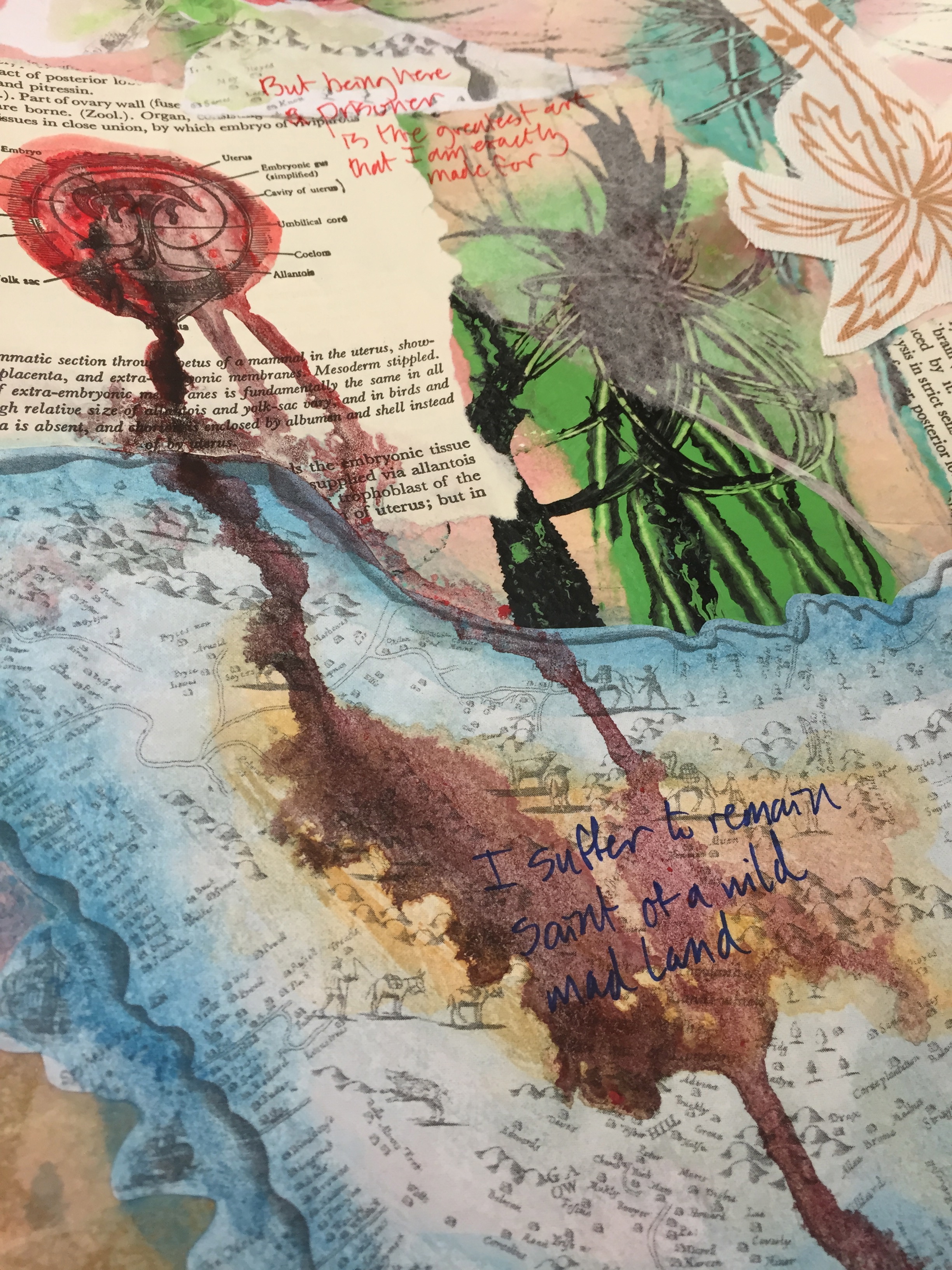
“But being here a prisoner
is the greatest art
that I am exactly made for”

There is a loose narrative, a voice that belongs sometimes to a traveller, sometimes with a companion, and other times belongs to a collective. Place, time and body collapse and expand, melt away and come into focus, but remain always in an abstract, deconstructed and unsettled state. I’m enjoying the little insights this provides into our historical foundation and current realities in the Caribbean space. It makes me think about what I said it week one, that visiting other Caribbean spaces is like an exercise in magical realism—this text is the written experience of that feeling, a constant rush of déjà vu.

I think it is appropriate to continue this exploration as I myself remain an explorer for these next few months, finding refuge in the strange but also exciting nature of this act even outside of the Caribbean. Because I’m still captivated by this idea, the in-progress poem and its imagery became my subject during a three day workshop in San Diego, ‘Sketch Book Stitch’, taught by Cas Holmes and hosted by San Diego Book Arts.

Less about creating a finished product and more about encouraging experimentation, the class helped to break open my obsessions with Ligon’s text and the themes I’m exploring in the erasure. I brought together decorative papers, found imagery, maps, and Ligon’s own drawings to create mixed media collages that respond to the poem. Just like the poem, these pieces are in no way finished, but they have allowed me to keep dig deeper into this project began at Fresh Milk. I think I’m gaining clarity on another theme that interests me while I deconstruct this text and also visit other spaces, which is how violence plays into the physical and social formation of landscape, and how violence inflicted upon one ties into the other. That definitely came out in the imagery, and I’m still turning it over in my head. We will have to see how it plays out.

I’d like to take this last opportunity to thank Fresh Milk for such a life changing experience. This residency has helped me tap back into my creativity with confidence and playfulness. I have been so fortunate to meet some incredible creative thinkers while there and also light a fire for book arts through my class. After our last class together, many of my students seemed pleased with the course. They walked away with many book structures to explore through their own creative practices, and we left three collaborative books in the Colleen Lewis Reading Room as a tribute to our time together. I’m so proud of them and I hope they continue to explore the craft! Thank you, Fresh Milk, for giving me the opportunity to teach again.

I’m at a rare rest moment in a months-long nomadic journey, but soon I’ll pack my bag and head to the next city on a train or bus, discovering new landscapes and their strange histories, carrying the voice of the narrator inside of me:

“I suffer to remain

Saint of a wild
mad land”

16

Sonia Farmer’s Residency – Week 3 Blog Post

Sonia Farmer writes about her third week in residence at Fresh Milk. Continuing her erasure poetry project using the text ‘A True and Exact History of the Island of Barbadoes’ by Richard Ligon while conducting her own exploration of the island, she contemplates the loaded act of ‘discovery’ and the implications it carries. She also shares the outcome of the challenging but successful third week of her book-binding workshop ‘The Art of the Book‘, which saw the students begin to create their own hardcover notebooks and leather journals. Read more here: 

1

Lives in and out of the studio are converging in interesting ways given my chosen project. I’m still working my way through an erasure of A True and Exact History of the Island of Barbadoes by Richard Ligon, but also discovering more of the island myself. The week began with thrilling visits to Harrison’s Cave, Hunte’s Gardens, and Bathsheba, all self navigated with a car rental rather than a pre-arranged tour. We became dreadfully lost on the way to the cave, got soaked in one of those short-lived island downpours in the gardens, and found our recommended lunch place closed due to construction with dangerously low blood sugar levels—but we could say we had a pretty fantastic adventure. Similarly, I’m reconnecting with a Bahamian friend who lives here in Barbados. When she asks what I would like to do around the island, I answer, “Anything.” I’m hungry to see and do it all.

These moments bring out the romantic in me, even though I know all too well the often-frustrating realities of island living and rolling stone travel. But just as I felt during our Week One island tour, exploring a new space is a thing of wonder and an entirely individual experience, something that I am trying to honor and witness in my personal journey as well as my creative practice. I want to be an explorer, not only of physical space, but emotional space too—to study how we meet new experiences with both head and heart.

Is discovery the endgame? Discovery is a problematic word for me, but one that I have been turning over in my head as I think about what it means to write “a true and exact history” of anything: the weighty privilege of it, the naiveté, the narcissism, the violence, all inherent in that word as we have learned it, especially in the Caribbean. We all know the story: In 1492, Columbus sailed the ocean blue. Good for him. Not so great for others. Because we know that no place can be “discovered” that has already existed in the minds and hearts of others. What maybe can be discovered is something entirely individual and emotional, found on an inward journey while on the outward journey, and that discovery is completely personal. The “true and exact history” of the world as we have learned it is a myth. I don’t think discovery is an endgame here. Exploration and deconstruction, perhaps.

Because when I revisit this historical text by Richard Ligon, a man who, by his privilege, has found a spot in this island’s history, I am interested in deconstructing and reconstructing through the act of exploration. I’m drawn to finding a new narrative within the existing narrative, one that touches upon emotional landscape. And one that honors the fact that if I had approached the text on any other given year, or day, or hour, I could pick up on a completely different set of words and perspective. And that would be true for any other person I hand the text over to.

So I don’t want to think about the history of discovery, I want to think about the discovery of history. I want to think about the act of exploring. I want to explore what we carry and what we choose to include vs. what we overlook and what we choose to leave out. I want to think about the fragility of the moment in the process of choosing one story over the other, and why we are drawn to that. I want to think about making space and leaving room. I want to think about the stories we tell ourselves when we only have one version of history to work from, and how we can still find power and wonder and self-discovery in that. Or not. I have my own set of privileges guiding my through the process behind this project. So overall, I want to keep it personal, because there is no true and exact history.

10

Meanwhile, setting aside the 24 hours I thought I was coming down with a flu but somehow gained strength from a fantastically indulgent meal at Chefette, my students crushed week three of our workshop when they sewed their first multi-signature text blocks to create two different blank notebooks. One will be an exposed-stitch hardcover, while the other will be cased into leather for a travel-notebook. As usual, I was completely too ambitious within my given time-frame, even though we extended the class by an hour. Luckily, week 4 is a catch-up class as well as a fun final class, so we will case in our notebooks, revisit a group project, and then make some quick fun book structures. Also luckily, they all had a blast even though I know it was a very challenging class and I couldn’t split myself into three people to assist everyone, but they passed with flying colors. I’m so proud of them!

Alex Kelly’s Residency – Week 2 Blog Post

Fresh Milk resident artist Alex Kelly shares some reflections from his second week in Barbados. In looking at some of the connections and common threads he has noticed in the region, he has revisited his use of a shipping pallet as a symbol of our reliance on imported goods. He has also been looking at the similarities and issues within the Caribbean’s educational systems, and the importance of encouraging critical thinking to avoid perpetuating unproductive cycles of action and thought. Read more here:

Image (3)

I’ve discovered for the second time how a change of environment can help to refocus my thoughts about work and about the space that I am discussing. I suppose the conscious act of applying for and participating in a residency is a way of surrendering myself to possibility. I become more in tune to the elements that potentially connect to define Caribbean people and their environment.

Within the boundaries of this particular space, where you can find water from Jamaica, films from the USA, dried seasonings from Puerto Rico and I shop in a supermarket chain from Trinidad and Tobago, the wooden shipping pallet that I had been working with since last August becomes significant yet again. It is a symbol of dependence on imported goods and cultural influences. In a moment of economic and political uncertainty, the lack of self reliance suggested by the pallet is noteworthy. It is quite striking that this symbol would be the one to connect my practice in three separate Caribbean territories.

What has also struck me as significant is the shared education system and the role it plays in shaping the kind of citizens that individuals become. A conversation I recently had has  reminded me that the education systems of many Anglophone Caribbean islands are ultimately geared towards the same goal. So that each of the countries are equally influenced by a curriculum that was not designed to foster critical and creative thought or to nurture citizens capable of shaping the kind of environment that they desire. We are sitting in a rocking chair, moving vigorously back and forth, but making no progress. It begs the question, what effect might decades of this kind of action have on a people and their culture.

chair

Still, in spite of these and other similarities I have discovered, I find that my work represents a reality of life that seems frightfully specific to Trinidad and Tobago. In questioning how this work might be relevant in a wider Caribbean context I can only hope that a possible answer is, that it acts as an account of how we made it to where we are and as such provides a means by which other territories might avoid such a fate.

________________________

Tridium

This residency is supported by Tridium Caribbean Limited