Caribbean Linked VI Launches Virtual Edition

The regional residency Caribbean Linked VI, co-managed by Ateliers ’89 (Aruba), The Fresh Milk Art Platform (Barbados) and ARC Magazine will be changing its focus this year in light of the severe impacts that the COVID-19 pandemic has brought upon the lives of artists regionally. Caribbean Linked VI will be conducting all of its programming and support virtually from July 30th – August 31st, 2021, with live public conversations between the artists taking place on Wednesday, August 11th and Tuesday, August 31st from 4:00 pm – 5:00 pm AST on each day. As usual, the residency’s programming supports creatives across the French, Spanish, English and Dutch speaking Caribbean.

Participating artists for Caribbean Linked VI include Claudio Arnell (Saint Martin), Taisha Carrington (Barbados), Romelinda Maldonado (Aruba), Akley Olton (St. Vincent and the Grenadines), Susana Pilar (Cuba), John Reno Jackson (Cayman Islands), Sarabel Santos-Negrón (Puerto Rico), Samuel Sarmiento (Aruba/Venezuela) and Béliza Troupé (Guadeloupe).

This residency will allow the participants to be exposed to the practices of other emerging Caribbean artists, providing an opportunity to strengthen regional connections and cultural understanding. This edition of Caribbean Linked is being conceptualised as a bridging year, with participating artists still scheduled to meet physically in August 2022 at Ateliers ’89 in Oranjestad, Aruba.

Now more than ever in light of COVID-19, it is critical to mitigate isolation and use available technologies to advance creative production, critical thinking and engagement. This preliminary remote encounter is focused on provisioning artists with dedicated studio time to make new works, while reinforcing the value of Caribbean artists’ practices and enabling their growth and development.

The writer in residence for the virtual edition will be Ethan Knowles, an emerging scholar and writer from The Bahamas currently studying in Rome, Italy. This year’s specially invited curators will be Sofia Olascoaga, an academic curator at MUAC (Museo Universitario de Arte Contemporáneo – UNAM) in Mexico City, where she coordinates Campus Expandido an academic programme of critical theory, and Miguel A. López, former chief curator of TEOR/éTica turned independent curator living and working in Lima, Peru.

The month long residency will be supported by the generous funding provided by BankGiro Loterij Fonds, Mondriaan Fonds and UNOCA.

For more information or to request interviews with any of the participating artists, please contact the Caribbean Linked Team at caribbeanlinked@gmail.com, and visit our website caribbeanlinked.com to learn more about all editions of the Caribbean Linked residency programme.

Open Call: Tilting Axis Fellowship 2021

Het Nieuwe Instituut and Tilting Axis launch the second iteration of a fellowship programme for mid-career or established applicants based in the Caribbean. The initiative aims to foster and stimulate mutual exchange between the Caribbean region and the Dutch cultural field. Together with lead partners Het Nieuwe Instituut and Tilting Axis, other cultural institutions including The Amsterdam Museum, De Appel, Stedelijk Museum Amsterdam, and Kunstinstituut Melly will collaborate with the selected applicant during the fellowship.

Applicants have until July 4th, 2021 to submit proposals for consideration. Please send proposals to ta-fellowship@hetnieuweinstituut.nl, attention: Tilting Axis Fellowship 2021 Review Committee. Late submissions will not be reviewed.

Who Should Apply?

One mid-career and established researcher, artist, designer, writer, curator, or cultural producer based in the Caribbean region interested in building new links with cultural institutions in the Netherlands, and who has an interest in developing their practice around themes related to architecture, spatial practice, design or digital culture.

Goals

  • To develop, stimulate and visualise curatorial, design and artistic realities coming out of the Caribbean region
  • To enhance knowledge exchange and collaboration with a cross-section of Dutch cultural institutions
  • To provide a variety of platforms for professional experience
  • To produce critical knowledge on inter-disciplinary exchanges as well as visual culture
  • To offer practical support and travel to the Netherlands for an extended fellowship
  • To engage with hosting and collaborating institutions to interrogate and challenge their institutional structures and methodologies
  • To utilise the existing Tilting Axis network

Applications

Applicants for the Fellowship are invited to develop an independent proposal outlining a clear interest in the areas of research/practice and organisations highlighted. The proposal should be content driven and can be based on already existing research or offer new projects. The Fellow is not expected to produce an outcome or finished artwork, yet will be encouraged to publicly present the ongoing research interests whilst in the Netherlands. The research will also be published on an ongoing basis via Het Nieuwe Instituut and partner institution’s website, newsletter or other publications.

The Fellow will be invited to:

  • Make a series of presentations in Rotterdam & Amsterdam at host and partner institutions on their research/practice;

  • Produce a monthly text/sound/video/photo essay (6 essays in total). The series of monthly texts will be posted on the websites of Tilting Axis and Het Nieuwe Instituut, with links to the partner institutions;

  • Research could lead to an installation, exhibition or further events at partner institutions during or after the Fellowship;

  • A final report on the Fellowship experience is required.

Format and Submission Requirements

The Open Call for 2021 is available from May 25, with a deadline for submission on 4 July 2021. The call is open to individuals. Applications should be submitted in a single PDF file of maximum 10MB. In order to be considered, proposals should include the following information:

  • A self-introduction in which applicants articulate the relation between their interests and the hosting/partner institutions. Departing from a curatorial, research or design and artistic ambition, we expect to see a statement of intent of maximum 1000 words. This statement should explain the applicant’s research focus, and its possible connection to architecture, design or digital culture, as well and the interest in the anchor and partner institutions.

  • Relevant documentation of previous work, and/or links to audio or video files (maximum 10 minutes) in the application PDF.

  • Indication of availability to take up the Fellowship from October 2021 – March 2022

Proposals should be written in English and applicants must have a working knowledge of English. While we understand that English proficiency may vary or that English may not be the applicant’s first or primary language, unfortunately, we are not able to offer translation support at this time. Applicants with specific questions are encouraged to contact ta-fellowship@hetnieuweinstituut.nl about the availability of any support service.

Applicants have until July 4th, 2021 to submit proposals for consideration. Please send proposals to ta-fellowship@hetnieuweinstituut.nl, attention: Tilting Axis Fellowship 2021 Review Committee.

About The Tilting Axis Fellowship

This fellowship focuses on applicants living and working in the Caribbean region and is both research and practice-led. The selected applicant will be based in Rotterdam at Het Nieuwe Instituut and will have access to other partner cultural institutions in Rotterdam and Amsterdam. A total stipend of 12,000 EUR will be granted by Het Nieuwe Instituut to cover living expenses and one round-trip airfare from any Caribbean country to the Netherlands. Accommodation will be provided for a period of six months for a maximum of 800 EUR per month. Stipends may be subject to a withholding tax. Specific details about the position will be discussed with the selected applicant. Developments around Covid-19 and any resulting government restrictions will be taken into account. This means that the fellowship might be undertaken remotely in part.

Read more about the first iteration of the Tilting Axis Fellowship, with architect and researcher Sean Leonard in 2020.

Knowledge Exchange

The fellowship will be developed through: independent research; individual support and interaction with the Research Department team at Het Nieuwe Instituut; monthly meetings to discuss thematic and methodological aspects of the project; and diverse collaborations with partner institutions.

Application and Selection Process

Applicants for the fellowship are invited to develop an independent proposal outlining a clear interest in the areas of research/practice and organisations highlighted. The proposal should be content-driven and can be based on pre-existing research or propose a new project. The fellow is not expected to produce an outcome or finished artwork yet will be encouraged to publicly present the ongoing research while in the Netherlands. The research will also be published on an ongoing basis via the website, newsletter or other publications of Het Nieuwe Instituut and the partner institutions. Apllication deadline is July 4, 2021.

Proposals will be considered by an international committee consisting of the Tilting Axis and Het Nieuwe Instituut teams, along with representatives from the partner institutions including curators, academics, and museum professionals. The review committee includes: Aric Chen (Artistic and General Director, Het Nieuwe Instituut), Marina Otero Verzier (Director of Research, Het Nieuwe Instituut), Holly Bynoe (ARC Magazine, Sour Grass and Tilting Axis co-founder), Annalee Davis (visual artist, Founding Director of Fresh Milk, and Tilting Axis co-founder), Sofía Hernández Chong Cuy (Director, Kunstinstituut Melly), Mark Raymond (Director of the Graduate School of Architecture at the University of Johannesburg in South Africa and the current Plym Distinguished Visiting Professor at the University of Illinois at Urbana-Champaign), Monika Szewczyk (Director, De Appel), Imara Limon (curator of modern and contemporary art at Amsterdam Museum), and Charl Landvreugd (Head of Research and Curatorial Practice, Stedelijk Museum Amsterdam).

Read more about the Tilting Axis Fellowship and the call for applications on the websites of Het Nieuwe Instituut and Tilting Axis.

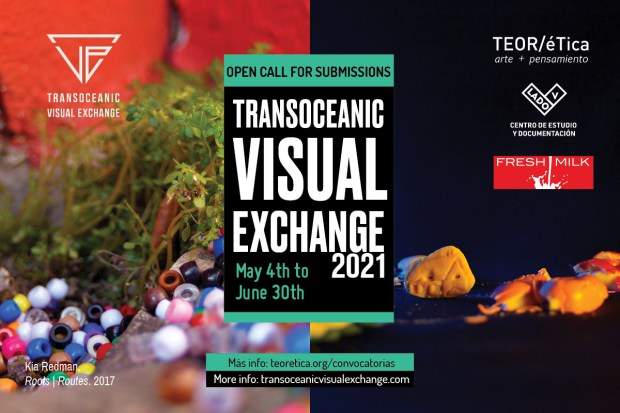
Open Call: Transoceanic Visual Exchange 2021

Important dates:

Start of reception period: May 4th, 2021
End of reception period: June 30th, 2021
Community of curatorial practice workshops: July – August, 2021
Public announcement of results: September, 2021
TVE 4 2021: November –  December, 2021

Call for Works:

The Fresh Milk Art Platform (Barbados) and TEOR/ética (Costa Rica) are pleased to welcome submissions of recent film and video works – screenings, installations, new media and expanded cinema – by contemporary artists, to be included in the fourth edition of Transoceanic Visual Exchange (TVE), a series of programmes taking place online this year, with accompanying screenings in Barbados and Costa Rica.

Submitted works must have been completed in the last five years and must be made by artists practicing in the Caribbean and Central America.

TVE 4 will be a collection of recent artists’ films and videos from each region. However, the final shape and content of the programme will be informed by a community curatorial process, which aims to involve and promote discussion within the wider creative communities of each participating initiative.

Working between the Caribbean and Central America, TVE 4 aims to negotiate the in-between space of our cultural communities outside of traditional geo-political zones of encounter and trade. TVE intends to build relations and open up greater pathways of visibility, discourse and knowledge production between the regional art spaces and their publics.

Submission Requirements:  

  • Must be work from artists practicing in the Caribbean or Central America;
  • Must be work that has been completed/made in the last five years;
  • Can be films of any length (shorts, experimental, features and video artworks);
  • Can be in any language (films originally produced in regional languages are welcome);
  • Up to 3 submissions per applicant are welcome;
  • Must be accompanied by a description of the work (500 words max), a bio (200 words max) and details of any technical requirements i.e. audio, installation, equipment required, preferred setting etc.;
  • Works must be mp4 files no larger than 100MB, or Vimeo/Youtube links;
  • Works must not have been submitted to the previous edition of TVE;
  • Please specify whether your submitted works have permission to be exhibited on an online space, particularly as the virtual aspect of TVE 4 will be a significant focus of the programme.

Selection Process:

One of the core values of TVE is the model of community curatorial practice as opposed to one of solely contracting curators or hiring a jury to review submissions in isolation. This has taken the shape of open roundtable conversations with interested members of the community in each partner’s country/region, where current trends, concerns and interests in the areas of video art, film and new media are discussed. After these conversations, the partners will convene to select works which align with and reflect the research gathered, including the community’s input in the design of the final programme.

What TVE 4 Offers:

  • Each selected artist will receive a stipend of $200.00 USD for their participation in the programme;
  • Artists’ work will be showcased in a virtual exhibition on the TVE website, facilitated and promoted by the TVE partners;
  • Artists’ work will be exhibited or screened physically in Barbados and Costa Rica (pending safety and with COVID measures and protocols enforced);
  • The artists’ profile will be permanently housed on the TVE website, and their work will be widely promoted throughout Fresh Milk and TEOR/ética’s networks in the Caribbean and Central America;
  • The artists’ will have the opportunity to grow their own networks and knowledge regarding video arts and filmmaking practices across the Caribbean and Central America, deepening understanding between the two regions and opening up greater possibilities of collaboration.

Deadline for submissions: June 30th 2021

Click here for the online form for Caribbean submissions
Click here for the online form for Central American submissions

To view this open call in Spanish, visit TEOR/ética’s website here

For more information on TVE and its first three iterations, visit the website transoceanicvisualexchange.com


About the Partners:

Fresh Milk

Fresh Milk is an artist-led, non-profit organisation founded in 2011 and based in Barbados. It is a platform which supports excellence in the visual arts through residencies and programmes that provide Caribbean artists with opportunities for development, fostering a thriving art community.

Fresh Milk offers professional support to artists from the Caribbean and further afield and seeks to stimulate critical thinking in contemporary visual art. Its goal is to nurture artists, raise regional awareness about contemporary arts and provide Caribbean artists with opportunities for growth, excellence and success.


TEOR/ética

Located in San José, Costa Rica, TEOR/éTica is a private, independent, non-profit, dedicated to the research and promotion of contemporary artistic practices.

Throughout more than two decades, TEOR/éTica has worked as a platform that promotes the research and dissemination of contemporary art, with an emphasis on Central America and the Caribbean. It aims to create spaces for doubt, debate and the generation of critical thought relevant to its context. It does this through exhibitions, publications, talks, workshops, grants, an archive and a specialized library, understanding art as a common space from where to generate study and find other ways of being together that build collective learning.

Fresh Milk’s 2020 Highlights

Thank you for your continued support of Fresh Milk!

While it’s taken us a little while to share our reflections on the year 2020, we’re pleased to celebrate what we have been able to achieve in spite of the challenges that cultural workers everywhere have had to navigate.

__________________

Still reeling from the COVID-19 pandemic, the virus has made our already precarious cultural sectors here in Barbados and across the wider Caribbean even more fragile. We have been challenged to find new ways to nurture one another, and Fresh Milk has participated in collaborations that have been beneficial to many artists in the region.

To learn more about the work we have done including CONTESTED DESIRES – an ongoing partnership with artist initiatives in the UK, Portugal, Spain, Cyprus and Italy; working with Le Centre d’Art in Haiti on a residency exchange programme; the most recent Tilting Axis Fellowship in partnership with Het Nieuwe Instituut in the Netherlands; or the pan-Caribbean CATAPULT project in partnership with The American Friends of Jamaica (AFJ) and Kingston Creative, see more below!

For 2021, Fresh Milk remains committed to delivering virtual editions of the programmes Caribbean Linked and Transoceanic Visual Exchange (TVE). These online platforms will unite artists across linguistic territories in the region, as well as expand our work with colleagues in Latin America.

If you would like to support artists participating in Caribbean Linked and TVE, or would like to lend support to the management of these various projects, go ahead and click on the donate button below! It’s very easy to support us and the artists we work with by making a donation through this PayPal link. Your contributions make our programmes possible, and gifts of any size are welcome.

While our artist residency programme is on pause now that we have honoured all previous commitments, we look forward to sharing an open call for a local project with three exciting components, which will take place right here in Barbados, in the parish of St. George.

Stay tuned for more details!

  If you’d like to work with us to build your art collection by acquiring work by local and Caribbean artists, please get in touch.

__________________

We would like to thank everyone who worked with us, supported us, and express gratitude to the many artists who we have had the privilege of working with across the Caribbean during this very demanding year.

We are pleased to be able to share our 2020 reflections with you all and hope you enjoy this newsletter.


Matilde dos Santos writes on CATAPULT Awardee Gwladys Gambie for Madinin’Art

Martinique based historian, art critic and independent curator Matilde dos Santos, who was one of the guest curators/mentors selected to conduct studio visits with 6 of the 24 CATAPULT Stay Home Artist Residency participants, has generously offered to write features on each of the artists she engaged with during the programme. The fourth piece focuses on the practice of Martinican artist Gwladys Gambie!

Read the article, originally published in French on Madinin’Art: Critiques Culturelle de Martinique (January 10th, 2021), in English below!


Gwladys Gambie, Incandescent scars

In August 2020, Fresh Milk (Barbados) and Kingston Creative (Jamaica), with the support of the American Friends of Jamaica (United States), launched CATAPULT | A Caribbean Art Grant, a programme which, through six initiatives, provided direct financial support for five months to more than 1,000 Caribbean artists and creatives affected by the pandemic. One of these initiatives was the Stay Home Artist Residency (SHAR). Twenty-four artists were selected and the residencies were spread out into three groups from September 21 to December 11. I was delighted to be one of the visiting curators, and it is a pleasure to share the outcomes of these meetings with you.

Cartographie sensible (detail) SHAR residency November 2020, courtesy of the artist

Gwladys Gambie, an artist from Martinique, was selected for the home residency opportunity, so I was able, between one confinement and the other, to visit her studio in person.

Gwladys was born in Fort de France in 1988. After studying literature and education, she entered the Caribbean Arts Campus and obtained her DNSEP (Master) in Visual Arts in 2014. Gwladys’ work explores her own body and revolves around the character Manman Chadwon (mother sea urchin), a kind of divinity invented by the artist. Through drawing, collage, sculpture, sewing or embroidery, the artist works with voluptuous body shapes adorned with thorns, forceful yet evanescent. In recent years the artist has participated in several residencies, including Création en cours initiated in 2018 by the Ateliers Médicis in Guadeloupe and Caribbean Linked V organized by Ateliers’ 89 and Fresh Milk in Aruba. She has also participated in the Fountainhead Residency, in Miami (2019) and most recently the CATAPULT SHAR. Gwladys also participated in the international exhibitions Désir Cannibale at the Little Haiti Cultural Center in Miami, as part of the Tout-Monde Festival (2019), and in the Mercosur Biennale (2020), held on-line due to the COVID pandemic.

Corps paysage, felt on paper, 2018, 65 x 50 cm. Courtesy of the artist.

Corps paysage, felt on paper, 2018, 65 x 50 cm. Courtesy of the artist.

In her drawings, the female body is laid out into a dreamlike landscape. All-powerful femininity displays full bodies assuming their sensuality. Paradoxically, the delicacy and precision of the drawing impart a kind of harshness. It’s Manman Chadwon, Afro-Caribbean deity, a bit Mami Wata, a bit Manman Dlo, her body bristling with quills. An avatar of the artist that incorporates both softness and pain.

In her drawings, black and white dominates. Color comes in small touches and until recently, almost always by collage. Then, there is the red ink, connecting her work to the present day violence: against women, or the soil in Martinique poisoned by chlordecone. Emanating from these bodies drawn in black or red are real ecosystems supporting minerals, plants, and animals. In an organic landscape, the body spreads out, secretly forming folds that both enclose and exhibit.

The birth of Manman Chadwon, 2018, ink, collage on paper, 75 x 100 cm, courtesy of the artist

Cartographie sensible (detail) SHAR residency November 2020, courtesy of the artist

We can link Gwladys’ work to that of female artists, who since the 1960s have built a feminist aesthetic designed to liberate women’s imagination. The work of many artists who do not claim to be feminists shares common traits none-the-less with the feminist movement as a whole, such as the affirmation of the body and the deconstruction of stereotypes, or in the practice of strictly feminine crafts, such as embroidery and sewing, which triggers a subversion of hierarchies by promoting what was usually considered as subordinate. A combined concern for issues of gender, race, ethnicity and social class forms the basis of a feminism that is reinventing itself today through the enhancement of an exacerbated femininity, which, rather than denying sexist stereotypes, reappropriates them and throws them back in the face of the public.  In its pop version, this appears in the form of vertiginous heels and superlative “bondas”. Gwladys’ femininity is radical, yet poetic; assuming violence portrayed by omnipresent thorns that render both pleasure and protection. Thus, we can compare her works to those of the Haitian artist, Florine Démosthène, and her round heroines endowed with monumental buttocks, as doubles of the artist. Her work is also comparable to White shoes (2015), a performance of the photographer Nona Faustine, who exposed her own ‘unconventional’ naked body perched on white pumps while she browsed places linked to slavery in New York, such as Wall Street, an ancient slave market. Or, yet again, to the drawings of black women by Rosana Paulino, their bodies always round, always a little the artist herself, or to Paulino’s use of sewing to roughly patch up photos of naked slaves, or the way she obliterates the eyes, throats or mouths of black women by stitching over them as if to emphasize the state of servitude in which they are found, while their photos are delicately presented on embroidery hoops.

Cartographie sensible (work in progress) SHAR residency November 2020. Photo by Matilde dos Santos

Gwladys’ works breed rebellion: against stereotypes of black women’s bodies, against objectification and fantasies of sexuality tainted with exoticism. The artist would like to reinvent eroticism, with drawings of a touching sincerity: full bodies, black skin, challenging the canons of beauty. Thorny bodies, triple breasts, powerful yet fragile bodies; vulnerability as a weapon. To make the body of the black woman, for a long time the territory of all oppressions, a decolonial body: neither in the Western norm, nor against it, but rather outside the norm. Rooted in ancestrality.

The link with African ancestrality has been widely claimed in recent years by artists from the diaspora. With Gwladys this demand is visceral, as the need to examine oneself, to express oneself. The use of Creole, and poetry, which invade certain drawings, goes without saying. This is because Creole goes straight to the heart of things. A language that is very imaginative yet straightforward, like the visual language of Gwladys.

Ambulatory performance, The beautiful monster, FIAP 2017, Fort de France. Courtesy of the artist

For the SHAR programme, Gwladys experimented with needlework. Her particular affinity with sewing was noticeable in her work with “grennen” (frizzy) hair while she was still in art school. She built mole sculptures with hair; weaving, knotting and sewing, adding beads, fabrics, and frills. In the sequence, there were performance costumes, including that of FIAP 2017, a full leotard that she had personalized with rather coarse protuberances and adorned with pearls and fringes. Later on, after discovering the Moko Jumbie from Trinidad, she feminized the costume even more while keeping the thorns. It then became Moko Chadwon (2018). The Moko Jumbie is not just a dancer on stilts, the name retains its African origins, the idea of ​​a healer, and from the Caribbean, the word “jumbie” meaning spirit. This is probably why in 2020, to participate in Trinidad’s carnival, Gwladys added a fringed crown to her red costume; in it, I recognized the “odê” with “imbé”, which hides the face of certain orishas in Afro-Brazilian and Afro-Caribbean rites.

During the first part of confinement, Gwladys participated in a collective residency in the 16M2 art space in Fort de France. Since the shops were closed, she was forced to turn this constraint into an opportunity and use an old transparent curtain that was a little frayed as support. So she incorporated the holes of the fabric into her embroidery, a technique she was only just then discovering. The connection was immediate and very quickly her work was very successful. The idea of ​​reparation guided her. And while physically she was repairing the fabric, it was also the health of the world, the bodies of women, history itself, that was being symbolically repaired. In the SHAR residency, Gwladys wanted to give continuity to the embroidery work on two types of support: the first was an unbleached cotton fabric, a little thicker than a canvas, on which she made rough imprints of the erogenous parts of her body. (buttocks, breasts, thighs, crotch) in red ink. On these prints, she subsequently added random embroidery. On photos of fragments of the work, I imagined, with the help of red, that it was drawing a woman’s reproductive system; in front of the whole work, we can see that every figure is pure interpretation. The imprint is indeed that of the artist’s body, but deliberately they are fragmentary imprints whose shape cannot be easily identified and on which the embroidery is applied in a hazardous manner. The large size of the support allowed her to work on the idea of ​​a geography of emotions making an epidermis of the tissue, on which the artist embroidered scars. Fragments of texts add depth to the work and the color red gives them a false air of Chinese characters.

The second support was a banana leaf. The confinement once again forced the artist to review her way of creating. Working on a living natural object was a novelty for Gwladys. Laying the leaf flat on a stand, she felt like she had a body on the operating table, ready to respond to a double health emergency: Covid and chlordecone. Find an antidote for the poisoning? Circumscribe it? Talk about it anyway. And always this idea of ​​repair. The leaf is fragile, so the artist wanted to embroider the edges to prevent them from fraying. As she embroidered it, the leaf followed its natural process of deterioration, which the artist documented in photographs. The intense red magnifies the wound as the leaf gently rots. A first draft, beautiful and moving, which resonates with a poem by Brazilian Cristiana Sobral that I have only just discovered:

I have an incandescent scar of pain
But it’s only inside
Outside I drew a flower

– Matilde dos Santos – Historian, art critic and independent curator

Appreciation to the partners of the CATAPULT programme: The American Friends of Jamaica, Kingston Creative and Fresh Milk.

The SHAR participants described their experiences in blogs that you can read on the Fresh Milk platform here.


For further information:

Artist Gwladys Gambie’s website: http://gwladysgambie.blogspot.com/

Website of the artist Florine Démosthène: https://florinedemosthene.com/home.html

On the performance White shoes by Nona Faustine: https://africanah.org/nona-faustine-white-shoes-project/

On Rosana Paulino and other women artists of Brazil and the Caribbean: https://aica-sc.net/2018/01/28/femmes-artistes-noires-bresiliennes-et-caribeennes-defier-linvisibilite/