Fresh Milk contributes to the 2019 Understanding Risk Caribbean Conference

The 2019 Understanding Risk (UR) Caribbean Conference took place May 27 – May 31 at the University of the West Indies (UWI) Cave Hill Campus, Errol Barrow Centre for Creative Imagination (EBCCI) in Barbados. This conference brought together representatives of government ministries and national disaster management agencies, disaster risk management practitioners, urban planners, insurance industry stakeholders, private sector organizations, academia, multilateral development banks, regional partners and donors to discuss the core theme ‘From Risk to Resilience: A Foundation for Action’.

Janot Mendler de Suarez, a consultant with the World Bank, most recently the Caribbean Technical Programme of GFDRR’s Disaster Risk Financing and Insurance initiative, and Pablo Suarez, Artist in Residence, National University of Singapore – Lloyd’s Register Foundation Institute for the Public Understanding of Risk, invited Fresh Milk to co-develop three artistic interventions for the conference. These projects acted as a way of translating and communicating key factors about environmental risks in the Caribbean into a visual language, as well as showing tangible examples of resilience within our culture and landscape in Barbados.

Photographs by Dondré Trotman unless otherwise specified.

__________

Risky Timelines:

Concept: Janot Mendler de Suarez & Pablo Suarez
artists: Akilah Watts, Alanis Forde, Anna Gibson in collaboration with Kia Redman and Kraig Yearwood
With thanks to: Harclyde Walcott, Joseph Spagnuolo, Kerri Cox, Mary Boyer, Rashmin Gunasekera, Thibaut Humbert, UWI EBCCI

Photo by Dondré Trotman

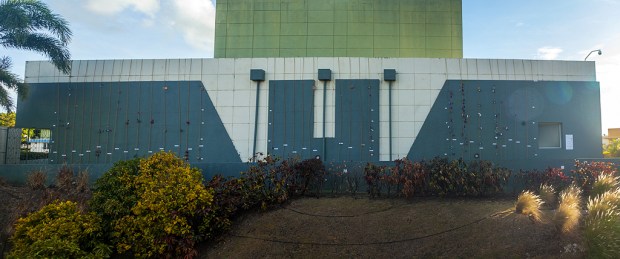
This project, conceived by Janot Mendler de Suarez and Pablo Suarez and created by Barbadian artists Akilah Watts, Alanis Forde and Anna Gibson with Kia Redman and Kraig Yearwood, saw the depiction of natural disasters which have taken place in 33 countries across the Caribbean in the form of a large data sculpture.

This piece showcases a timeline of these events spanning from 1990-2019, and communicates the breadth and impact of these catastrophes on the region. The artwork creates a visually intuitive juxtaposition of natural hazard data – on hurricanes from category 1 to 5, earthquakes, volcanic eruptions, landslides, and floods – with impact data on the number of people affected, the number of lives lost, economic losses and the amount of money invested in response and recovery efforts.

‘Risky Timelines’ was installed at the EBCCI between May 27th – June 3rd, 2019.

The Making

This slideshow requires JavaScript.

The Installation

This slideshow requires JavaScript.

The Finished Work

This slideshow requires JavaScript.

__________

Sargassum and Coral Reef Benches

Concept by Janot Mendler de Suarez & Pablo Suarez, Photography By Nadia Huggins & Data Story Layout by KAtherine Kennedy
A collaboration with Adopt A Stop Barbados
With thanks t:o Shelly-Ann Cox and Hazel Oxenford of CERMES, UWI Cave Hill Campus

Photo by Dondré Trotman

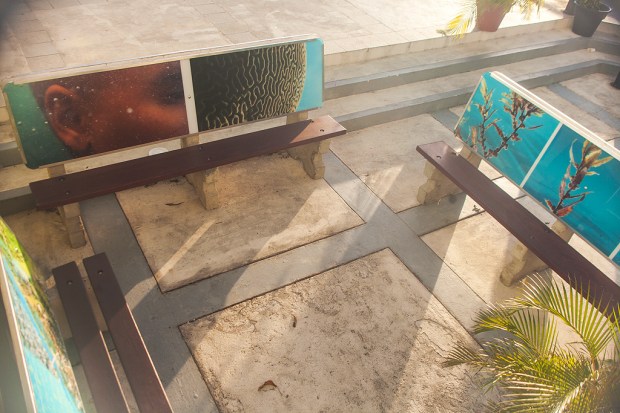
As an extension of our Fresh Stops public art project in collaboration with Adopt A Stop Barbados, the design and production of two benches to be permanent fixtures at the EBCCI were commissioned by the World Bank for the UR Caribbean Conference through Janot Mendler de Suarez.

Telling the stories of ‘Risk and Resilience’ within the Caribbean’s oceans, the backs of these two benches feature data stories about the properties and importance of coral reefs and Sargassum seaweed. These graphics were designed by Barbadian artist and Fresh Milk’s Communications & Operations Manager, Katherine Kennedy, using information largely provided by the Centre for Resource Management and Environmental Studies (CERMES), UWI Cave Hill Campus.

The fronts of each bench showcase photographs by Vincentian artist and photographer Nadia Huggins, depicting modified versions of photos related to her Transformations series, which she describes as “[exploring] the relationship between my identity and the marine ecosystem.”

This slideshow requires JavaScript.

__________

(Bush) Tea Plots – A Decolonial Patch

A Work by Annalee Davis in collaboration with Ras Ils and Kevin Talma

Photo by Dondré Trotman

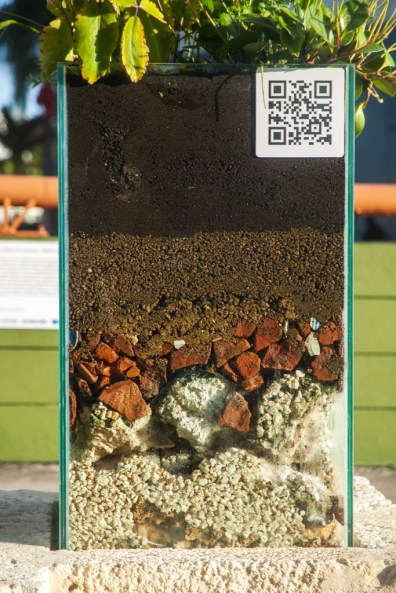
This artwork by Barbadian artist and Founding Director of Fresh Milk Annalee Davis in collaboration with Ras Ils and Kevin Talma, also commissioned by the World Bank for the UR Caribbean Conference through Janot Mendler de Suarez., sits within Davis’ larger artistic practice and confronts the historical imposition on this island of the monocrop–Saccharum officinarum–while recognizing nature as a radical maneuver against the singular model of the plantation. Observing how the natural world is threatened and degraded, (Bush) Tea Plots acknowledges the resilience of our regenerative biosphere and its inherent capacity for healing at the agricultural, botanical and psycho-spiritual levels.

The work creates visibility of near extinct (Bush) tea practices, appreciating biodiversity through dormant wild botanicals now resurfacing in abandoned sugarcane fields. This live restorative plot–an apothecary of resistance–is permanently installed at the EBCCI for the UR Caribbean Conference 2019, includes mobile accessibility via a QR code linked to the project’s web platform.

The Installation

This slideshow requires JavaScript.

The Finished Work

This slideshow requires JavaScript.

__________

UR Caribbean is organized by the World Bank’s Caribbean Disaster Risk Management team, in partnership with the Caribbean Disaster Emergency Management Agency (CDEMA) and the European Union (EU), and will be hosted by the Government of Barbados. This conference is co-financed by the European Union-funded Africa, Caribbean, Pacific – European Union (ACP-EU) and the Natural Disaster Risk Reduction (NDRR) Program and managed by the Global Facility for Disaster Reduction and Recovery (GFDRR).

Fresh Milk Welcomes a Trio of Residents for June 2019

Fresh Milk is excited to announce that we will have three writers/researchers in residence with us for the month of June, 2019: Bahamian writer and photographer Ethan Knowles (June 10th – July 5th) as part of our international residency programme; Barbadian artist Kia Redman (June 10th – July 5th) as the selected participant in the Colleen Lewis Research/Writing Residency; and Barbadian writer Ark Ramsay (June 17th – July 12th) as the sponsored participant in this year’s ‘My Time’ Local Residency Programme.

____________

About the Residents:

Ethan Knowles

Ethan Knowles is a writer and photographer from The Bahamas. His work, largely tied to the islands of the Lucayan archipelago on which he grew up, aims to decolonize and sensitize, paying particular attention to topics of cultural erasure, environmentalism and identity in the Caribbean. After completing his high school education in Nassau, he spent two years in Italy at the United World College of the Adriatic and graduated with his International Baccalaureate diploma in May 2018. He is now enrolled at Colorado College in the United States, working part-time as a photographer while pursuing a bachelor’s degree in English with a minor in Italian. Over the past few summers, he has published writing on tourism, culture, and neocolonialism in The Nassau Guardian, worked as a curatorial attaché for and exhibited at the National Art Gallery of The Bahamas and, most recently, been awarded the James Yaffe Prize for Short Fiction by the Colorado College English Department for a story set on the Bahamian island of Eleuthera.

____________

Kia Redman

Kia Redman is a creative professional living and working in Barbados. She attained her BFA in Studio Art from the Barbados Community College where she received an award from the Lesley’s Legacy Foundation for the highest GPA.

She has worked as a scenic painter for Operation Triple Threat, taught video marketing at the World University Service of Canada Caribbean, participated in an open studio residency with Punch Creative Arena and taken part in local group shows and screenings internationally. In 2018 her short film Roots|Routes won six awards including Best Short Film at the Barbados Visual Media Festival.

Kia currently works as a designer and videographer for Acute Vision Inc. and Bajans in Motion Inc. whilst cultivating her creative practice.

Being born into a post-independent nation in formation, Kia’s work focuses on issues of identity, defining culture and documenting histories. She aims to rewrite the blanket definition taught to be her Caribbean identity and discover the things unique to her lived experience.

____________

Ark Ramsay

Ark Ramsay is a 25-year-old Barbadian writer, currently completing an MPhil in Chinese Philosophy at Fudan University in Shanghai. Their short fiction has been published in Small Axe (50) in 2016, after winning that journal’s emerging writer’s contest. Ark’s writing is centered around queer, Caribbean identities and coping with the reality of a warming earth–the fragility of an island ecosystem that cannot fight back.

Ark will begin an M.F.A in creative writing at Ohio State University in the Fall.

Event Cancelled – FRESH MILK XXII – A Potlatch of Histories: Lessons on Brazilian Art

Due to unforeseen circumstances related to travel, Paulo Miyada’s trip to Barbados and the event FRESH MILK XXII will no longer take place this week as planned. We apologize for any inconvenience caused, and we hope to make arrangements to reschedule for later in the year.

Thank you for your understanding, and wishing you all the best.
The Fresh Milk Team

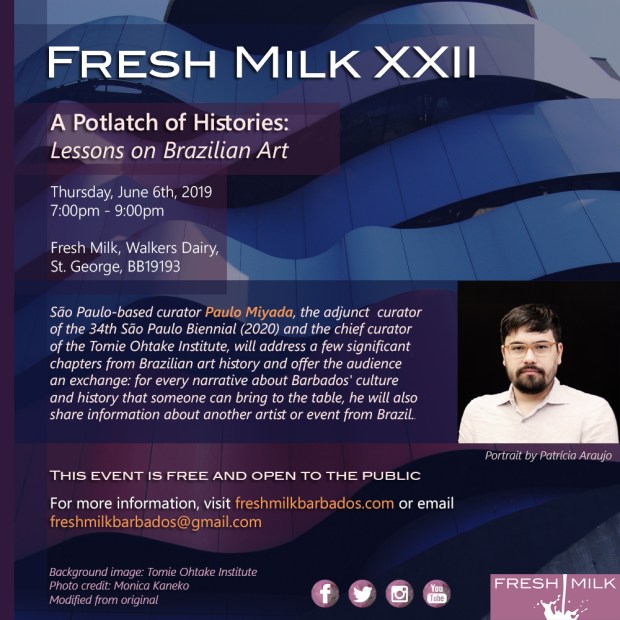
The Fresh Milk Art Platform is pleased to invite you to FRESH MILK XXII – A Potlatch of Histories: Lessons on Brazilian Art, taking place on Thursday, June 6th, 2019 from 7:00pm – 9:00pm at Fresh Milk, Walkers Dairy, St. George, Barbados. This event will feature a presentation by São Paulo-based curator Paulo Miyada, chief curator of the Tomie Ohtake Institute and the adjunct curator of the 34th São Paulo Biennial (2020).

Paulo will address a few significant chapters from Brazilian art history and offer the audience an exchange: for every narrative about Barbados’ culture and history that someone can bring to the table, he will also share information about another artist or event from Brazil. Join us for an evening of rich cross-cultural discussion and knowledge transfer!

This event is free and open to the public. Directions to Fresh Milk can be found on the ‘About Page’ of our website.

________________

About Paulo Miyada:

Photo credit: Patrícia Araujo

Paulo Miyada is a curator and researcher of contemporary art. He holds a Master’s Degree in History of Architecture and Urbanism from FAU – USP. He is the adjunct  curator of the 34th São Paulo Biennial (2020) and the chief curator of the Tomie Ohtake Institute, where he coordinates the Research and Curation Center, as well as co-coordinating the course programme of the Escola Entrópica, where he teaches. He was assistant curator of the 29th São Paulo Biennial (2010), part of the curatorial team at Rumos Artes Visuais do Itaú Cultural (2011-2013) and was adjunct curator of the 34th Panorama of Brazilian Art at MAM-SP (2015). Among other projects, he has curated: É preciso confrontar as imagens vagas com os gestos claros (2012), Paulo Bruscky: Banco de Ideias (2012), Medos Modernos (2014), Estou Cá (2016), Leda Catunda: I love you, baby (2016), Osso – Exposição-apelo ao amplo direito de defesa de Rafael Braga (2017), Miguel Rio Branco: Wishful Thinking (2017) e AI-5 50 Anos – Ainda não terminou de acabar (2018).

Marianne Keating – Second Blog Post

Irish artist Marianne Keating shares her second blog post about her ongoing Fresh Milk residency. Outlining events which have provided rich research content and have helped to shape her project – such as the exhibitions Arrivants: Art and Migration in the Anglophone Caribbean World and Insurgents: Redefining Rebellion in Barbados, both held at the Barbados Museum and Historical Society – Marianne continues to reflect on the history of  Irish migration to Barbados in the 17th century. She also addresses popular misconceptions about this migration, and the problematic trend of equating indentureship with the transatlantic slave trade. Read more below:

Vanishing Villages – In search of Irish Town, Barbados, April 2019.

The focus of my research in Barbados addresses the subaltern non-elite white community on the East Coast of the island, who are believed to be descendants of indentured labourers – both voluntary and involuntary from Ireland, England, Scotland and Wales.  Since their arrival in the seventeenth century, the creolisation process now makes it difficult to determine their exact origins. During my residency at Fresh Milk, I seek to examine conflicting existing narratives relating to their arrival and subsequent positioning in Barbados during the 17th Century.

Studio View at Fresh Milk – The Colleen Lewis Reading Room

Today, the ‘poor white’ communities can be predominately found in villages of the parish of St John along with other sites of importance including the “vanishing villages” of Irish Town and Below Cliff. The analyses of this material and sites are fundamental to my research and development of my practice-based output, which involves the gathering of oral histories through interviews, film footage, research and documentation.

My initial onsite investigation in Barbados began in November 2018 during my first visit to the island for an exhibition I was part of called Arrivants: Art and Migration in the Anglophone Caribbean World. The exhibition, curated by Veerle Poupeye and Allison Thompson at the Barbados Museum and Historical Society, featured a powerhouse of artists including Eddie Chambers, Hew Locke, Keith Piper, Veronica Ryan, Ewan Atkinson and Cosmo Whyte to name a few. During this time, I spent many days researching at the Barbados Museum and Historical Society’s Shilstone Memorial Library which has a rich collection of over 6,000 books, journals and pamphlets, covering subject areas such as the Caribbean, Barbadian and African history, archaeology, natural and social history amongst many more.

The Barbados Museum and Historical Society featuring Eddie Chambers Untitled (1994), flag.

The museum and library are housed in historic buildings which were used initially as the military prison at St. Ann’s Garrison. With the support of Librarian Ms. Harriet Pierce, I trawled through old copies of the Journal of the Barbados Museum and Historical Society dating from 1933, publications such as Richard Ligon’s, A True and Exact History of the Island of Barbados 1657 and copies of old newspaper clippings. These resources greatly helped to established secondary sources about the arrival of Irish indentured labourers and political prisoners to Barbados in the seventeenth century. I also spent many days at the Barbados National Archives exploring their records and the 1715 census which lists many Irish names within the document, leaving more questions than answers.
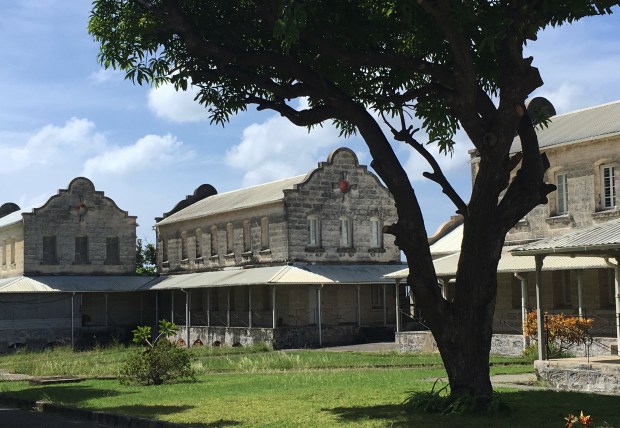
The National Archives of Barbados.

On my return to the island in March, I attended the opening of the exhibition Insurgents: Redefining Rebellion in Barbados curated by Natalie Batson in collaboration with Life in Leggings: Caribbean Alliance Against Gender Based Violence and Barbados Youth Development Council at the Barbados Museum and Historical Society. The exhibition challenges the popular belief that Barbadians are and have been passive when it comes to acts of resistance against injustices.

Amongst the many protest images within the exhibition stood a 390-year timeline which documented insurrection in Barbados including accounts of Irish rebellion against the British Colony. The first post-dated 1655 mentioned the following referencing historian Sir Hilary Beckles, A History of Barbados: From Amerindian Settlement to Caribbean Single Market, 1990.

It is reported that “several Irish servants and negroes out in Thicketts and thereabout, plundered estates systematically”.

And the second mention of the Irish was listed for 1661

Master and Servants Code of 1661 and the ‘Act for the better ordering and governing of Negroes’ slave code drawn in response continued unrest by Irish indentured servants and enslaved Africans.

When discussing Irish migration to the Caribbean in the 17th – 19th century, it is important to discuss the vast difference between indentured labourers/servants and African enslavement or chattel slavery and to address the incorrect use of the term ‘white slave’.

Since the early 2010’s the ‘white slave’ narrative has received more traction, frequently popping up on online platforms and social media across Ireland and throughout the Irish diaspora, a narrative supported by the far right in the United States amongst others, to support a racist political agenda.  This narrative is spread in relation to the discussion of Irish migration to the Caribbean when attempting to nullify the differences between indentured labour and African enslavement or chattel slavery. This narrative has been devised to remove race as an aspect of slavery, “the ‘white slavery’ narrative stresses a sense of shared victimisation; this sentiment then serves to discredit calls for reparations from descendants of enslaved Africans in the U.S. and the former British West Indies.”[1]

These false narratives continue to grow online through the constant referencing of many poorly researched books and publications resulting in the misconception, misinterpretation and misappropriation of the reality of the terms of Irish indentureship. There are many distinctions between indentureship and enslavement, with articles such as Contesting “White Slavery” in the Caribbean: Enslaved Africans and European Indentured Servants in 17th Century Barbados by Jerome Handler & Matthew C. Reilly offering a detailed examination on the socio-legal distinctions between servitude and slavery.[2]

The differences are extreme, and although many are aware of these inaccurate narratives, it has effectively complicated the already convoluted story of the subaltern non-elite white in Barbados. And the history of Irish migration to the Caribbean becomes intrinsically linked to this narrative, leaving it impossible to address this history without also addressing this false narrative.

Through my research, I am exploring all aspects of this complex history, as to leave an area untouched threatens the recording of this history through a clouded lens. Many researchers have written articles correcting these falsities, and one of the areas I will focus on is addressing the impact of this narrative on the history of Irish migration. In this way, I will attempt to separate it from the clutches of this racist political agenda which has become click bait for readers as they scroll through their posts on social media.

In Jamaica, Irish Indentured labour began in the years after abolition. Under colonial rule, the Irish poor had few opportunities in a country with high unemployment and ongoing food shortages resulting in limited funds to rent land to grow provisions for the landless workforce. Irish migrants seized opportunities offering a better life and voluntarily signed contracts where they signed a bond to work for a term of up to three years in return for passage, housing and provisions in Jamaica, becoming the legal property of the planter for the duration of the contract to pay off their debt. At the end of their contract, depending on the planter, they had the option to continue working under a new contract with new terms or leave the plantation free from any obligation. Alternatively, they could begin a new life elsewhere in Jamaica or, if funding permitted, in another country by signing up to a new emigration scheme.
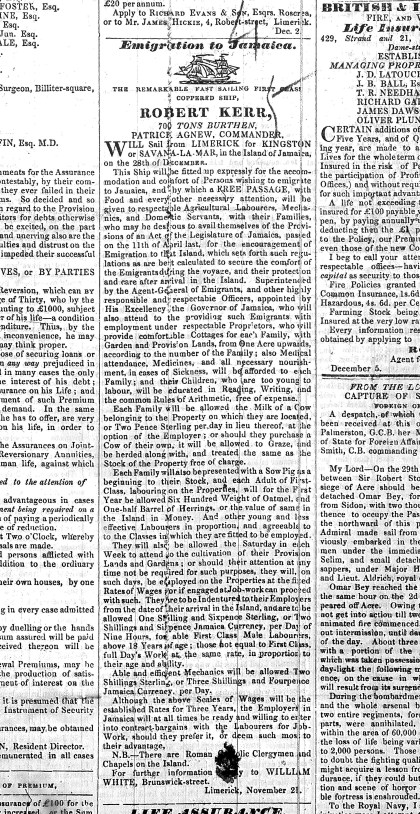
Advertisement Emigration to Jamaica on board the SS Robert Kerr.

This is not to say that the promised conditions were always in place on arrival or that the plantation owners met the agreed terms. Agents and sub-agents working for the West India Immigration Scheme or on behalf of private planters were known to have exaggerated or mislead migrants regarding the opportunities available or working and living conditions in their need to recruit large numbers of labourers.

In the years that followed the abolition of slavery in 1834, the Jamaican sugar cane industry became less lucrative and Jamaican planters struggled to maintain their economic position in the global economic market. With a reduced labour force unwilling to work under the proposed conditions, crops failed due to a lack of manpower required to bring the crops to fruition, and bankruptcy ensued amongst the Jamaican plantocracy. Increasing numbers of labourers chose to sail to Jamaica, where legislation had not yet been put in place and conditions varied from plantation to plantation. The scheme to recruit Irish indentured labourers ran without controls implemented by the legislators until after the controversy of the S.S. Robert Kerr–the last ship to sail to Jamaica under the scheme in 1841.

Although the exact number is unknown due to limited records, there are accounts of the Irish indentured succumbing to diseases such as yellow fever as they were held in low lying areas more prone to illness or death resulting from poor working and climate conditions. However, if a labourer became dissatisfied with their terms and ran away, they were often not tracked down. There are many possible reasons for this, including the scale and rugged terrain of the country and the dwindling resources of the plantocracy. There is a case of a group of Irish causing such uproar they were returned to Europe to stop the unrest spreading to others on the island. Another example is of a woman from Galway who was prosecuted for running away and abandoning her contract. Indicted before the court, her mistreatment by the planter was discussed publicly with the resulting decision unknown. Some who ran away became homeless and destitute in Kingston, whereas others completed the term of their indenture and quickly moved up the ranks of society by taking advantage of their whiteness, privileged in a society driven by race. Through this manipulation of their whiteness, former peasant workers transitioned from bonded workers to positions of authority in the militia, the police force and later into the ranks of politics.

In Barbados–a new area of research for me–the conditions varied significantly from those in Jamaica. Recruitment there began in the mid-seventeenth century where different terms were applied and which were extremely different from the Africans who were enslaved under chattel slavery. Here contracts of indentureship lasted up to seven years if the signing was voluntary, or varied in length if brought to Barbados as a political prisoner. The working conditions of the indentured or political prisoners often led to their preliminary death as a result of mistreatment or harsh working and climatic condition. However, unlike chattel slavery, the terms of indenture lasted for a specific time and did not pass from adult to offspring or their descendants. Furthermore, the indentured had certain rights that the enslaved did not. These differences are addressed very clearly in the aforementioned article Contesting “White Slavery” in the Caribbean[3] and in the article The Irish in the Anglo-Caribbean: Servants or slaves? Why we need to confront the ‘Irish slave myth’ and how terminology is not simply semantics[4], an extract of which is seen below.

the differences and commonalities between these two forms of unfree labour are of fundamental importance to our understanding of the development of racialised perpetual chattel slavery in the British colonies. The term ‘indentured servitude’ is not a denial of their suffering or unfree situation but rather an accurate term to describe their legal status, few rights and harsh reality. Colonial servitude in the Anglo-Caribbean was temporary and non-hereditary, with legal personhood, while chattel slavery was perpetual and hereditary with sub-human legal status. It is inevitable that if we refer to these two different statuses in the same historical context using the same term (‘slave’) these profound distinctions are erased. The refusal to differentiate often reveals a motivation to equate indentured servitude for Europeans with African chattel perpetual slavery to claim spuriously that slavery had nothing to do with race.[5]

Over the next few months, I will focus on making two short films (which may later merge into one), investigating this history of Irish migration to Barbados and the complex environment in which this history sits. My research is looking at these multi-vocal approaches to the past, exploring sites of importance while tracing oral histories and physical fragments remaining in the landscape. As I begin to address this history through practice-based research, I will concurrently address false narratives within this history and their impact on contemporary understanding of the histories of Irish migration to the Caribbean.

[1] The Irish in the Anglo-Caribbean: Servants or slaves? Why we need to confront the ‘Irish slave myth’ and how terminology is not simply semantics by Liam Hogan, Laura McaTackney and Matthew C. Reilly p19

[2] Contesting “White Slavery” in the Caribbean: Enslaved Africans and European Indentured Servants in 17th Century Barbados by Jerome Handler & Matthew C. Journal of the Barbados Museum and Historical Society, Vol 63 p156- 187

[3] Contesting “White Slavery” in the Caribbean: Enslaved Africans and European Indentured Servants in 17th Century Barbados by Jerome Handler & Matthew C. Journal of the Barbados Museum and Historical Society, Vol 63 p156- 187

[4] The Irish in the Anglo-Caribbean: Servants or slaves? Why we need to confront the ‘Irish slave myth’ and how terminology is not simply semantics by Liam Hogan, Laura McaTackney and Matthew C. Reilly p18-22

[5] The Irish in the Anglo-Caribbean: Servants or slaves? Why we need to confront the ‘Irish slave myth’ and how terminology is not simply semantics by Liam Hogan, Laura McaTackney and Matthew C. Reilly p19

________________

This residency is supported by the Arts Council of Ireland
Marianne Keating – First Blog Post

Irish artist Marianne Keating shares her first blog post about her Fresh Milk residency. During her time in Barbados, Marianne’s focus will be  on the migration of indentured labourers from Ireland, England, Scotland and Wales who arrived in the island in the seventeenth century. She intends to explore this complex history both through the physical and social landscape of the country, beginning by conducting site visits and reflecting on the journeys of those who have long since traversed this space. Read more below:

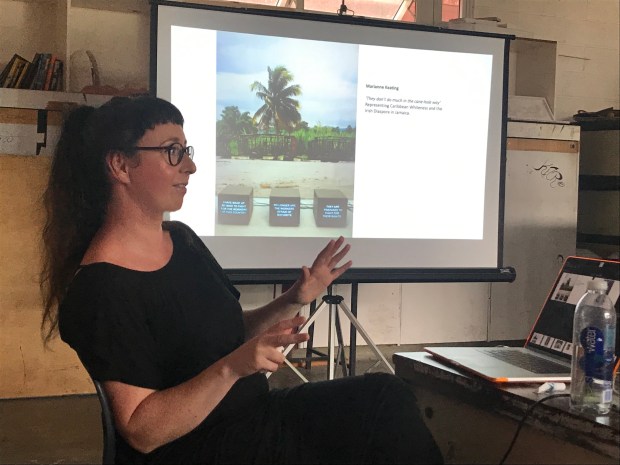
Marianne Keating presenting to the students at Barbados Community College

During the last six years, I have spent my time as a practice-based researcher exploring and tracing the multiple trajectories of the migration of the Irish to Jamaica during Ireland’s colonial rule by Britain. My beginning point in the complex histories of Irish emigration to the Caribbean is the movement of Irish indentured labourers from Ireland to Jamaica beginning in 1835 until its abrupt end in 1842, and their resulting legacies in contemporary Jamaica.

My practice-based research combines many hours spent in national archives, libraries, onsite research, interviews and location shooting before combining all these research methods in my studio, where my multi-disciplinary outputs include a series of video pieces and written accounts. My research has now expanded to include the Irish diaspora in Barbados – bringing me back once again to the beginning –with a new direction in my research in an unknown land, surrounded by a new landscape, history, culture and people.

Although my research subject is the same, there are vast differences in all aspects between the Irish migration to Jamaica and Irish migration to Barbados of which I am still attempting to wade through and come to grips with during my first few weeks of onsite research.

To Begin
LAND – Ireland, Jamaica and Barbados

“By land is meant not merely land in the strict sense of the word, but the whole of the materials and forces which nature gives freely for man’s aid in land, water, in air and light and heat.” – Alfred Marshall.

I have always been fascinated by the geology of land, how the soil under our feet has been formed, who has passed this way before and the frequency of such movement. I think of our homogeneous desire to follow the same, well-worn path and manoeuvre inside the marks created in the landscape by those who have come before. These lie in stark contrast to the rawness of other areas, where few now walk allowing the natural world to continue ownership or reclaim the land back to its original form; removing all traces of life that passed through before.

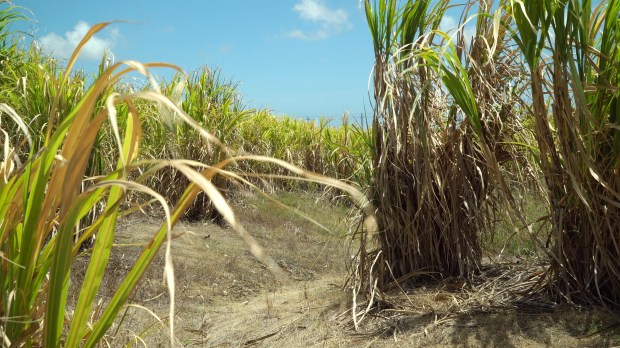
Path of migration within a cane field, St. George, Barbados

As economist Alfred Marshall discusses, the word ‘land’ refers to not just the soil beneath our feet, but instead encompasses all of nature’s resources including the minerals underneath the soil and the trees above. “The term ‘land’ thus embraces all that nature has created on the earth, above the earth, and below the earth’s surface.”

Land holds the memories of past lives. The coral and limestone sediment on which we stand embeds what has come before and consumes the archives of past experiences, leaving us with few traces with many details never to be recovered. We trail through all manners of the past archaeology, anthropology and sociology to attempt to reconstruct the narrative, but often the land holds onto more traces than it reveals.

I think of the importance of our place in the landscape, and its gradual erosion by the constant migration of people over thousands of years, crossing the land back and forth on daily journeys and the eroding and erasure of the ground by natural or human-made means. It highlights the experience of all who have emigrated and continue to migrate from one country to another whether by choice, necessity or force. The formation of land over millions of years is a culmination of its coral and limestone structure and the inedible marks left in the soil by those that have passed through.

Many conflicts have been fought, whether on global or localised scales, over the ownership of land. But as Mason Gaffney discusses in his essay Land as a Distinctive Factor of Production, we are all only present for a time before the land is handed down over and over again, recycled as the limit of land is determined; its value may change due to circumstances, but its supply is finite. “Land is reusable. All the land we have is second-hand, most of it previously owned. Our descendants, in turn, will have nothing but our hand-me-downs. As there is never any new supply, the old is recycled periodically, and will be in perpetuity, without changing form or location.”

The importance and weight of land can never be diminished, and people’s connection to the land is universal. As each new generation is born, their attachment to the land continues, both of the lands of their birth and of that of their ancestors.

There are many points of connection between the three countries of my research through which I trace the migration of the Irish to Jamaica and Barbados. They all have the collective experience of being island states, their connection by the Atlantic Ocean and their colonisation by Britain till the 20th Century. This is not where these connections end, but it is instead the starting point for my exploration in Barbados.

To look at the lands of Ireland, Jamaica and Barbados, there are vast physical differences. Barbados, the eastern-most Caribbean island, was created by the collision of the Atlantic crustal and Caribbean plates, along with a volcanic eruption. It comprises low-slung terraced plains, separated by rolling hills, with eighty-five percent of the island’s surface consisting of coralline limestone. The island is small in comparison to the others, measuring 23km at its widest point, 34km long and a small surface area of 430 square km, with Mount Hillaby – the highest point on the island – at 340 meters above sea level.

Barbados is geologically unique, being two land masses that merged over the years with the deep ravine visible across the island. The distance by sea between Ireland and Barbados is approximately 6,357km, and I am imagining time spent by the Irish on their migratory path travelling across the Atlantic Ocean, knowing there was little chance of returning to the soil of their birth.

________________

This residency is supported by the Arts Council of Ireland