Danilo Oliveira’s Residency – Week 4 Blog Post

Brazilian artist Danilo Oliveira shares a blog post about the final week of his Fresh Milk residency. Danilo documented his experiences through a visual diary, sharing images and sketches that capture impressions of his time here in a series he has dubbed ‘The Bajan Chronicles’. See more below:

_____________________

‘The Bajan Chronicles’ consists of images generated during my residency at Fresh Milk, looking at Barbados’ history, everyday life and culture. Of course, one month is not enough to create any kind of deep reflection, but it’s time enough to realize some historical coincidences and explore some cultural and social issues, even in a superficial way. It’s about a foreign view, for a short time, touching on some restrictive issues, and trying to generate questions and reflections out of these.

Dorothea Smartt’s Residency – Week 2 Blog Post

Barbadian-British poet and live artist Dorothea Smartt shares her second blog post about her ongoing Fresh Milk residency. This week saw Dorothea continue her research around gender, sexuality and the Barbadian migration to Panama in the 1900s,  as well as preparing for a ‘Community Constellations’ workshop to be facilitated by Sonya Welch Moring. Read more below:

This last week seems to have sped by! Full of rich encounters and insightful conversations – not least with my ‘roomie’ Danilo as we both try to unpick the complexities of ‘Bajan-ness’ and the near invisibility of any African cultural/social/religious/spiritual life-ways in this most ‘English’ of ‘West Indian’ Caribbean islands. This has implications for how I might re-imagine the characters I have coming to me through my ‘panama poems’.

I know that in every place/space, things are not always as they may appear at first glance – the ‘happy couple’ may be rife with indifference or conflict! The ‘happy couple’ may not be a couple at all! Lol! To all intents and purposes, I can appear to be heterosexual, or perhaps I fall ‘victim’ to persons assumptions and lack of imagination. Unlike some of the queer community – I can ‘pass’ as a straight Blackwoman. My gender appears binary, fitting into one of the two accepted categories of ‘male’ or ‘female’.  If I am seen out and about with a friendly male (and I do have them in my life these days!), it’s often assumed we are a couple or husband and wife. This is true in every society, not just here in B’dos. However it comes with its own particularities given the specifics of the location, age of the persons and so on. If I’m seen out and about with a friendly Blackwoman, it can be assumed we are sisters (regardless of how unalike we might be!) or we are mother and daughter (these days I often get to be the ‘mum’ half of the equation!). Only those with what you might call ‘queer-eyes’ or ‘zami-eyes’ would see that we are a couple, that we are in an intimate sexual relationship of some kind.

This week I sent out personal invitations to a few selected artists/writers/friends and the Fresh Milk team to come to a “Community Constellations” workshop next week. A visiting friend and colleague from London, Sonya Welch-Moring will be facilitating the session. Sonya’s heritage is Guyanese, we were friends at South Bank Poly back-in-the-day, and re-connected on First Street, Holetown one magic night last year. Sonya’s intro to the session reads:

(Community or) “Systemic Constellations explore relationships within a system, by creating a ’mapping-process’.  The method can indicate ‘entanglements’ over generations and ‘stuckness’ within wider systems and networks of relationships.  This approach can surface what is hidden and offer steps to reconcile or resolve difficult situations, in order to ‘restore the flow of love’ between individuals and within communities… family constellations,…offers a way to honour your family and reconnect to your cultural and ancestral lineage.  …systemic constellations [can] explore a range of community and social-justice issues and seek solutions to problems.”

I’ve taken part in Sonya’s workshops in London, and have been excited and moved by what can be accessed through a skillful application of the Constellation technique. For my session, I will be bringing a ‘social/community’ issue relevant to my ‘panama poems’ and creative research.

One highlight of this week was returning to the B’dos Archive for an Open Day. Danilo was able to introduce me to Frederick Alleyne, and I saw his modest but telling display of the Bajan-Brazilian connections, created by ancestors who went to Brazil to build a railway in the late 1800’s. Several generations on, and significantly, their descendants are still Bajan-English speakers! This is not the case with descendants of Panama Canal workers. I was delighted to discover that the Open Day programme included a screening of Diggers, a remarkable 1980’s documentary with interviews of then 90-plus years old men, for whom the harsh and dangerous working conditions on the Panama Canal had been a teenage rite of passage to manhood. Post-traumatic stress syndrome was not a consideration, in how these young men’s lives had been shaped by the experiences they spoke of with clear emotions, and in some instances tears.
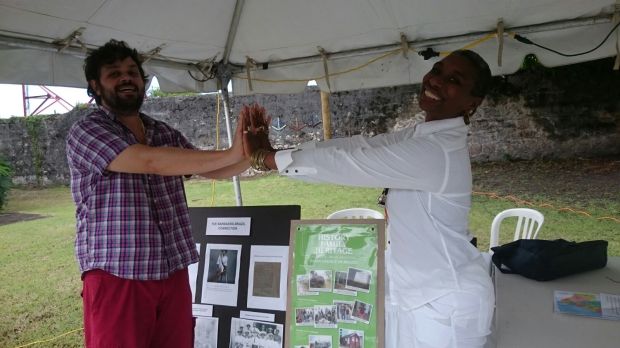
Danilo and Dorothea

Danilo and I left the screening subdued yet angered by the injustices portrayed. We both needed to walk and vent! The importance of my small offering in highlighting this period of our history was re-affirmed. And the early black & white film footage and photographs of energetic young men (for it was very much a Blackmen’s story, in fact there was only one Blackwoman’s voice in the entire documentary), digging, jumping trains, recklessly balancing dynamite boxes on their heads, operating steam-powered engines was an amazing sight. As I scanned the faces in the crowds I wondered who in today’s language would have been gay, queer, men-who-slept-with-men? I wondered what loves and affections might have kept them going through this trauma. I wondered who might be wearing womens’ underwear under their work clothes! I wondered who had a charm or a talisman to keep them safe and alive in this virtual war-zone of construction – a crucifix or a bag of dried herbs with bones and stones? A set of baths they’d taken before they boarded the boat? And once arrived in the ‘pestilence of the jungle’, if they fell sick or were injured – would they look for cerasee, five-fingers, dog-dumplin’, or leaf-of-life to soothe them?

Maferefun Egun. Maferefun Orisha.
whatsapp-image-2016-12-01-at-7-24-23-am

Dorothea Smartt’s Residency – Week 1 Blog Post

Barbadian-British poet and live artist Dorothea Smartt shares her first blog post, expanding on her time in the Fresh Milk residency programme. With Barbados being Dorothea’s second home, it did not take her long to settle in, connect with the community and begin reaching out to those she hopes to collaborate with, as well as getting to know her fellow resident artist for the month, Danilo Oliveira. Read more below:

I arrived on Thursday, my bruthafren met me at the airport and drove me up to Fresh Milk where we were met by a warm and welcoming Katherine. We followed her car slowly up the pot-holed driveway back out to the main road, driving the short stance to the lodgings. Danilo welcomed me like a an old friend with a shot-glass of smooth premium cachaça, and bonded with my bruthafren over a mutual interest. Next morning, I settled myself into my spacious room, making it my own with a few adjustments to the furniture.

Katherine came to take me grocery shopping. On the way out, a parliament of twenty (I counted) guinea fowls (the Brazilian translates as ‘Angola birds’), leisurely crossed the driveway as Katherine waited for them to cross. It’s been a week of synchronous events. The two best bits of news were that Lauren Craig, one of my collaborators, was coming out later in the week, and would be able to spend some face-to-face time with me here at Fresh Milk. And I was delighted to learn that Iya M. Jacqui Alexander had arrived the same day as me to spend a few days in Barbados, with her former student and my future PhD Supervisor Yanique Hume. It’s been almost 10 years since I saw Jacqui in New York during the last days, death and funeral of my dearest friend and mentor Myrna Ilare Bain – who introduced me to Jacqui and Santeria back in the 1980’s.

Danilo and I shared food, cooking, conversation and XO Mount Gay rum like practised housemates. Iya Jacqui and Yanique came by the studio, and left their good energies singing in the air. The ‘New Partner’ Angel card I’d drawn over the weekend at my bruthafren’s place near the beach, had told me a chance meeting would send me someone who I’d recognise by my “sense of familiarity, comfort, and safety”, “an answer to my prayers.” The cat at the lodgings attached herself to me from my first night. The large African snail slowly crossed our doorway. On her visit, Lauren helped me by organising my video cameras and my old Olympus OM 10, charging them up and checking batteries. Over an early dinner I‘d cooked that morning, I read her a poem-in-progress I’d shared with my potential collaborators. She was particularly drawn to it because it had emerged and was titled for a live art workshop we’d both done in London with Stacey Makishi. ‘Death For Beginners’  is my attempt to write something of the claustrophobia  and censoring of women & girls I experienced growing up in my Bajan house in London and had heard and seen here in Barbados. The characters of Olive Senior’s short story ‘Window’ had provided a (November!) setting.  The Sunday visit to the Farmers’ Market at Holder’s Hill gave me gifts of ‘leaf of life’ and the delight of a stall-holder’s toddler son who had attached himself to me, and was set on helping me with my shopping. He picked small yellow flowers and presented them to me.

The first part of this week I was able to finish and submit a funding application to a fellowship offered by the Center for Lesbian & Gay Studies at CUNY Grad. Centre. The late night task to meet the deadline created an opportunity to review the impetus and previous Arts Council funded research I intend to build on during my time at Fresh Milk. Phone calls, messages and emails to my artist friends/collaborators will hopefully open the door to their contributions and feedback via Skype/WhatsApp/Facebook Messenger in the coming weeks. I set up a shared Google Calendar.

My weekend back at my bruthafren’s was an opportunity to play, party, dance through the night, re-connect with Bajan poets, freestylers and spoken word artists, and sing karaoke in Holetown after seeing Mannequins in Motion do their fabulous Sunday night show. More signs, as the Angel Card had said. A beautiful Super Full Moon (the closest a full moon has been to the Earth since 1948), playful children, the warm sea off Lower Carlton, and lush countryside of St. George, let me know there’s beauty, love and laughter in this world (now being dumped with Trump as President). Always.

Maferefun Egun. Maferefun Orisha.

Danilo Oliveira’s Residency – Week 2.5 Blog Post

Brazilian artist Danilo Oliveira shares a blog post about the floor mural he is producing during his Fresh Milk residency this November: “Utopian Geology Services” – The Cultural Geology of the Caribbean. See more below:

___________________

“Utopian Geology Services” – The Cultural Geology of the Caribbean.

When I arrived in Barbados for my Fresh Milk residency, my proposal was to research and study the borders and identity relations present in Barbados and in the Caribbean. It is my first time in this part of the world, and so it’s been great to learn from each person that I meet. Some things surprised me, some things had a huge impact on my visions around ideas of belonging, colonialism and ancestral identity. At some point, I began to see the geology of Barbados as an important aspect of its development (as it is in any country). And so, in spite of the fact that Barbados and Brazil endured slavery for centuries, the post-colonial periods are very distinct. Maybe some of that could be related to the geological differences. Here in the Caribbean, I have been looking for traces of identity: Bajan? Caribbean? Part of the Americas? Afro-Caribbean? British? Little England?

I began to wonder how it would be if we changed something that is unchangeable, like geological aspects of the region. I’m calling this “Utopian Geology Services” – The Cultural Geology of the Caribbean. How would it be if the Caribbean islands were closer? How would it affect the history, if it had always been like this? What are the real distances in a world controlled by routes?