Kraig Yearwood’s Residency – Week 3 Blog Post

Barbadian artist Kraig Yearwood shares his third blog post about his Fresh Milk ‘My Time’ Local Residency. Things began to come together both materially and conceptually for Kraig this week, having investigated the properties of concrete and experimented with how it behaves both on its own as well as in combination with other elements.  He also had the opportunity to have a studio visit with Natalie McGuire, manager at the Barbados branch of Gallery NuEdge, where he expanded on his ideas around consumption, mass manufacturing and materialism. Read more below:

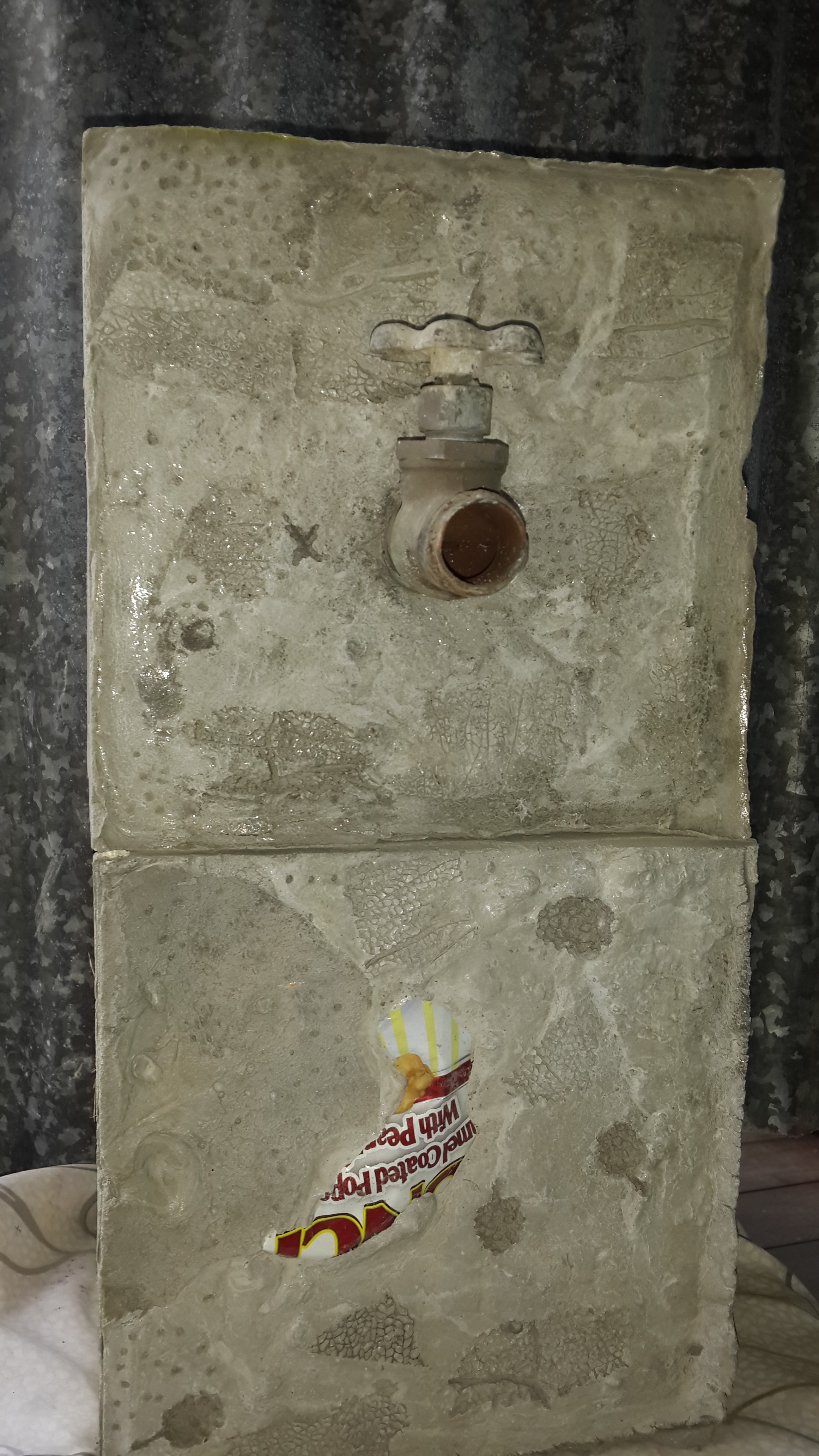
A detailed view of Aquifer

Week number 3 at Fresh Milk has been a mixed bag; and if I’m being totally honest, a bit disjointed.

Happily, I’ve really started to get a handle on how the concrete reacts, and as such a better understanding of its characteristics, possibilities and limitations. While I’m loving all its various textural nuances and the ability to embed various materials, getting accustomed to the materials’ prep and drying times has been a challenge since I am not used to using mediums with long drying times. Perhaps this stems from primarily utilizing a hairdryer for most of my acrylic works. This is my preferred method of hurrying the drying process, out of a little impatience and eagerness to allow additions to be made to artwork. However, I am getting used to the wait.

In addition, I’m gaining more clarity conceptually, relative to overall directions I wish to take, on individual pieces I’m working to resolve, and those I have yet to get started on. On Saturday, I was privileged to have a studio visit with Natalie McGuire, Gallery Manager at Gallery NuEdge, where we discussed the themes that I’m currently working on.  I’m interested in using a broader theme of “the shifting philosophies of the traditional Caribbean landscape to one which is littered not only physically but figuratively as well.” The land is becoming a mirror for the mindsets of our people. This main theme of interest is accompanied by satellite themes of consumption, mass manufacturing and materialism.

Work in progress Aquifer

It’s amazing how time flies. At the onset, a month seemed a long time, but with one week left I’ve constantly been feeling like I need to do more. This week I’ve found it hard to balance my output and expectations with all the other projects and commitments outside of the residency. It was only after a chat with an art colleague, that I was reminded that we are artists and not machines, that sometimes things happen in their own time.

So…it’s with that timely reminder that I go into my final week with renewed energy and a plan to focus on things that can realistically be completed by week’s end; with the knowledge that as the residency comes to a close, that the exploration has only just begun.

Experiments

Idyllic Caribbean garden on the grounds of Fresh Milk

Kraig Yearwood’s Residency – Week 2 Blog Post

Barbadian artist Kraig Yearwood shares his second blog post about his Fresh Milk ‘My Time’ Local Residency. Having spent the first week researching and collecting his thoughts, Kraig has progressed into experimenting with materials such as concrete and discarded objects, seeing how these interact and address the conceptual side of his work. Read more below:

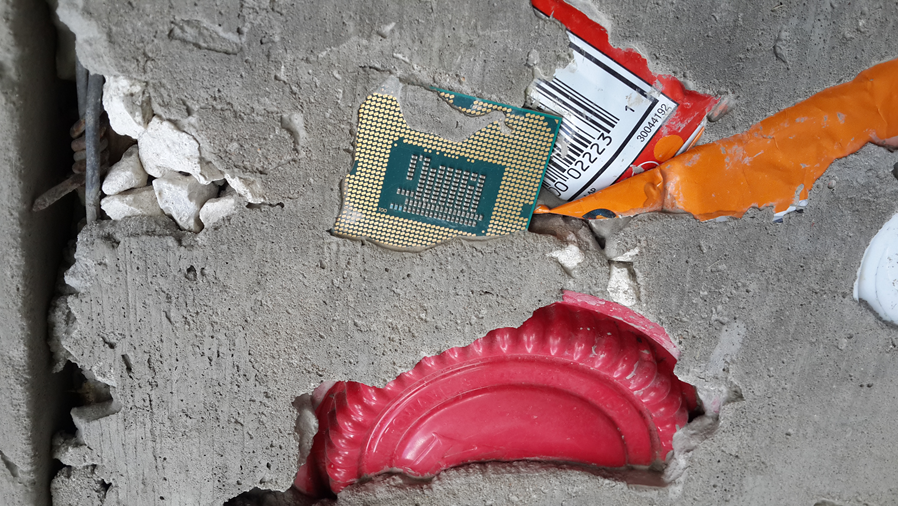
3 of the works in progress, each utilizing items of trash encased in concrete.

It’s now the conclusion of my 2nd week at the Fresh Milk residency, and I’m a bit more focused and much more clear on the direction of the work. Usually my mixed media production relies on the use and incorporation of items and found objects that I find some aesthetic quality in, but during this residency my main focus will be exploring the inclusion of garbage and objects mainly acquired during my walks and runs across the length and breath of Barbados, as well as trash generated during my stay.

In the week ahead, it’s my hope continue to work on a few of the themes I’ve been developing and to introduce the use of resin.

During my 1st week and most of my 2nd, I’ve had neither the time nor the head-space to enjoy and appreciate just how beautiful the grounds that are home to Fresh Milk are.  It was while waiting for cement to dry on Friday that I decided to explore the outside of my studio a bit take in the amazing flora and fauna in every corner. Yes, while it’s true the Fresh Milk platform is located a working dairy farm, there’s no shortage of all manner of critters as well as an impressive array of plants and flowers and of course beautiful Caribbean light.

Kraig Yearwood’s Residency – Week 1 Blog Post

Barbadian artist Kraig Yearwood shares his first blog post about the start of his Fresh Milk ‘My Time’ Local Residency this month. He spent the first week researching new materials as well as looking through publications in the Colleen Lewis Reading Room, gathering his thoughts and concepts for the weeks ahead. Read more below:

The Fresh Milk ArtBoard featuring work by Ronald Williams

And so, the journey begins….

As soon as I learned I’d been awarded this residency, I was engulfed by two emotions: excitement and nervousness. I was excited that I’d perhaps have an opportunity to explore new directions and materials; but also nervous because I haven’t been working on these types of projects for many months, and now I actually have to kick into gear and get to work.

This 1st week, I stuck to my plan of doing as much reading and research as possible on the themes and concepts that I was thinking of exploring, as well as on the materials I wish to delve into. I usually prefer solitude when I’m working – however, during this week, I don’t think that I’ve ever felt more alone with my thoughts or more aware of time. Never a bad thing, right?

My new friends! 😬

Some concept sketches from my 1st week at Fresh Milk.

Some of the random objects and trash found and gathered on my daily runs and walks; which I’m hoping to use in my new work.

I’d like to thank the Fresh Milk team for having me and making me feel instantly welcomed, and I’d also like to thank the talented Camille Chedda and Dominique Hunter for encouraging me to apply.

Dorothea Smartt’s Residency – Final Blog Post

British-Barbadian poet and live artist Dorothea Smartt, who was in residence with Fresh Milk in November-December 2016, led a workshop on poetry and free writing with Class 4 students at St. George Primary School on January 16, 2017. Read more from Dorothea about this experience below. Thanks so much to the staff at St. George Primary for allowing us to host the session, and to the bright and enthusiastic children for embracing it!

20170116_113708

After a return to London to take care of pressing domestics, I reconnected with Fresh Milk in January. We had a good meeting with local St George Primary School in December. Katherine at Fresh Milk followed through, and we were given a date, Monday January 16, to hold an 80 minute session with some of the students.

We met the head teacher before going to the class. A junior class of curious boys and girls greeted us formally, after a brief introduction from their welcoming class teacher. Katherine introduced me as a Fresh Milk International Artist in Residence. I talked a little with the pupils about myself and being a poet.

The class took part in a discussion on people leaving Barbados to go to work building the Panama Canal. I drew a rough map of the Caribbean, and they joined in identifying where Panama was. Some pupils, one boy in particular shared about great grandparents who’d gone to Panama. Some pupils were hearing about it for the first time.

I read them one of the poems about Panama that spoke of some of the men who died. And we spoke about the dangerous working conditions people endured. I guided the pupils in a free-writing exercise with a prompt: ‘In those days…” and they wrote for 3mins. They responded with enthusiasm.

To follow I shared five old black and white photos of the Caribbean. These were from a learning resource pack produced by the (British) National Archive. The pupils worked in five groups with a photo each. First they discussed the image and were asked to imagine how they might relate to Panama workers. For example, they imagined a banana worker was harvesting food for the workers; a large drawing room, a place where bosses would have gathered to relax; and an image of a hut with a canoe outside a place where a worker may have lived and fished for food.

Then each pupil wrote a short poem drawing on our discussion, their free-writes and the photos. We had time to hear some of the pieces produced, which were full of imagination and insight.

I really enjoyed meeting these pupils, they were keen and interested. Their input, questions, and writing added to my own imagination, especially when it came to what the workers would have eaten! Hopefully my workshop is the start of an on-going relationship with Fresh Milk – as they have plans to work with this class on a future project!

I had hoped to connect with the group in Panama again, and present something of my work and process. Time, internet and availability of space weren’t able to come together and after a discussion with Katherine/Fresh Milk, I let this go.

On this residency, the space, time to focus and reflect, discussions with Bajans and others, and the events I attended have enhanced me. I feel encouraged and affirmed on my journey with this research and the poems I written. There’s more to unfold and write, and this residency has definitely resourced me to carry on.

Maferefun Egun. Maferefun Orisha.

Dorothea Smartt’s Residency – Week 3 Blog Post

Barbadian-British poet and live artist Dorothea Smartt shares her third blog post about her Fresh Milk residency. Highlights of the week included hearing US artist Ellen Gallagher deliver an artist talk at the Barbados Community College and managing to hold a ‘Community Constellations’ workshop facilitated by Sonya Welch Moring, despite its postponement due to serious flooding afflicting Barbados on the eve of its 50th Independence celebrations. Read more below:

My week started with my first ever visit to Barbados Community College, a place so many Bajan artists and creatives have passed through. I was excited, arriving just in time to hear Ellen Gallagher begin her talk. Before I came on this residency, I’d thought of my poems, still in draft form, written in response to pieces in her retrospective exhibition AxME [Tate Modern, 2013]. I’d been engrossed by her imagery and the collage and layering she so often employs. I was particularly taken with Monster one of her collaborative 16mm projections from the sequence Murmur ; the Watery Estatic series; and the large Bird In Hand portrait. I was drawn back again and again to sit with and explore her work.

I listened to Ellen speak about the making of, and process that birthed her Oh Susannah painting. One of the first things that resonated, was her saying she’d had no intention of being an artist – because she hadn’t known then that it was something you could become. She went to Oberlin College, studied the history of sailing and oceanography. This led to her being on a sail ship travelling the Caribbean sea – the US Virgin Isles. It was only after this she enrolled in art school. She found community off-campus, with poets and writers like Sharan Strange, a co-founder of The Dark Room collective. The only non-writer in the group, Ellen put up her work during their Salon events, with readings from authors like Samuel R. Delaney and Ntozake Shange. I was startled – these are all writers I have some kind of connections to. They and/or their works have made a pivotal impact on my journey to becoming a poet-artist.

I find myself wondering if the seemingly abstract pieces I’ve written, drawing on her imagery, aren’t in some way connected with my more obvious ‘Panama poems’. Perhaps if I were to re-visit them now, they could be edited to say something about the very watery world of Canal construction: the torrential rainy season that drenched everything in Panama?; creating Gatun Lake (the size of Barbados)?; the flooding of the valley and the subsequent underwater world?; the two-week voyage from Barbados to Colon, that some did not survive; and of course the two oceans that kissed when the canal opened.

Ellen quoted Delaney, History is not a single file stutter, explaining that history is not a fixed thing, but rather it’s like a net over the world, with closures and openings. Being here at the culmination of Independence celebrations you can’t help thinking of history. Of the gaps and silences of Bajan history. I posted Prof. Sir Hilary Beckles anniversary lecture Cuffee’s Stool to my Facebook page, for the sense he talked, and the insights he offered – not least how to be engaging when delivering a history lecture!

The rain. Caan talk bout dis week an’ not talk bout de rain! ‘Bout how much floodin went on. How half a’ Cin-Cin front door did drown out! How roads turn t’rivers, and new potholes get gouge out by water. How in d’midsts of Independence, St Joseph (issa year now?) still ain’t got nuh water! And CBC put on ah advert from B’dos Water Authority, straight after The Reveal dun! An advert of smiling BWA staff, wishing we ‘Happy Independence!’ – widout a care in de worl’! So my planned Tuesday workshop, get postpone to Friday, at WKD Beach Lofts up pon d’big roof patio. It was small but mighty!

Sonya and her peer facilitator Katherine, expertly guided Danilo Oliviera, Yvonne Weekes, Sonia Williams, and myself through the techniques of mapping relations; that is, Constellations work. After we all introduced ourselves, Sonya said a little on the history of Constellations. Then she straight away got us into things by asking us to pair-up and invite our partner to ‘represent’ someone in our lives we had a question or difficulty with. I invited my partner to ‘represent’ Jay, an ex-lover and friend who after a long period of silence had phoned unexpectedly a few days before. Guiding “Jay” by the shoulders, I placed them in a physical position on the roof, relative to me, that I thought suited our situation. My partner, representing “Jay” then began to intuitively move and speak as they felt to. It was interesting how spot-on much of what “Jay” said was, and some of what was said, and where they re-positioned themselves, was surprising based on my knowledge of them.

We all finally ended up working on a constellation suggested by my research and Panama poems. Someone represented ‘men who went to Panama and never came back’, another ‘my father’ and the third ‘my project’ – I observed. With Sonya guiding everyone, asking the right questions and picking up on aspects of the dynamic unfolding between these ‘characters/elements/things’ and myself, an amazing pattern emerged. I was reminded, for example, how my creative practice is never purely abstract or removed from me/my experiences. That the juice in this Panama project of mine, is in exploring, imagining and re-imagining my life and personal family history – that is how I will achieve something universal, something that speaks to our humanity.

The following day I had a wonderful Skype dialogue with members of Fundacion Casa Matria in Panama City. Despite my almost non-existent Spanish, and thanks to Valentina’s able English and translating, we ended a two-hour Skype excited by the role re-working the lyrics popular songs can play in grassroots resistance and street protests.

I shared the back-stories of two of the transgender and cross-dressing characters in my Panama poems – Miss John/Senorita Juan, who left her Bajan village a butch woman and worked in Panama as a man. And Carmelita, a trans-woman, prostitute, and beloved of Canada – a man who loved her for who she was. After his death, in a terrible accident, she learns to sew and re-invents herself as a maker of ladies intimate apparel. Fundacion Casa Matria shared memories of their modest Abuelas, covering with a sheet, any underwear they hung out to dry. We all felt that in this act, we’d found an ideal metaphor for the hidden, unseen (and therefore presumed non-existent) lives of same-gender loving and trans-persons in days gone by.

Maferefun Egun. Maferefun Orisha.