Announcing the Lucayan Archipelago Residency

Fresh Milk in partnership with Poinciana Paper Press and supported by the Panta Rhea Foundation are delighted to announce an 8-week Lucayan Archipelago Residency which will take place in The Bahamas between September and November 2024.

In response to the critical need for exchange across creative and environmental ecosystems, this residency brings together a writer and a visual artist from the Caribbean to imagine and co-create a critical cultural dialogue with the environment and resources in The Bahamas through the crafts of book arts. Our two residents are Ark Ramsay (Barbados) and Jocmarys Viruet Feliciano (Puerto Rico).
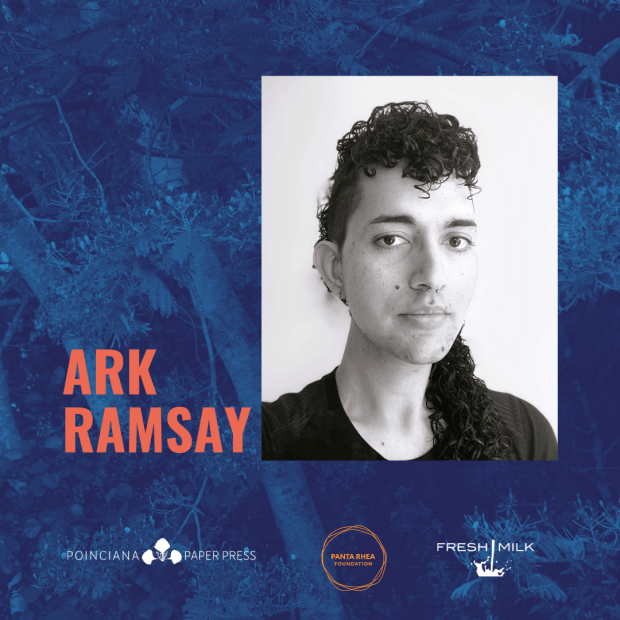
 

Ark Ramsay (Bridgetown, 1994), is a non-binary writer based in Barbados. Their work has appeared in or is forthcoming from The A-Line: Journal of Progressive Thought, Small Axe, Gertrude Press, Meridian, Adda, The Rumpus, Passages North, and The Gulf Coast. They have been a finalist for the Inaugural Story Foundation Prize through Story Magazine, an honorable mention in Ninth Letter’s 2021 Literary Award for Nonfiction, and shortlisted for the 2024 Commonwealth Short Story Award. They have received an MFA from The Ohio State University.


Puerto Rican-based Jocmarys Viruet Feliciano, a visual artist from Puerto Rico focuses on hand papermaking and book arts. She holds a bachelor’s degree in Fine Arts from the University of Puerto Rico, Mayagüez Campus and a master’s degree from the University of Iowa, Center of the Book. Jocmarys worked as an intern at the Morgan Conservatory in Cleveland, Ohio and has been an assistant at the Rare Book School at the University of Virginia. Her first experience with handmade paper was in 2014 as an exchange student in South Korea. Jocmarys has taught several bookbinding and handmade paper workshops in Puerto Rico and in the United States. Her artist’s books are part of special collections such as University of Miami, University of Iowa, Yale University, University of Pennsylvania and Stanford University. 


Together, Ark and Joko while based in Nassau will explore some of the family islands of this 700-coral island archipelago, meet with contemporary visual artists and writers, ecologists, and environmentalists to understand the ecological reality of the Lucayan Archipelago that sits within the Atlatnic Ocean. We can hardly wait to see what emerges from this collaboration!


About Fresh Milk:

Fresh Milk is an artist-led, non-profit organisation founded in 2011 and based in Barbados. It is a platform which supports excellence in the visual arts through residencies and programmes that provide Caribbean artists with opportunities for development, fostering a thriving art community. Fresh Milk offers professional support to artists from the Caribbean and further afield and seeks to stimulate critical thinking in contemporary visual art. Its goal is to nurture artists, raise regional awareness about contemporary arts and provide Caribbean artists with opportunities for growth, excellence and success.

About Poinciana Paper Press:

Located in the capital of the archipelagic nation of The Bahamas, Poinciana Paper Press provides opportunities to engage with books and their allied crafts to empower people to share their narratives in a region that has historically erased, marginalized, and exploited the culture and lived experiences of its inhabitants.

Bahamian writer and artist Sonia Farmer created Poinciana Paper Press as an independent book publisher in 2010, releasing handmade limited-edition chapbooks and artists’ books of Caribbean poetry, short stories, and experimental writing. Her vision is to advance the diversity of narratives and publishing modalities in The Caribbean.

In 2022, she established Poinciana Paper Press as the first Center for Writing, Book Arts & Publishing in The Bahamas—arguably, in the wider Caribbean—to expand this vision, developing visibility in the literary and book arts from within the Caribbean cultural ecosystem.

A major collaborator in the literary and visual arts communities in the region, Poinciana Paper Press facilitates programming aligned with its mission by providing opportunities to engage with the form of the book and its allied crafts of writing, bookbinding, letterpress printing, handmade paper, printmaking, book design, and calligraphy. This includes workshops, community outreach and engagement, exhibitions, publications, and residencies.

About Panta Rhea Foundation:

Mission: To catalyze a just and sustainable world through food sovereignty, community power building, and grassroots liberation around the globe.

The Panta Rhea Foundation (PRF) was established in 2001 as a private foundation devoted to researching issues and analyzing the operations, goals and potential of organizations committed to building a more just and sustainable world. The Foundation advises individual donors and other charitable entities on grantmaking strategies and specific grants.

We believe that lasting, authentic change must come from the grassroots; from the organized efforts of people and organizations to enliven the social imagination and envision a better future, to experiment with new ideas, and to hold elected leaders and corporations accountable to the communities they serve.

Our foundation name, Panta Rhea, is inspired by Ancient Greek philosopher Heraclitus. It roughly translates to “You never step into the same river twice” or “All things change, all things flow”—suggesting both inherent constancy and change as a fundamental of life itself. 
Caribbean Linked VI – Live Conversation II

The regional residency Caribbean Linked VI, co-managed by Ateliers ’89 (Aruba), The Fresh Milk Art Platform (Barbados) and ARC Magazine is conducting all of its programming and support virtually this year, with live public conversations between the artists taking place on Wednesday, August 11th and Tuesday, August 31st. As usual, the residency’s programming supports creatives across the French, Spanish, English and Dutch speaking Caribbean.

The second conversation will feature  Claudio Arnell (Saint Martin), Romelinda Maldonado (Aruba), John Reno Jackson (Cayman Islands), Samuel Sarmiento (Aruba/Venezuela) and Béliza Troupé (Guadeloupe)..

Watch the conversation on live on YouTube on August 31st from 4:00 pm – 5:00 pm AST at the link above!

For more information, please visit the Caribbean Linked website.

Caribbean Linked VI – Live Conversation I

The regional residency Caribbean Linked VI, co-managed by Ateliers ’89 (Aruba), The Fresh Milk Art Platform (Barbados) and ARC Magazine is conducting all of its programming and support virtually this year, with live public conversations between the artists taking place on Wednesday, August 11th and Tuesday, August 31st. As usual, the residency’s programming supports creatives across the French, Spanish, English and Dutch speaking Caribbean.

The first conversation will feature  Taisha Carrington (Barbados), Akley Olton (St. Vincent and the Grenadines), Susana Pilar (Cuba), and Sarabel Santos-Negrón (Puerto Rico).

Watch the conversation on live on YouTube on August 11th from 4:00 pm – 5:00 pm AST/EST at the link above!

For more information, please visit the Caribbean Linked website.

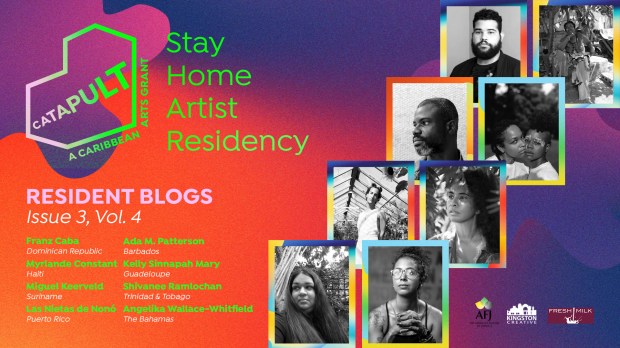
CATAPULT Stay Home Artist Residency Blogs – Issue 3, Vol. 3 & 4

The CATAPULT Stay Home Artist Residency (SHAR) provides opportunities for 24 cultural practitioners from the English, French, Spanish and Dutch speaking Caribbean to be supported while safely remaining in their studios/work-spaces, each of whom will receive a $3,000 USD stipend to produce work over a two-month period.

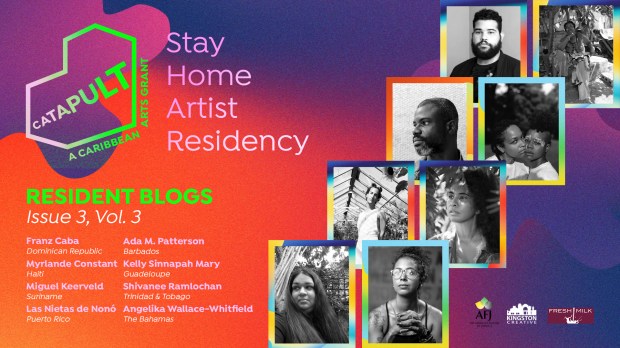
We are pleased to share Issue #3, Volume 3 and Volume 4 of the blog posts produced by participating residents, documenting their experiences and processes during their residency. Issue #3 follows the journey of the third group of SHAR awardees: Franz Caba (Dominican Republic), Myrlande Constant (Haiti), Miguel Keerveld (Suriname),  Las Nietas de Nonó (Puerto Rico), Ada M. Patterson (Barbados), Kelly Sinnapah Mary (Guadeloupe), Shivanee Ramlochan (Trinidad & Tobago) and Angelika Wallace-Whitfield (The Bahamas).

Click on the images below to read these sets of resident blogs as e-zines!


Issue 3, Vol. 3

Issue 3, Vol. 4


ABOUT CATAPULT:

CATAPULT | A Caribbean Arts Grant is a COVID-19 relief programme conceptualised by Kingston Creative (Jamaica) and Fresh Milk (Barbados) and funded by the American Friends of Jamaica | The AFJ (USA). Designed as a capacity building initiative it will directly provide financial support to over 1,000 Caribbean artists, cultural practitioners and creative entrepreneurs impacted by the pandemic and working in the themes of culture, human rights, gender, LGBTQIA+, and climate justice.


ABOUT THE PARTNERS:

American Friends of Jamaica | The AFJ has a near 40 year history of funding charitable organizations in Jamaica in the fields of Education, Healthcare and Economic Development. A registered 501 c 3 nonprofit headquartered in New York City, AFJ relies on individual and corporate contributions made by donors who believe in our work and will advocate on our behalf. Part of the AFJ’s mission is to facilitate donor directed contributions which enables donors to support registered charitable organizations aligned with their own goals for philanthropy.


Kingston Creative is a registered non-profit organization founded in February 2017. Its mission is to enable creatives to succeed so that they can create economic and social value, gain access to global markets and have a positive impact on their community.


Fresh Milk is an organisation whose aim is to nurture, empower and connect Caribbean artists, raise regional awareness about contemporary arts and provide global opportunities for growth, excellence and success. Fresh Milk supports excellence in the visual arts through residencies and programmes that provide Caribbean artists with opportunities for development and foster a thriving art community.

Matilde dos Santos writes on CATAPULT Awardee Réginald Sénatus for Madinin’Art

Martinique based historian, art critic and independent curator Matilde dos Santos, who was one of the guest curators/mentors selected to conduct studio visits with 6 of the 24 CATAPULT Stay Home Artist Residency participants, has generously offered to write features on each of the artists she engaged with during the programme. The second piece focuses on the practice of Haitian artist Réginald Sénatus!

Read the article, originally published in French on Madinin’Art: Critiques Culturelle de Martinique (November 29, 2020), in English below!


Last August, Fresh Milk, Kingston Creative and The American Friends of Jamaica, conceived and launched the program CATAPULT | A Caribbean Arts Grant; a set of six initiatives designed to support Caribbean creatives confronted with the COVID-19 pandemic. I had the honour of being invited by Fresh Milk to visit the artists’ studios as part of the “Stay Home Artist Residency.” Among the 24 candidates selected by the CATAPULT jury, I was able to virtually meet 6 young and talented artists from Aruba, Barbados, Haiti, Jamaica and Martinique. I wanted to share these moments of discovery with you. Here is the second episode in this series of studio visits.

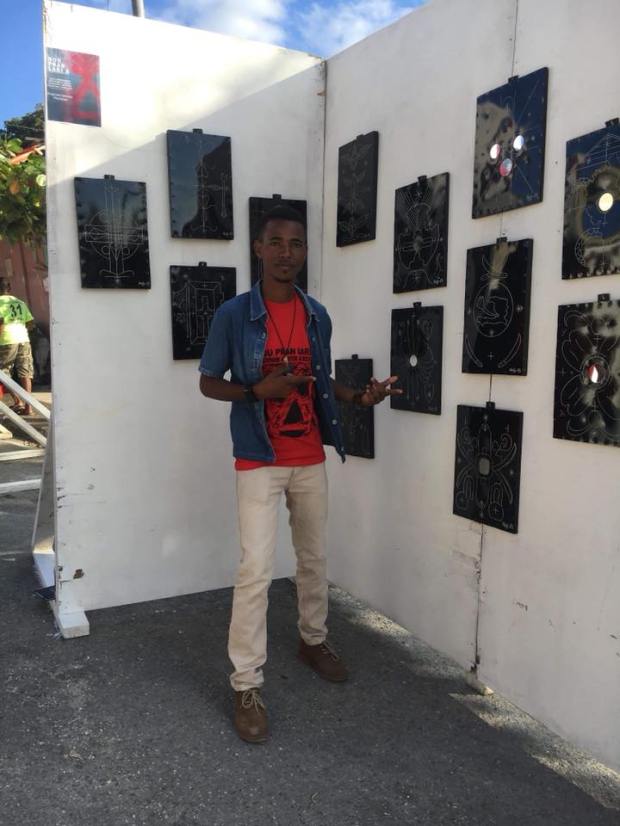
Réginald Sénatus was born in 1994 in Port au Prince, where he lives and works. Having grown up around artists’ workshops on the Grande Rue, and inspired by artists like Celeur and Casseus, he participated since 2010 in the Collective Atis Rezistans, comprised essentially of sculptors working with recovery materials. As of 2017, he is a founding member of Nou pran lari a, an artistic and social movement that invests urban space to exhibit artists outside of traditional spaces. Hanging out on the Grande Rue, he became exposed to practices where the border between crafts and art is vague, or even non-existent, as it is becoming more and more common in the world of contemporary art. Self-taught at the outset, he trained at the Art Centre by participating in workshops on engraving, sculpture, painting, ceramics… with artists such as Pasko, Mario Benjamin, Sébastien Jean, Patrick Villaire, Simil, Tessa Mars, Mafalda Mondestin and Pascale Faublas, among others. He also had the opportunity to collaborate with other artists such as Gina Cunningham in 2017 and Ernest Pignon-Ernest in 2019. Very active, he participated in various artistic events including several editions of the Ghetto Biennale in Port-au-Prince, receiving the 3rd  prize in 2015 and the 1st prize in 2017 and 2019. In January 2020, in a kind of national consecration, he exhibits at The Musée du Panthéon National Haïtien (MUPANAH).

Reginald Sénatus, Nou pran la ria

Réginald studied law, and that may be why his work reflects a constant concern for societal issues, namely social and environmental injustices. His work focusses on the country and its capital, adopting a benevolent but not complacent look at the ills of the city, revealing a particular interest in both the exclusions and the affirmation of life.

Technically his works from the Ghetto biennials of 2017 and 2019 and Mansuétude, which he produced in the SHAR-CATAPULT programme this year,  all belong to the same series. All three of them are composed of raw and smooth plywood, forming a surface on which the artist assembles pieces of square or rectangular wood, to serve as a support for a rubber plate, which is then engraved, painted, and inked. Up until 2017 Réginald used recycled rubber tires, which he cut into plates; since 2018 he uses rubber plates, that generally serve in Haiti to make shoe soles. He works with them like any other engraving material, such as linoleum blocks. First he draws on the plate and then digs out the patterns. Afterwards, he inks the hollows with acrylic auto paint.  The 2017 piece was painted white, while carefully avoiding the hollows, which remained naturally black. Other works, once ready, are rubbed with a fabric soaked in solvent to obtain a shiny finish. The plates do not constitute a step in an engraving process; they will not serve to print, but provide the support for cutting and painting, as a canvas. For a long time, he used a razor to dig out his motifs, but since 2018 he uses gouges. Once the plate is engraved and painted, he may add mirrors, plastic bottles, any kind of objects. A practice of recuperation, reuse and upcycling. A very contemporary painting practice through its use of non-traditional materials and supports, but also a practice that shares a great intimacy with popular art and Art brut. And if we want to refer to established movements in the history of art, we could relate his work to the Nouveau realisme or the Arte povera, for the use he makes of poor materials and recovered objects.

In 2017, he devoted six months to the creation of  Nan Benyen Potoprens Pa gen kache lonbrik,  literally, “when Port-au-Prince bathes, she does not hide her navel,” which reveals the city “without lying and without reserve” according to his words. The installation is an imagined cartography of the city, drawn with small wooden briquettes, each surmounted by a rubber plate, engraved and painted, often with religious symbols that the artist uses to represent historical and contemporary aspects of the city. The installation was interactive in a way, since the public was invited to invest one side of the work to record its thoughts, on the city, its problems, its hopes… A work that I see in pieces in the dim light of the studio, and that renders it all so beautiful in the photos.

In 2019, working on the theme of the Ghetto biennial “The Haitian Revolution and Beyond,”  Réginald chose to portray the Battle of Vertières, the last battle against slavery and colonization in Haiti. The work Murs et portes de Vertières is accompanied by a text that reveals the artist’s intention. At Vertières, he says, two men born as slaves, Jean Jacques Dessalines and Capois-La-Mort, defied the world order. Their victory led to the creation of the first black republic in the world. If Réginald has shown an interest in walls and doors, it is because these are ambivalent objects that can give passage or on the contrary, restrict access, to both good and evil.   Insurmountable, they protect or exclude. Crossed over, they can open up on dreams or nightmares.  In this work, we notice that the artist abandoned religious symbols for those of his own making. He also added mirrors and gave the work a finish so lustrous that the black surfaces shine like mirrors.

Mansuétude, the work produced in residence, bears the mark of the pandemic. He created it as a kind of exorcism: talking about the virus to keep it at bay, to cast out fear as well. Here, the artist approaches figuration, with more elaborate drawings, almost characters, depicting masked women. All the young artists I met at the SHAR residency told me how much they felt the impact of the pandemic; living most often in precarious situations even before confinement, they then suffered cancellations or postponements of projects, loss of income and above all, for Réginald, loneliness and alienation. The CATAPULT grant offered Réginald the possibility to focus on a project: the piece Mansuétude made entirely while in residence, yet another assemblage of rubber plates mounted on wood, engraved and inked. On almost all of the plates, a spiral or circle, that of the virus itself, that of the circle of humans.

On two smaller plates, there are plastic bottles and cutlery; on another, the symbol of the US dollar; in the end, comprising a whole series of recurrent concerns in the time of pandemic. The artist experiences the crisis as indicative of the fragilities and weaknesses of our societies on a global scale, affecting first of all the most vulnerable: the elders. He thinks that only mutual aid can overcome these fragilities, hence the figures of masked women discussing in a circle. In Haiti, as in Martinique, a woman is a poto mitan, fanm doubout, pillar of the family. Similarly, it is through them that we begin to heal the world. I find the plates very beautiful, taken individually;  but I can’t say why their assembly on the wooden support leaves me dubious, as if the installation was not yet finished.

The visit to Réginald’s studio was disrupted by technical glitches. One could not hear, the other could hardly see. He showed me around his studio with his phone, which was not ideal for visibility, especially since the workshop was rather dark. I wanted to see better what I was guessing in the dark. So we continued to talk the following days, via WhatsApp. Réginald also sent me photos and texts. I discovered a committed artist, socially engaged and concerned about the current state of his country. Proud of his story. Eager to meet people and learn from them. Undeniably gifted with his hands. An artist who seizes every opportunity to learn and enrich his practice; an artist focused on sharing, who intends to pass on the fruits of his experience in residency to his fellow artists in Haiti. A young artist to follow, no doubt.

– Matilde dos Santos – Historian, art critic and independent curator

Appreciation to the partners of the CATAPULT programme: The American Friends of Jamaica, Kingston Creative and Fresh Milk.

The SHAR participants described their experiences in blogs that you can read on the Fresh Milk platform here.