Tilting Axis: Within and Beyond the Caribbean – Shifting Models of Sustainability and Connectivity

The two-day conference ‘Tilting Axis: Within and Beyond the Caribbean – Shifting Models of Sustainability and Connectivity’ will be held at The Fresh Milk Art Platform, Barbados on February 27-28, 2015. This meeting aims to promote greater conversations and engagement between artists and professionals working within artist-led initiatives across the wider Caribbean region, build and redefine historical relationships with those in the North, and establish open dialogue with active networks emerging in the Global South.

Organized by Fresh Milk, ARC Inc., Res Artis and Pérez Art Museum Miami, Tilting Axis sees the founders/directors of several of the region’s artist-led initiatives coming together to engage in face to face conversations, along with a number of professionals from outside the region interested in working with Caribbean based initiatives.

The objectives of the two-day engagement are to:

● Create opportunities for more integration, awareness, and collaborations to take place across the Caribbean and between international foundations, cultural organizations, and practitioners;
● Enable local, regional, and international artist networks to reflect on lessons learned and share best practices, methodologies, and ideas;
● Develop an action plan for continued collaboration and for moving the Caribbean out of a peripheral position in the global art conversation.

Directing Organizations: ARC Inc., and Fresh Milk Art Platform Inc.
Associate Partners: Res Artis and Pérez Art Museum Miami
Supporting Partners: Arts and Sport Promotion Fund Committee (Barbados), the Davidoff Art Initiative, the British Council and the Prince Claus Fund.

Participants:

Annalee Davis – Founder/Director, The Fresh Milk Art Platform Inc. (Barbados)
Holly Bynoe – Co-founder/Director, ARC Inc. (St. Vincent & the Grenadines)
Mario Caro – President, Res Artis (The Netherlands)
Tobias Ostrander – Chief Curator, Pérez Art Museum Miami (USA)
Solange Farkas – Director, Videobrasil (Brazil)
N’Goné Fall – Co-founder/Director, GawLab (Senegal)
Katherine Kennedy – Assistant to Directors, The Fresh Milk Art Platform Inc. & ARC Inc. (Barbados)
Versia Harris – Visual Artist/Volunteer, The Fresh Milk Art Platform Inc. (Barbados)
Sammy Davis – Videographer/Volunteer, The Fresh Milk Art Platform Inc. (Barbados)
Deborah Anzinger – Executive Director, New Local Space -NLS (Jamaica)
Malaika Brooks-Smith-Lowe – Co-founder/Director, Groundation Grenada (Grenada)
Caryl Ivrisse-Crochemar – Director, 14Nº61ºW (Martinique)
Nicholas Laughlin – Co-founder, Alice Yard (Trinidad & Tobago)
Marsha Pearce – Senior Editor, ARC Inc. (Trinidad & Tobago)
Amanda Coulson – Director, The National Art Gallery of the Bahamas (The Bahamas)
David Bade – Co-founder, Instituto Buena Bista – IBB (Curaçao)
Tirzo Martha – Co-founder, Instituto Buena Bista – IBB (Curaçao)
Elvis Lopez – Director, Ateliers ‘89 (Aruba)
Natalie Urquhart – Director, The National Gallery of the Cayman Islands (Cayman Islands)
Raquel Paiewonsky – Artist and Co-Founder, Quintapata (Dominican Republic)
Kira Simon-Kennedy – Program Manager/Co-founder, China Residencies (New York City)
Maria Elena Ortiz – Associate Curator, Pérez Art Museum Miami (USA)
David Codling – Director Arts, Americas, British Council (Colombia)
Remco de Blaaij – Curator, Centre for Contemporary Arts (Scotland)
Jessica Carden – Curator, Mother Tongue (United Kingdom)
Max Slaven – Co-Director, David Dale Gallery, Glasgow (Scotland)
Ellie Royle – Co-Director, David Dale Gallery, Glasgow (Scotland)
Janice Whittle – Curator, The National Cultural Foundation (Barbados)
Joscelyn Gardner – Visual Artist (Barbados)
Therese Hadchity – Art Historian (Barbados)
Llanor Alleyne – Visual artist (Barbados)
Tonika Sealy – Independent Cultural Producer (Barbados)

Image credit: Mark King, Untitled Grid Fields, paint on concrete, 2015. Photo by Llanor Alleyne

Mother Tongue’s Residency – Week 3 Blog Post

Mother Tongue, the curatorial duo of Jessica Carden and Tiffany Boyle, share their third blog post about their ongoing Fresh Milk residency. As well as continuing to meet with artists, collectors and academics based in Barbados, they also made two presentations to the students in the BFA degree programme at the Barbados Community College, screening their 2012 programme ‘Afrofuturism: Revisions Towards a Place in Modernity’ and expanding on their work as curators. Read the full post below: 

photo(12)

As the third week of our residency here with Fresh Milk draws to a close – and with only a little over a week left to go – we are continuing  to make the most of our time here in Barbados, whilst also beginning to formulate ideas for the return UK project. As with last week, we have primarily been focusing on meeting with artists, writers, curators and academics, in order to further understand the arts infrastructure on the island and how this is affecting practitioners across the board. We have had many productive and engaging conversations about the shape our modest return project may take – both internally and externally – and we’re very focused on producing something that can be meaningful for Barbados and the UK.

photo 1

Our third week began with the first of two presentations made by us to the BFA Degree programme students at Barbados Community College. Our afternoon session for the first, second and third year students was a talk and re-screening of our 2012 programme, ‘Afrofuturism: Revisions Towards a Place in Modernity,’ which was originally developed for the Africa In Motion Film Festival 2012. The programme included five works in total by Neïl Beloufa, Philip Mallory Jones, The Otolith Group, Rico Gatson and the Glasgow-based artist Michelle Hannah. Then on Thursday morning, we made a presentation to the third year students speaking with them on the history of curating and exhibition-making, and an introduction to our practice. The students do not have a curating module here, but the dialogue following our presentation was really impressive. We have found the various discussions with students at the college really helpful for our outlook on contemporary art here in Barbados, especially for understanding the conditions under which emergent artists are producing. Whilst at BCC, we took the opportunity to sit in on art historian and curator Therese Hadchity’s seminar on ‘Caribbean Art,’ which explored modern and contemporary Caribbean art with a focus on post-independence practitioners in Trinidad, Jamaica and Barbados. After the lecture we had the opportunity to briefly discuss Therese’s role as the founder and director of the former Zemicon gallery, which formed a central role in supporting the work of Barbadian artists throughout the 90’s.

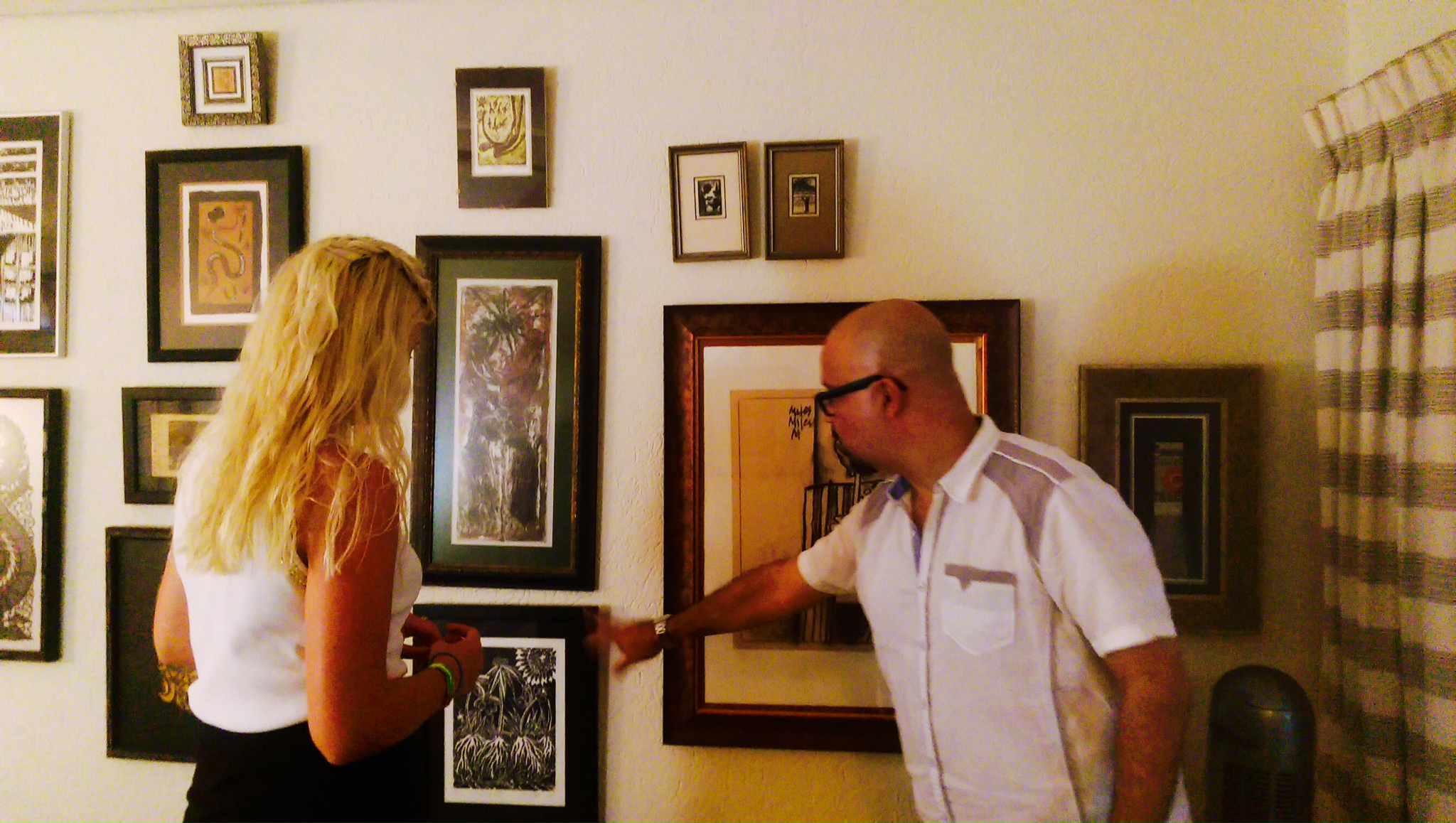
Continuing to gather information about the arts in Barbados, particularly during the 90’s and early 2000’s we met with art historian Alison Thompson who talked us through her regional and international work and upcoming projects. We were also fortunate enough to meet with the established artist Alison Chapman Andrews, who allowed us full access to her wonderfully active studio and large archive of sketchbooks and prints dating back to the 1970’s. Alison wrote a long-running column on art for local press, and flicking through her – very well arranged – collection of these, gives a real sense of a vibrancy in the local art scene during the 80s and 90s. Alison’s house is also something of a gallery in itself: with paintings, drawings and sculptures adorning every wall from the various artists she has known and admired over her long a career as an artist. We also took a visit to meet Clyde Cave, a renowned art collector, whose house is also arranged around, and in tribute to, his fascinating collection of Caribbean contemporary art.

Touring Clyde Cave's collection

After a discussion with Fresh Milk’s Director Annalee Davis surrounding our interest in the art networks between the Caribbean islands, she made an informal presentation to us on Fresh Milk’s ‘Caribbean Art Spaces’ online mapping project, which maps-out the variety of art spaces and artist-led initiatives across the Caribbean from Jamaica to Trinidad to Guyana, the Dominican Republic, to Martinique. It’s a fantastic resource and really important in crossing the many language barriers between the islands and mainland. Over these past three weeks, our many conversations with Annalee have been some of the most insightful and constructive dialogues, as we attempt to come to an understanding of the arts infrastructure here.

photo 5

Finally, we met for a second time with Professor Sean Carrington, this time at the University of the West Indies Biology department where he lectures, to be given a tour of the herbarium. Sean opened up their vast archives, talking us through the many specimens that have been collected from all over the Caribbean for hundreds of years. The visit helped push along our thinking around the colonial elements of horticulture, flora and fauna, and its significance in the work of Caribbean artists. We’re working hard to fit in as much in our fourth week as possible – we look forward to reporting back!

Fresh Stops: Simone Padmore’s ‘Protector’ kicks off 2015

SAM_1577

Fresh Milk and Adopt A Stop continue the Fresh Stops collaborative project, beginning 2015 with a piece by Simone Padmore titled ‘Protector’. In an attempt to bring art into the public space, six artists were commissioned to produce original artwork for benches that will appear at varied locations around the island.

The other participating artists include Evan Avery, Matthew Clarke, Versia Harris, Mark  King and Ronald Williams. This project creates visibility for the work of emerging creatives, allowing the public to encounter and interact with their pieces in everyday life, generating interest and inviting dialogue  about their practices.

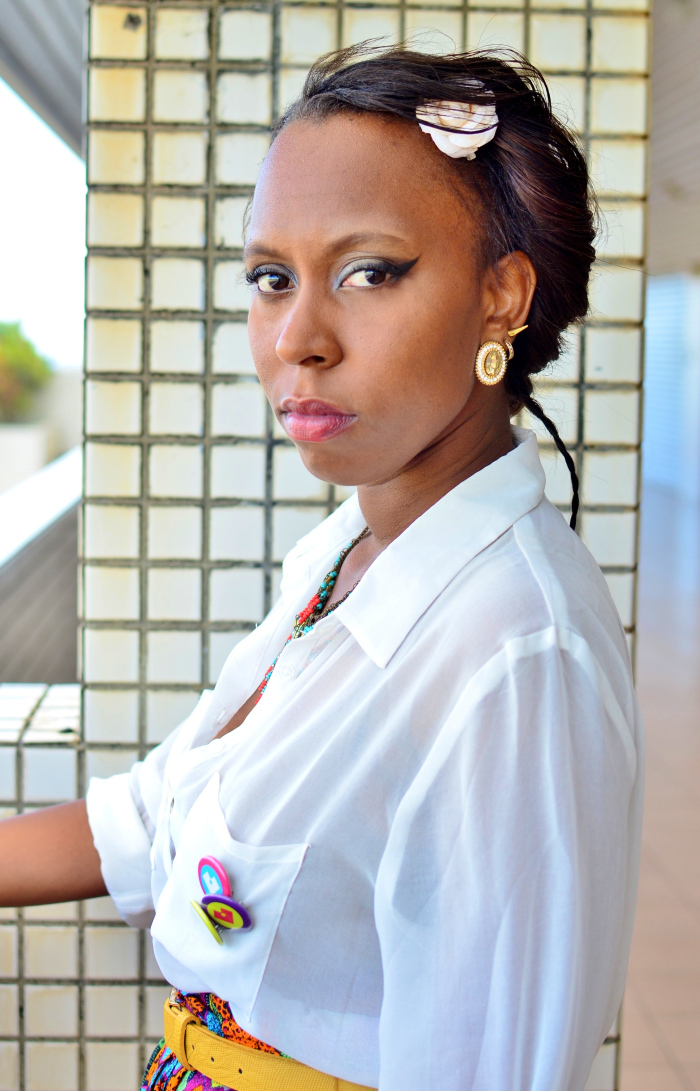
‘Protector’ by Simone Padmore has now been installed at Hunte’s Gardens, St. Joseph . Thank you to Adopt A Stop for partnering with us to produce this beautiful bench, and to Hunte’s Gardens for agreeing to host it!

Artist Statement for Protector:

I originally wanted to work along the theme of Organic versus Geometric. During the process I repeatedly listened to a song by the name of ‘Iulius‘ by Justin Nozuka. It inspired me to create a deity or nymph for the bench and its surroundings. The song’s trance caused my work to turn out dominantly organic.

About Simone Padmore:

Simone Padmore, also known as Simone Asia, is an illustrator who was born on May 2nd, 1990 in Bridgetown, Barbados. Since the age of four she has been very interested in art, particularly the drawing of human figures. From 2006-2011, Simone attended the Barbados Community College (BCC) where she received her Associate’s Degree in Visual Arts and her Bachelor’s of Fine Art. Attending BCC exposed Simone to many different art forms, techniques and experimentation. As the days went by, she developed a stronger sensibility for drawing and a love for pen and ink, which today is her desired media of choice.

After college, Simone continued her independent practice and has exhibited in art shows and fund-raising events. Simone won an incentive award at NIFCA in 2011. She also was featured in magazines such as ARC Magazine, FuriaMag and Caribbean Beat, along with a few online fanzines.

Simone has done three residencies so far – Fresh Milk (Barbados) in 2012 and Projects & Space (Barbados) and Alice Yard (Trinidad) in 2014, all of which have contributed to the further development of her work.

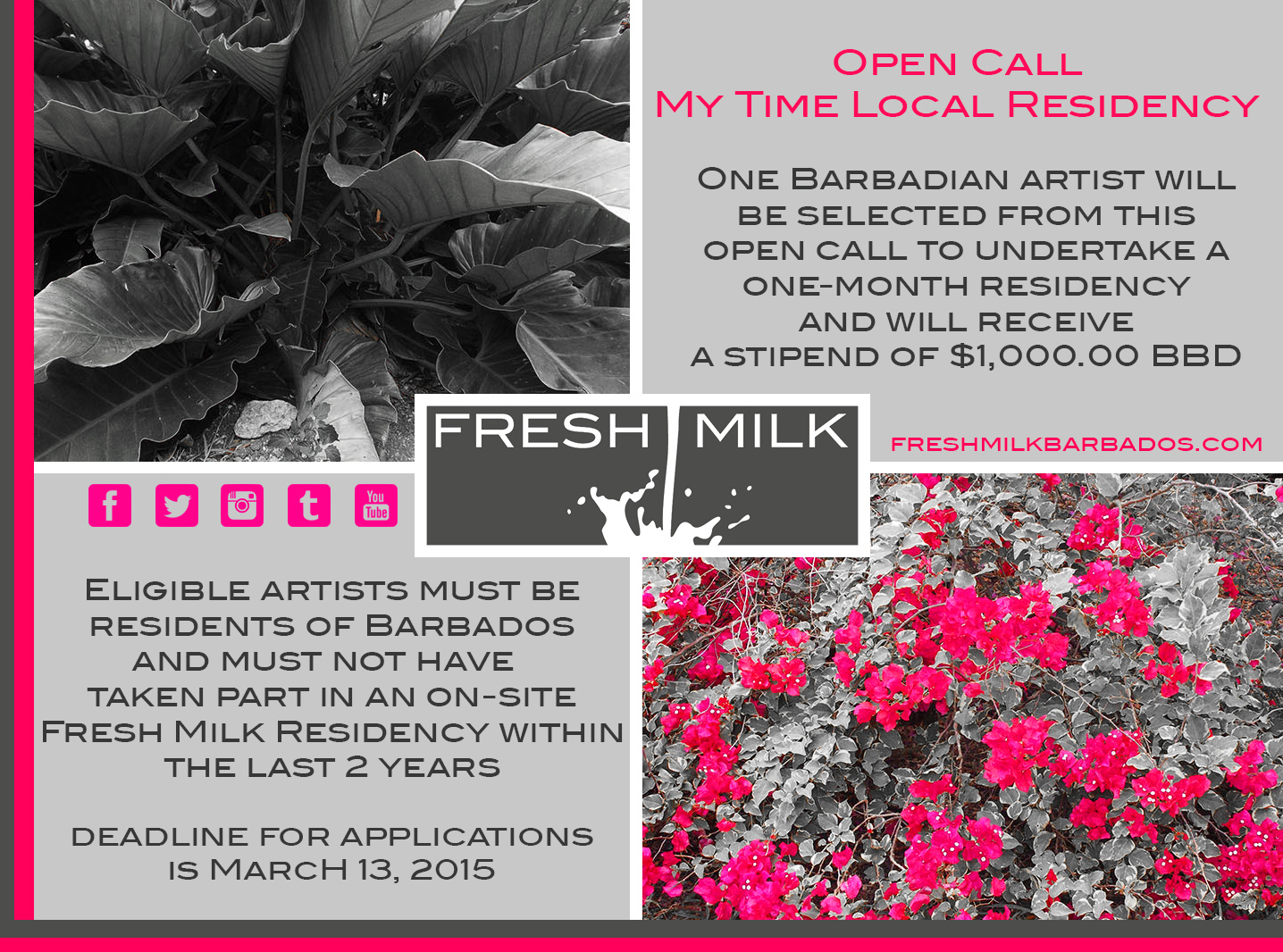
Open Call: FRESH MILK ‘My Time’ Local Residency 2015

FM My Time Residency 2015 Final

Following last year’s local residency programme, which was awarded to Barbadian artist Cherise Ward, Fresh Milk is pleased to announce that we have again received generous support to host the second edition of the ‘My Time’ Local Residency for 2015.

One Barbadian artist will be selected from this open call to undertake a one-month residency, and will receive a stipend of $1,000.00 BBD towards their production costs. Visual artists working in a variety of disciplines (sculpture, installation, painting, drawing, performance, photography, new media, interdisciplinary) are invited to apply.

Duration of Residency:  4 weeks

FRESH MILK will provide:

– A $1,000.00 BBD stipend to the artist
– Wireless internet
– A 15.5 x 14 ft studio space
– A wide expanse of rural land
– Access to the Colleen Lewis Reading Room on site
– A varied network of creatives to connect with
– The option to participate in a public event showcasing the outcome of the residency

Eligibility criteria:

–  Artist must be a resident of Barbados
–  Artist must not have taken part in an on-site Fresh Milk Residency within the last 2 years

Expectations of the Artist:

–  Artist must come out to the studio a minimum of four days per week between Monday and Friday. Studio access is between 7 am and 6 pm.
–  Artist must supply their own materials and equipment
–  Artist must complete some form of public outreach in relation to the work created during the residency (artist talk/presentation, workshop, exhibition, etc.)
–  Artist will be required to keep a weekly blog of their activities and processes, and submit a report to Fresh Milk at the conclusion of the residency
–  Artist will be required to donate a piece of work to the donor who made this residency possible

Application Process:

To be considered, please submit the following to freshmilkbarbados@gmail.com with the subject line ‘My Time Local Residency 2015 Proposal’:

–   The completed application form which can be downloaded here (includes applicant’s contact information, an artist statement, and full residency proposal)
–  An up to date Curriculum Vitae (CV)
–  A numbered portfolio of 5-10 images (or 2-3 short videos as the case may be) of recent work
–  An index of the portfolio pieces in numerical order, with the title, medium and date listed

Incomplete applications will not be considered.

The deadline for submission is March 13th, 2015. Residency dates will be negotiated with the artist after they have been selected, and may commence as soon as March 23rd. The residency must be completed by June 12th, 2015.

Mother Tongue’s Residency – Week 2 Blog Post

Mother Tongue, the curatorial duo of Jessica Carden and Tiffany Boyle, share a blog post about their second week at Fresh Milk, which kept them busy with a number of meetings and visits. These sessions were not only with artists, but also focused on the island’s history, geography and social environment; topics that feed into a number of the art practices they have encountered so far, and contribute to Mother Tongue’s overall understanding of the space. Read their report below: 

photo(7)

Whilst our first week in Barbados took the form of an introduction to Fresh Milk, the reading room collection and the studio space, our second week has been a flurry of meetings, studio visits and trips around the island to meet with various individuals, museums and organisations. It has been a week of connecting with a whole host of people who are instrumental to the arts scene here on the island – both in the past and in the present – with established and emergent practitioners. We have also consciously widened our scope to look at the rich histories outside of the arts, but which have been preoccupying local artists, such as the sugar industry, tourism and the colonial role in the horticulture of the island.

photo(5)

On Monday we met with the Barbadian artist Alberta Whittle, who we were originally introduced to in Glasgow whilst she was studying at Glasgow School of Art. Alberta gave us a tour of the National Museum of Barbados, and provided a brilliant insight into her position as a Barbadian artist who has become established outside of the island but returns regularly to make work here as an invested member of the arts community. Alberta also introduced us to our very first Caribbean snow cone, which consists of crushed ice, sugar syrup and condensed milk; perfect for a Scottish sweet tooth! We attended a lecture at the museum which was focused on the evolution of the tourist industry here in Barbados from the early 19th century onwards, and how it has become central for the islands’ economy, which was for such a long time monopolised by sugar cane.

Having become aware of their work through various Caribbean art publications in the Fresh Milk reading room, Director Annalee set-up studio visits with the artists Ewan Atkinson and Mark King. We were really lucky to have caught a sneak preview of Ewan’s exciting new work for the Havana Biennial which he will be taking over later this year. He also gave us some really interesting background information to his recent series ‘The Neighbourhood Report’, which comprises of several fictional characters exploring notions of identity, sexuality and gender representations. In our conversation with artist Mark King, he charted his journey from the US and Holland, and why he has chosen to return to Barbados to make it his base, while he continues to exhibit internationally.

This week we have also been really fortunate to spend some time with the artist Holly Bynoe, who is also the Co-Founder and Director of Caribbean Arts and culture magazine ARC. Throughout her career as an artist, researcher, curator and writer in the Caribbean, Holly has been an invaluable source in providing references and links to artists and projects across the region. We were able to discuss the role ARC magazine has been taking as a platform for many projects – written and beyond – over dinner with Holly and Assistant to the Director Katherine Kennedy, who is also an artist and an integral member of the Fresh Milk team.

On Friday we were introduced to the artist Denyse Menard Greenidge, who founded Dayrells Art Gallery in Barbados in the 70s, and continues to curate the work of Barbadian artists locally and internationally. Talking us through documentation from the 70’s and 80’s, Denyse was able to provide us with an overview of how governmental support for the arts has changed over the years and how this has impacted the current activity on the island. We visited her husband Newlands Greenidge‘s self-founded Springvale Indigenous Folk Museum, which is located in the Scottish district on the east of the island. The museum hosts a collection of artefacts which describe what life would have been like on the island in the early 19th century. Created through a labour of love by Newlands and Denyse, their passion for the island’s history is clear through the wealth of information they provided about the collection and its significance for Barbados.

In our second week, we were also visited in the Fresh Milk studio by Sean Carrington, Professor of Plant Biology at the University of the West Indies, Cave Hill Campus. We had a really stimulating conversation about the importation of species into the island, indigenousness and plant life, and the problems language causes between islands in the region, in terms of classification and keeping track of plant populations. Following our meeting with Sean, we went to meet Dr. Anthony Kennedy, Director of the West Indies Central Sugar Cane Breeding Station. The station is one of the most successful breeding centres in the world, whose work and research helps to develop sugar industries across the Southern Hemisphere. During our visit we were talked through the history of sugar on the island, and how it formed and influenced the way we see not just the agricultural formations but the human geography and architecture of the island too. This history is so significant for any attempt to understand the island, and it’s something that we’re trying to grasp as best as we can during our visit.

We look forward to a busy third week that will include two presentations at Barbados Community College on curating, and a re-screening of our ‘Afrofuturism’ programme, originally developed for the Africa in Motion Film Festival 2012.