The BIAC in collaboration with Caribbean Linked presents “TRANS-SISTORS”

As part of the International Biennial of Contemporary Art (BIAC) in Martinique, supported by the European fund INTERREG Caribbean, the Campus Caraïbéen des Arts (CCA) in partnership with the Collectivité Territoriale de Martinique (CTM), and Ateliers’ 89 in Aruba, the exhibition “TRANS-SISTORS” will run from October 7 to November 6, 2023, at the La Véranda Gallery of the Tropiques Atrium, Scène Nationale in Fort de France, Martinique.
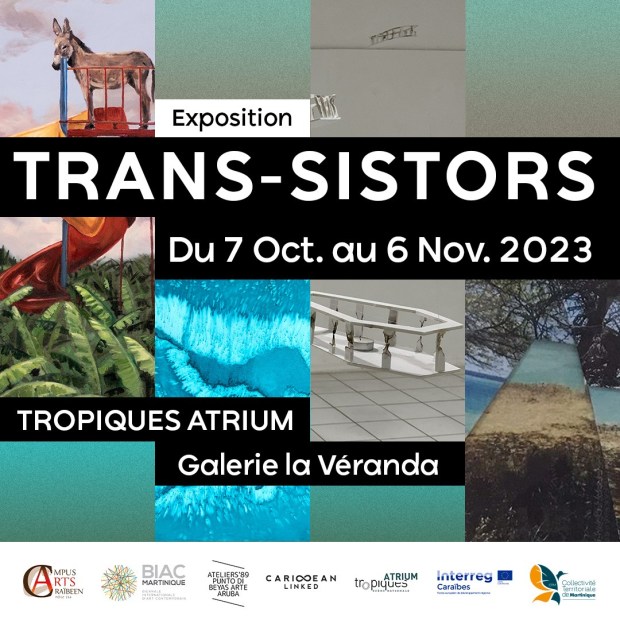

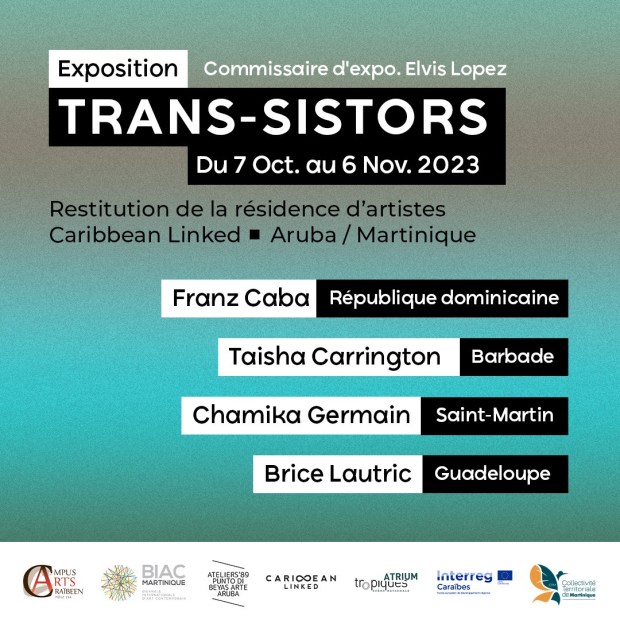
This exhibition is produced under the curatorship of Elvis Lopez, Director of Ateliers ’89 and a visual artist from Aruba. Four young artists from the Caribbean:  Franz Caba (Dominican Republic), Taisha Carrington (Barbados), Chamika Germain (St. Martin) and Brice Lautric (Guadeloupe), will exhibit the work they produced as part of the Caribbean Linked artist residency exchange which took place in Martinique and Aruba between April and September.

Caribbean Linked is a program of artist residencies and exhibitions offering a space to raise awareness of the region’s disparate creative communities by bringing together emerging artists from the English, French, Spanish, and Dutch Caribbean.

This exhibition, held at the Tropiques-Atrium, was born from the desire to show the general public the work made by these artists during their residency. Two of the artists, Germain and Lautric, are CCA graduates. Since the start of 2023 and as part of the BIAC, residency exchanges with international artists, and curatorial training for students in collaboration with Martinique-based institutions are being coordinated by the Campus Caraïbéen Arts. This regional exchange programme will continue through 2024.
TVE 4 Artist Talk & Closing Event

Closing Event – Transoceanic Visual Exchange 2021
Date: February 2nd, 2022
Time: 4:00 – 5:30 PM (CST) / 6:00 – 7:30 PM (AST)

Via Zoom
​​Meeting ID: 885 8020 0966
Passcode: 323839

Moderator: Russell Watson (Barbados, works as an interdisciplinary visual artist, multimedia educator and media professional)

Participating Artists: Kayla Archer (Barbados), Marilyn Boror Bor (Guatemala), Milko Delgado (Panamá), David Gumbs (St. Martin/Martinique), Natalia Lassalle-Morillo (Puerto Rico), Patricia Villalobos (Nicaragua).

The fourth edition of Transoceanic Visual Exchange (TVE) held between November 2021 and February 2022 is a collaboration between The Fresh Milk Art Platform (Barbados) and TEOR/ética (Costa Rica). For this edition of TVE, a selection of recent video artworks produced both in the Central American region and in the insular Caribbean region were brought together through an open call and community-led curatorial model, and presented to the public through a virtual exhibition.

For the closing event of TVE 4, we invite some of the artists participating in this virtual exhibition from across both regions to be in conversation with one another, with the aim of putting their works in dialogue and deepening the understanding of themes and relationships that connect recent audiovisual practices of contemporary artists from Central America and the Caribbean.

Join the Zoom webinar here!

The event will be moderated in English, and will have simultaneous translation into Spanish via Zoom.

Visit the virtual exhibition here, extended until February 2nd!

Transoceanic Visual Exchange 4 Online Exhibition

Fresh Milk (Barbados), in partnership with TEOR/ética (Costa Rica), is proud to present the 2021 edition of Transoceanic Visual Exchange (TVE), an online exhibition showcasing video art, film and new media from across the Caribbean and Central America.

View the full online exhibition on the TVE website here! Show runs until the end of January, 2022.

Excerpt from the TVE 4 Curatorial Essay:

Transoceanic Visual Exchange (TVE) aims to decentralize curatorial authority in the process of the video selection by implementing a community of curatorial practice model. This curatorial framework, originally developed in 2015 for TVE 1, is derived from the concept of “communities of practice,” developed by Lave and Wenger in their 1991 book Situated Learning. The concept speaks to a social theory of learning through “a set of relations among persons, activity, and world, over time, and in relation with other tangential and overlapping communities of practice” (Leave and Wenger, 1991, p. 98). This model invites open discussions with contemporary practitioners regarding the current environment of film, experimental video and new media in the participating regions, allowing for curatorial concepts to arise out of the conversations, rather than the core project team imposing a particular curatorial framework for each iteration.

Curatorial Themes for TVE 4

As a result of these themes arising in the open conversations, the submissions of works from the open call were reviewed by the core partners in relation to their relevance regarding the curatorial concepts. The number of artists and works selected was limited to 10 in each region, dictated by the funding availability for artist stipends.

The core partners TEOR/éTica and Fresh Milk threaded the final selection of the ten works of video art produced in the Central American region with the ten selected works from the Caribbean region. Skirting the vastness of a body of water that separates us but nevertheless connects us, as if they were living currents,the following thematic axes were defined:

Group 1 (Performance, alternate perspectives & relationships to the environment)

  • Linero Ledezma, MORREM (Panama)

  • Raquel Paiewonsky, Isopolis (Dominican Republic)

  • Ada M. Patterson, The Whole World Is Turning (Barbados)

This slideshow requires JavaScript.

Group 2 (Concepts of culture explored through non-linear narratives and gestures)

  • Clémence Lollia Hilaire, The Silt has risen from the ocean floor and overturned everything (Guadeloupe)

  • Leonardo Armando Gonzalez, El oro del tonto (Honduras)

  • Violeta Mora Acosta, Mpaka (Honduras/Costa Rica/Cuba-based)

  • David Gumbs, Rhapsodie Martinique: La Marche de la Liberté (St. Martin/Martinique)

This slideshow requires JavaScript.

Group 3 (Resilience and responses to the pandemic across the regions)

  • Miquel Galofre, Little Moko (Trinidad & Tobago)

  • Momo Magallon, Caída Libre (Panamá)

  • Ever Natán Rodas Santos, Compulsión (Guatemala)

  • Kayla Archer, Playing it by Ear (Barbados)

This slideshow requires JavaScript.

Group 4 (Interpretations of collective and personal histories)

  • Milko W. Delgado, Apuntes conceptuales sobre el extractivismo bananero en Barú (Panamá)

  • Javier Calvo Sandí, Historia Universal (Costa Rica)

  • Melanie Grant, Those who have eyes to see (SVG/Barbados)

  • Natalia Lassalle-Morillo, Retiro (Puerto Rico)

This slideshow requires JavaScript.

Group 5 (The impact of colonial legacies and social unrest)

  • Marilyn Boror Bor, Receta: ¿Cómo blanquear tus apellidos? de la serie Edicto Cambio de Nombre (Guatemala)

  • Claudia Claremi, Amnesia colonial (avenencia) (Cuba)

  • Patricia Villalobos Echeverría, LATITUD 12<>LONGITUD-86, Version 2 (Nicaragua)

  • Miguel Angel Diaz Rizo, Nicaraguan Fighter (Nicaragua)

This slideshow requires JavaScript.

Read the full essay on the TVE website here!


ABOUT THE PARTNERS:

Fresh Milk

Fresh Milk is an artist-led, non-profit organisation founded in 2011 and based in Barbados. It is a platform which supports excellence in the visual arts through residencies and programmes that provide Caribbean artists with opportunities for development, fostering a thriving art community.

Fresh Milk offers professional support to artists from the Caribbean and further afield and seeks to stimulate critical thinking in contemporary visual art. Its goal is to nurture artists, raise regional awareness about contemporary arts and provide Caribbean artists with opportunities for growth, excellence and success.


TEOR/ética

Located in San José, Costa Rica, TEOR/éTica is a private, independent, non-profit, dedicated to the research and promotion of contemporary artistic practices.

Throughout more than two decades, TEOR/éTica has worked as a platform that promotes the research and dissemination of contemporary art, with an emphasis on Central America and the Caribbean. It aims to create spaces for doubt, debate and the generation of critical thought relevant to its context. It does this through exhibitions, publications, talks, workshops, grants, an archive and a specialized library, understanding art as a common space from where to generate study and find other ways of being together that build collective learning.

Caribbean Linked VI 2021 – Closing Event at Ateliers ’89

On Wednesday September 1st, between 4 – 5 pm (AST), there will be a closing event for the virtual edition of Caribbean Linked VI, taking place at Ateliers ’89, Aruba, and broadcasted live by TELE ARUBA!

Click here to access the livestream on TELE ARUBA, Channel 23

The event will also highlight the exhibition P A N, God’s Artist (In Times of Covid), with many of the participating artists (including Caribbean Linked VI residents & Caribbean Linked alumni) present to discuss their work in the show.

About P A N:

P A N, God’s artists (In Times of Covid) or Pan the bread that hasn’t been given to the artists during the hard times of the Covid period. A presentation of expressions by artists on the Island’s Covid management during the pandemic. An open criticism reflects the hard times of God’s artists in times of Covid. 

Watch a Youtube video showcasing the exhibition here

Do not miss the unique opportunity to attend the two events – whether online or on the ground in Aruba – and interact with local Aruban artists!

Caribbean Linked is a regional residency co-managed by  Ateliers ’89 (Aruba), The Fresh Milk Art Platform (Barbados) and ARC Magazine. Huge thanks to the event sponsors, The Government of Aruba, TPEF, TELE ARUBA, Mondriaan Fonds, UNOCA, Prins Bernhard Cultuurfonds, Bank Giro Loterij, VNO, Cine Aruba, SETAR, Rotaract
Aruba, Garage Centraal and Vibartion PR.

Fresh Milk hosts ‘A True & Exact History’ by Sonia Farmer

On Monday, April 30th, 2018 Fresh Milk hosted an exhibition & panel discussion around ‘A True & Exact History‘ – an erasure poem by Bahamian writer & artist Sonia Farmer, using Richard Ligon’s publication A True & Exact History of the Island of Barbadoes (1657) as its source material.

Sonia was in conversation about her work with Ayesha Gibson-Gill, Cultural Officer for Literary Arts at the National Cultural Foundation, and Tara Inniss-Gibbs, Lecturer in the Department of History and Philosophy at The University of the West Indies, Cave Hill Campus.

Thanks as always to our photographer Dondré Trotman for these images!

Artist Statement for A True & Exact History

I consider my writing practice a tool for disrupting and investigating existing narratives, forming a response that is not necessarily preoccupied with making new narratives to replace them, but rather exposing different narratives as a parallel, ultimately calling into question the inherent power structure in the existing narrative (such as historical accounts, folktales, mythologies, canonical books, etc). Experimental process of generation, such as erasure, found text, mistranslation, technological intervention, or other restrictive methods, are especially exciting opportunities to create direct responses to existing narratives by using its own language against itself. The resulting text then becomes the content for my final projects.

The core of my artist book A True & Exact History is an erasure of one of the most formative descriptions of the English Caribbean in the seventeenth Century, Richard Ligon’s 1657 guidebook, “A True and Exact History of Barbadoes.” This project began during March 2016 at a writing residency at Fresh Milk, an art platform in St. George, Barbados, where I encountered Ligon’s book through their Colleen Lewis Reading Room. Using the language, imagery, and thematic drives at the core of this text to disrupt the teleology of colonial Caribbean history, these unbound poetic fragments scattered among a shifting landscape simultaneously re-create and resist narrative as a device of cohesive history, ultimately calling into question what it means to write “a true and exact history” of anything.