Ronald Williams’ Fresh Milk Residency – Week 3.5 Blog Post

Barbadian artist Ronald Williams, the recipient of the 2018 Fresh Milk ‘My Time’ Local Artist Residency, shares his blog post for the three and a half week mark in the studio. This part of the residency was largely focused on production, taking the research and influences of previous weeks to experiment with pattern-making and digital collage. On Tuesday May 22nd, Ronald also led a collage & portrait workshop with a group of Class 4 students at Workmans Primary School as the community outreach component of his residency, where the children looked at African masks for inspiration and got creative and expressive with materials. Read more below:

Week 3 Monday saw me start what I fully intended to be a productive week in solitude. Both Katherine and Daisy were out at the Barbados Museum and the Jewish Synagogue respectively, so I took advantage of my little alone time and was a DJ for a while. Side note: K. O. D. and Without Warning are hard and I’m a lot late to the party but Migos’ two albums are better than I thought they would be. Judge me.

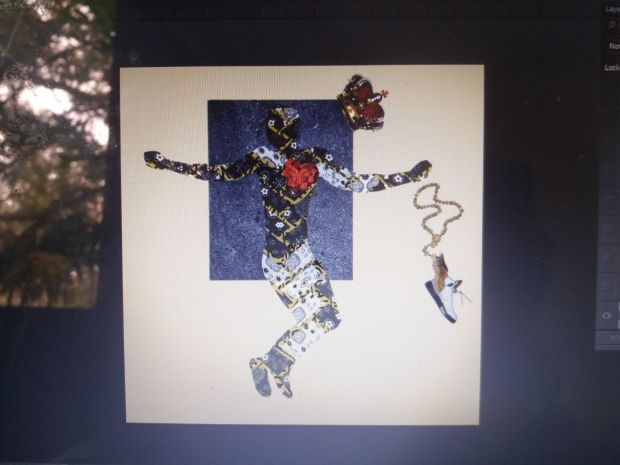
So, first order of real business was to create the pattern I had in mind. The base design is actually the amalgamation of various prints, cut and pasted together in Photoshop and laid on top of a photo of a piece of black fabric. Took much longer than I needed it to. That base image was then flipped, duplicated, pieced together and the process repeated until I got what I wanted. With that, the day was almost up.

I worked on this piece for the rest of the week, getting lost midway, questioning what exactly I was trying to say with the piece and if I could properly translate how I felt without the reading of it going very left. We’ll see.

Week 4 Monday was spent preparing materials for an African mask inspired portraiture collage project that I, along with Katherine and Daisy, would conduct  with the Class 4 students at Workman’s Primary School the next day. This project, which was my community outreach portion of the residency, was my personal highlight of the last week and a half. Daisy, Katherine and I all ended up making one. It was fun.

All things considered, a relatively complicated week and a half where everything didn’t go to plan, but an ultimately satisfying one.

Ronald Williams’ Fresh Milk Residency – Week 2 Blog Post

Barbadian artist Ronald Williams, the recipient of the 2018 Fresh Milk ‘My Time’ Local Artist Residency, shares his second blog post. In addition to catching up on his research using publications in the Colleen Lewis Reading Room, Ronald made site visits to the St. James and St. George Parish Churches as part of his interest in religious iconography and the relationship between spirituality, decadence and materialism. These visits, while awe-inspiring on the one hand, also prompted further thought around the role of organized religion in Barbados’ colonial history. Read more below:

Since week 1 didn’t go exactly as planned, week 2 was spent playing catch up on the research I wanted to do the prior week. In my mind that leaves me square with where I wanted to be at this point when the residency started. In reality, I’m probably quite a ways off the mark, but I won’t realise that until later when I can’t do anything about it. No sweat, right?

The highlight of the week was definitely my field trips to the St. James and St. George Parish churches. I intended to do St. John’s as well but time didn’t permit. Maybe I’ll do that this weekend. Those spaces felt like an alternate reality; the contrast from the draining heat outside to the refreshing chill inside, the various sounds of life outside to the deafening silence of reverence.

There’s something to be said, for me at least, about the energy in the Parish churches when you’re completely alone. There was a pressure I can’t quite describe; I felt small, like who I am was insignificant in the light of those grandiose stained glass renderings. Maybe I am.

I understand the effect those structures are meant to have—and boy do they work—but it’s my knowledge of this that makes it hard for me to ignore the fact that the churches were built in the 1600s, that in their pomp and circumstance are enduring symbols of colonialism and imperialism.

The architecture, which carries specific elements which have endured through every great period of history was also very interesting to me. That led me to do some research on sacred geometry and the symbolism of shapes.

As it is, I believe I’ve got enough pieces to play with so it’s time to make this work. I think this week will be good.

Sacred Practices Reading Group

Join us for a series of sessions facilitated by our current international resident artist Daisy Diamond, applying traditional spiritual reading practices to non-religious, contemporary or critical material focused on arts, culture and Caribbean thought collaboratively selected from Fresh Milk’s Colleen Lewis Reading Room. These collective ways of reading will be used to analyze and have meaningful, open ended conversations about the texts and how they may relate to lived experiences. The first session will be held on Thursday, May 17th, 2018 from 6pm-8pm at Fresh Milk.

RSVP to freshmilkbarbados@gmail.com to confirm your interest! Directions can be found on the ‘About Page’ of our website.

Statement from Daisy about the Reading Group:

Come together in an open-ended conversation where we will select a text to treat as “sacred” by guiding our reading with a series of spiritual reading practices. The texts will not be religious in content. We will just use these traditionally religious tools to analyze, dig deeper, and test our assumptions. The only requirements for this are an open curiosity and a commitment to dialogue within a community.

As an introduction to sacred reading practices, here are two examples which enable a semi-structured study of texts without a teacher/student hierarchy. Havruta is an ancient, Jewish practice where one student within a group poses a question about a text the group is familiar with. The student who asks the question then proposes one potential answer to their own question and explains their reasoning to the group. The group then challenges, opposes, or builds upon the initial response to the question. This platform for conversation builds both nuance and clarity. Lectio Divina is a Catholic practice for studying Scriptures. One person in the group will randomly select a sentence from the text. We will then pause on it and discuss what the word or passage is calling us to do or become. The random selection generates a surprising point to intentionally and thoughtfully build on.

The point of these practices is not to come to one, unified conclusion. Meaning and purpose proliferate in the disagreement, conversation, and unfolding exploration of interpretations and applications. I am not a theologian, but I am a student interested in building upon my understanding of engaging with texts intentionally and passionately within a community. If you have an understanding of tools to study texts, please come and be a part of this opportunity to teach and learn with others!

I’m interested in discussing a text from the Colleen Lewis Reading Room at Fresh Milk related to creative rituals, collective art practices, arts and revolution, or the influence of cultural tradition on contemporary artists. If any of these topics interest you, or if you have another direction you would like to go in, please join me Thursday, May 17th, 2018 to begin to discuss which text we will use and the methods for sacred reading.

_______________

About Daisy Diamond:

Daisy Diamond is a painter, animator, and student originally from Philadelphia who values interdisciplinary and intersectional collaborative exploration. She is currently pursuing a BA in Studio Art from Bates College and spent this past year as a visiting student at Rhode Island School of Design. While she is a resident at the Fresh Milk space, she plans to research the history of Judaism in Barbados and the relationship between ritualistic sacred practices and artistic creation.


Ronald Williams’ Fresh Milk Residency – Week 1 Blog Post

Barbadian artist Ronald Williams, the recipient of the 2018 Fresh Milk ‘My Time’ Local Artist Residency, shares his first blog post. Fresh Milk is by no means foreign territory for Ronald, as he has volunteered with us and participated in a number of our projects in the past, but as this is his first residency within the space, the focus of his work while here has shifted – leaving a familiar platform open for new encounters & experiences. Read more below:

A new old space. That’s how this familiar environment feels. I’m used to the wind chimes, the mahogany pods licking shots on the roof intermittently and the moo-mooing along with the rest of nature, but something‘s different in this country atmosphere. It’s not a sense of purpose, as I’ve always felt that here, nor would I call it pressure; but maybe it’s an accountability/responsibility to get cracking and produce as much as possible in these four weeks. This is perhaps/most definitely driven by the fact that I’ve got a certain goal by the end of the year. More on that later.

My initial plan was to gather as much potential reading material from the Colleen Lewis Reading Room and start doing some research in this space that I’m sharing with the quiet (as far as I can tell) and quite nice international resident artist Daisy Diamond. Given her focus on Judaism in Barbados and my ideas of decadence, materialism, mortality and their relation to religion/spirituality, I think there are interesting things to come.

I must confess to veering from my plan, as Sonia Farmer’s extremely dope work and setup kept calling for my attention. As a result, I put more of my energy into working on a piece I’d laid the foundation for just before the residency started. My time since has been split unevenly between producing and research.

Then Friday came, and with it Amanda Haynes who was setting up for Fresh Milk’s reading room open day. And the critical conversations started, with it the jokes came too, and it was a throwback…no, a Flashback Friday if you will. An old face in an old space where new things are happening.

Fresh Milk hosts ‘A True & Exact History’ by Sonia Farmer

On Monday, April 30th, 2018 Fresh Milk hosted an exhibition & panel discussion around ‘A True & Exact History‘ – an erasure poem by Bahamian writer & artist Sonia Farmer, using Richard Ligon’s publication A True & Exact History of the Island of Barbadoes (1657) as its source material.

Sonia was in conversation about her work with Ayesha Gibson-Gill, Cultural Officer for Literary Arts at the National Cultural Foundation, and Tara Inniss-Gibbs, Lecturer in the Department of History and Philosophy at The University of the West Indies, Cave Hill Campus.

Thanks as always to our photographer Dondré Trotman for these images!

Artist Statement for A True & Exact History

I consider my writing practice a tool for disrupting and investigating existing narratives, forming a response that is not necessarily preoccupied with making new narratives to replace them, but rather exposing different narratives as a parallel, ultimately calling into question the inherent power structure in the existing narrative (such as historical accounts, folktales, mythologies, canonical books, etc). Experimental process of generation, such as erasure, found text, mistranslation, technological intervention, or other restrictive methods, are especially exciting opportunities to create direct responses to existing narratives by using its own language against itself. The resulting text then becomes the content for my final projects.

The core of my artist book A True & Exact History is an erasure of one of the most formative descriptions of the English Caribbean in the seventeenth Century, Richard Ligon’s 1657 guidebook, “A True and Exact History of Barbadoes.” This project began during March 2016 at a writing residency at Fresh Milk, an art platform in St. George, Barbados, where I encountered Ligon’s book through their Colleen Lewis Reading Room. Using the language, imagery, and thematic drives at the core of this text to disrupt the teleology of colonial Caribbean history, these unbound poetic fragments scattered among a shifting landscape simultaneously re-create and resist narrative as a device of cohesive history, ultimately calling into question what it means to write “a true and exact history” of anything.