Ark Ramsay’s Fresh Milk Residency – Week 2 Blog Post

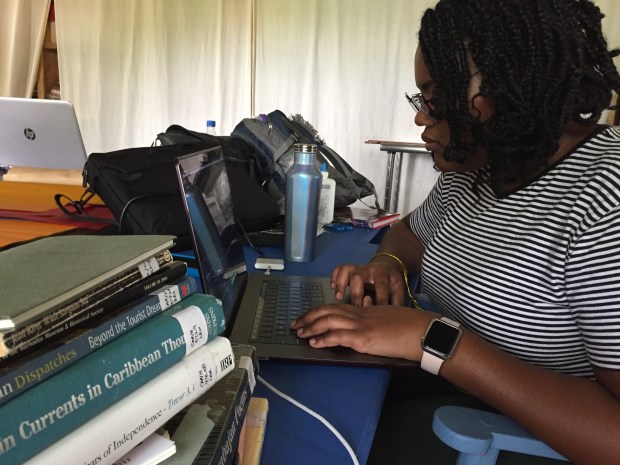
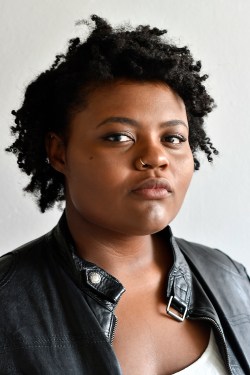
Ark Ramsay shares a blog post about week two of their Fresh Milk ‘My Time’ Local Residency. As last week was about trying back on the title of ‘Barbadian writer’ after time apart, this week Ark began working through what it means to reclaim that, setting things in motion for the start of a new novel while also undergoing personal transformations; all of which are part of the journey towards reckoning with and expressing their authentic self. Read more below:

In a moment of serendipity, I had read Brodber’s most famous book a few days before the workshop.

My work is always far bolder than I am.

I think of it as this separate, wilding mare (possibly why I distrust horses?), who occasionally bolts. And I, person-separate-from-writing, has to make my way after it.

I ‘came out’ (beyond a handful of friends), in 2014 at BIM LitFest, during a fiction writing workshop led by Erna Brodber.

She asked us to write a paragraph that encapsulated our Caribbean; I wrote two. I wrote something I desperately wanted to read, and something safe, sedentary. Something not mine at all.

When she called on me, I read–and it was halfway into the paragraph that I realized that my mouth was stumbling over a description of two men intimately entwined. The words themselves didn’t matter–I remember them being full of teenage angst and ennui–but the moments after–when I said, “Yeh, sure I’m gay,”–to a group of strangers, who then picked that up as fact (because I had said it as fact, and not in a small tremulous, backpedalling voice).

At that workshop I felt this impossible, unsayable, shameful wall–not exactly tumble down–but suddenly I was on the other side of it–not sure how, and not really prepared for my arrival there. It took me years to learn to navigate what the work had known all along.

This week, at Fresh Milk, that strange convergence of work leading life happened again.

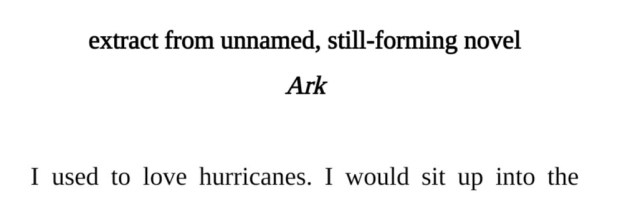
I am writing a novel here.

It is in its newborn baby period–colicky, demanding–and like every newborn baby, it sheds its skin each night and is a different color come morning.

I titled this for the reading on Thursday (apologizing for its incomplete state even though nobody would see it)

On Monday, I was trying to work through a puzzle within the text: how do I talk about the main character stumbling into the realization that their gender is somehow not what they had always thought it was? The earliest pulling apart of intertwined threads that re-entwine when you look away (or look too close)? It has to be grounded in the Caribbean imagination; filled with the richness of being part of this place; and void of the platitudes marketed for mass consumption. In short, I want it to feel honest, mine.

I puzzled, and puzzled, and by Tuesday–I wrote something. And set it aside–feeling nothing but flux and uncertainty. Wednesday came, and I followed through with a promise, to model for a photoshoot celebrating Pride month, by being painted in high femme, high glam makeup. It was border-crossing makeup. It was a thick beard against smokey eyes and a full lip.

Model: Ark Ramsay
Photographer/#Lightweaver: Risée Chaderton-Charles of eye one visuals
Make-up: Mandy Cummins
On set assist: Artemis M Benn

Wearing a new face transforms you, but it can also reconcile you to yourself.

The work at Fresh Milk this week eased the psychological tension of that transformation–and then when I returned to writing–it felt like I had found a new way into the work.

I don’t think this will change, and I’m not sure I want it to. Sometimes I think that I would be trapped if it weren’t for my writing–an ouroboros where I am both head and tail–stepping back at the moment of crisis–and therefore never stepping out at all.

This week was about stepping out–saying yes in an emphatic voice that shelters a baby-bird-voice underneath. On Thursday, the ‘trio of residents’ (à la Katherine Kennedy’s nickname for us), were invited to a small gathering at the house of Fresh Milk patron, Dr. Clyde Cave. In a home where every surface is anointed with Caribbean art, and surrounded by community, I read my work for the first time in years.

Whenever I performed before, I was never present. It was a fugue state. I disappeared into a recurring anxiety: when will this be over.

This time was different. I was present–I was alive in the reading.

Week 2 at Fresh Milk was about transformations, but from this point, the way forward requires that I think about structure. Most of my writing, up to this point, has been short stories. A story under 7000 words has to have one defining arc, and all of the smaller, extraneous pieces are slotted together within this word-budget. A novel is expansive, with interconnected pieces that have to function independently–its many threads woven together—it’s a tapestry.

And I have little experience weaving.

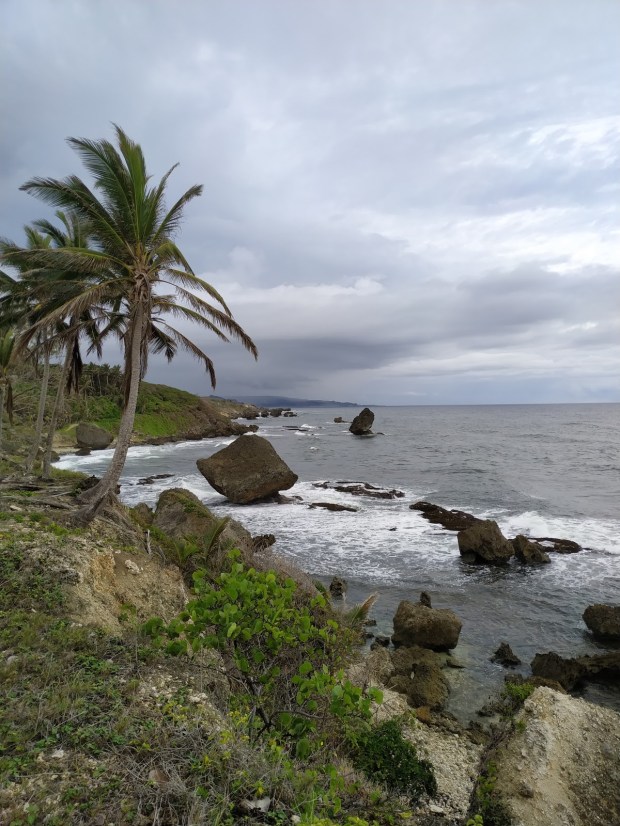
I bring my new (and old) questions to the ocean


Kia Redman’s Fresh Milk Residency – Week 2 Blog Post

Barbadian artist and aspiring writer Kia Redman shares a blog post on her second week in residence at Fresh Milk. Deviating from carefully laid plans, this week saw a whirlwind of activity for Kia through studio visits, openings, workshops and bonding sessions with her fellow residents. She has been going with the flow and taking in the action, hoping to return to research, writing and production moving forward, with these experiences to reflect on. Read more below:

My favourite part about making plans has always been witnessing the innumerable ways life will set them off course. The futility of it all and the sense of powerlessness it instigates is nothing compared to the exhilarating sense of serendipity that just overwhelms every derailed plan. This is the state in which my week progressed.

I ended the first week with a clear vision in mind for the goals I was planning to achieve during my second week at the Colleen Lewis Research/Writing residency. I had planned to get a start on writing and tackle some of the topics I had narrowed down. Life had other plans for me. Monday morning I pitched my idea for my community outreach, and the rest of the week went by in a blur of activity, excitability and camaraderie: One moment you could find us chilling on the studio floor with Ewan, as he shared his work with us. The next I was beating everyone at Ewan’s “unwinnable” game Peregrination. There was the invention of our “fish cake crawl” and its strict judging criteria. Our visit to the opening of The Enigma of Arrival -The Politics and Poetics of Caribbean Migration to Britain at the Barbados Museum and Historical Society and our hyped up selfie session. It was a dynamic week.

When I wasn’t off learning and bonding, I planned and prepared for my workshop I called ‘The Time Capsule Project’. Geared toward the class 4 students who will soon be leaving Workman’s Primary School, I thought it would be both a fun and important exercise to create a digital time capsule with them. We are all shaped by our histories. Our past memories, decisions, interactions and tales are the building blocks that form our foundations and influence our personalities, and inform our futures. History is something to be respected, cherished and most importantly, documented. Who better to chronicle the stories of a time than those living in it?

Friday morning I arrived at Workman’s Primary with Ark and Ethan, who had agreed to help me out. We were escorted to a classroom and I greeted the kids the only courteous way you should approach children forced to sit in a classroom all day: with snacks – more specifically Shirley Biscuits. I played them my stop motion animation,“HOME”, in which the little house from a Shirley biscuit traverses obstacles in an effort to find its way home. It was an example to show them how I chose to record my personal history. What followed was a brief chat on the importance of documenting their personal histories and memories, during which they shared with me the best memories they have from their time at Primary School. Using the cameras donated by a past Fresh Milk resident, I set them free and they spent the next couple hours playing, exploring and capturing whatever they deemed most important.

I won’t say what I foresee for this upcoming week. Regardless of what happens, I’m sure it will be an enjoyable one. I do hope that I will get more reading and writing in though…I really miss my hammock time.

Ark Ramsay’s Fresh Milk Residency – Week 1 Blog Post

Ark Ramsay shares their first blog post about the 2019 Fresh Milk ‘My Time’ Local Residency, which for the first time is focusing on research and writing practices. Ark speaks about the anxieties and concerns they have around returning to Barbados after completing an MPhil in Chinese Philosophy in Shanghai, while embracing the possibilities this residency has to offer and learning to re-inhabit the role of “Barbadian writer”.  Read more below:

Sonia Farmer’s “A True & Exact History of Barbados”

Honestly, I was worried about coming to Fresh Milk.

In the weeks before arriving, I burdened the space with a whole pantheon of anxieties. There were the familiar deities: Will-The-Work-I-Produce-There-Be-Any-Good (horned, feral, a biter); Is-This-Work-Even-Worth-Producing-At-All (tentacled, perpetually bored), and Will-I-Make-My-Page-Count (incarnated as everyone’s least favorite Primary School teacher).

I set about packing up my life in Shanghai, trying not to take notice of the fourth entity–larger than the others, skewed by perspective until all I could make sense of were the cracks in a cloven hoof–How-Do-I-Really-Return.

When I left Barbados, I abandoned writing altogether. I thought: “I’ll make a fantastic something-else”. I ditched narrative, dumped characters, and abandoned plots. I dislocated from the part of my brain that thought of itself as a ‘Barbadian writer’.

Or at least I tried to.

I still bought journals. Still scribbled notes in them. Still planned and orchestrated worlds. I could not seem to discard the machinery I had oiled so diligently for a decade.

So I returned to the island in the dark of memory. I smuggled back entire ships, boardwalks, car crashes, love stories, robots (who walked the length of Bathsheba), and dysfunctional families. I did all of this like a cat burglar until there were clear partitions between myself and the island. There was Ark the writer. Ark the islander. I began to feel like a tourist in my own dialect.

Arriving at Fresh Milk, under old-growth mahogany trees, I ruminated on what I hoped to achieve (and not achieve as in the ‘I’ of productivity, but achieve as in the summit that you reach in tandem with someone else)–I came to a realization. I wanted to be inundated with influences. To be upended.  To walk the long path home.

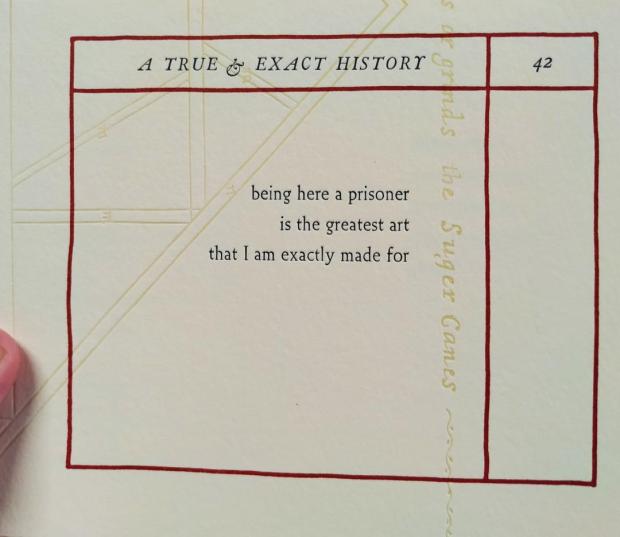
On the first morning, Annalee handed me a red box.

Even the design mirrors Ligon’s–even the paper feels like this text

It was Sonia Farmer’s strip-mining of Ligon’s “True & Exact History of Barbados”. She took his ‘accounts’ and reworked them, using his own words to uncover the silent-underneath. She questions the audacity of a “true” and “exact” anything. It was a simple gift: a reminder that the way back is via new trails in the oldest paths.

It liberated me into the rest of the week. I realized that this could become an artist’s retreat. The sense of retreat as wound-licking/marshalling the remaining forces/recalibrating. I looked around to find that the space was peopled not by anxiety-gods, but cows, and Mica–who must be some kind of Obeah Dog–because her presence brings with it an overwhelming calm.

Guarded by Obeah dog, Mica

I began to devour the library. It seemed to contain the exact mixture of books that I needed. I was handed a captivating review of Paulo Nazareth’s work–particularly News from the Americas (2011-2012)–where he left the state of Minas Gerais and travelled by bus and foot, traversing 15 countries before arriving in New York. He did this, without washing his feet, until he reached the Hudson. He carried the Americas on his body. Art as dirt that can be washed away.

This flowed into “Learning to Die: Wisdom in the Age of Climate Crisis”, meditative essays that try to retool traditional Socratic virtues so that they’re useful at the end of times–when the dirt of man catches up to the rest of us. Dirt. Dust. Carried on our skins or washed away forever. I read, surrounded by impossible beauty (and the lowing of cows), trying to bank all of these impressions.

No longer thinking, will this be useful, but trying to trust in the process.

On Wednesday, we were visited by Ewan Atkinson (visual artist/most engaging person in a room), who showed off one of the pieces from his mind-bogglingly intertextual work, “The Neighbourhood Project”. He built a board game that is a kind of ‘found object’ within the narrative of this fictional neighbourhood. While setting it up he reiterated what had become gospel by this point, that the filtration process–the coming together of ideas–is a slow, slow burn. Something found today can be used in twenty-five years.

The “unbeatable” Neighbourhood Game, “Peregrination!” by Ewan Atkinson

The lesson of week one seemed to be: time.

So I tried to give myself time, and space, to hack away at what I am working on. Hack being the right word, but a cruel word. To move from short story writing, to novel writing, feels like stripping naked in Broad Street–but forgetting (halfway through) how buttons on clothes work. It’s a fumbling, stumbling, soul-baring process.

But this seems a good place to begin.

Most complex problems become solvable if you add a dog to the equation

Kia Redman’s Fresh Milk Residency – Week 1 Blog Post

Barbadian artist Kia Redman shares her first blog post about her Fresh Milk residency, reflecting as the 2019 recipient of the Colleen Lewis Research/Writing residency programme. Writing has always been something Kia wanted to explore more within her growing creative practice, and she is taking this time to immerse herself within the material the reading room has to offer, with a particular focus on ideas of ‘paradise’ and ‘escapism’ in a Caribbean context. Read more below:

Writing is not something I have ever done for myself. There has always been an assignment, an application or a job providing the catalyst for me to flip the switch in my mind from visual to literary. As such, I have never presumed myself worthy of the title of writer, despite how much I enjoy the process. A title can often grow to become part of your identity. I could not, in good conscience, claim one that I had not had the courage to actively pursue…until now.

While I am not yet ready to claim the title, perhaps I will gain new perspectives by the end of this residency. For now, I will just embrace the joy of being able to write for myself.

My first week as the first Colleen Lewis Research/Writing Resident at Fresh Milk was liberating. There is a peculiar kind of freedom that comes with having a vast expanse of knowledge at your fingertips and a vast amount of time with which you can peruse it all. It is somewhat akin to living while time stands still. The construct of days and hours lose all meaning. The change in time now only marked by the end of a chapter, the occasional pang of hunger, and the draw of my bed as the light shifts gradually darker in the sky. Throughout that time only one thought occupied my mind: How to Escape from Paradise.

The irony of the topic of my research was never lost on me the many times I laid in the hammock strung up just outside the studio, basking in the breeze and lush foliage, with one of the many books I felt compelled to read nestled in my hands. It has been a near constant topic on my mind since the final year of my studio art degree, two years ago, when I wrote on it as part of an assignment for Ewan Atkinson’s Contemporary Issues class. It almost seems like it was an inevitability that I would confront it again after he suggested that I would be interested in applying to this residency.

Initially, I was a bit apprehensive when approaching the topic. It had been ruminating around in my head for two years and I was nowhere closer to being able to translate my jumble of thoughts into something tangible. Moreover, I had somehow convinced myself that the topic was limited and there were not many avenues down which I could pursue my ideas. I was proven wrong within the first few moments of stepping foot in the studio. Before I even fully unpacked, Annalee graciously provided me with many starting points and perspectives that gradually turned into large stacks of books on my desk as the week progressed. While the jumble of information in my head did increase, the breadth of my understanding deepened and the constraints I had unwittingly placed on the topic, fell away to make room for new pathways I will enjoy exploring in the coming weeks.

One of my goals for this first week was to delve into the Colleen Lewis Reading Room Collection and engage with books that caught even an ounce my interest. I wanted to start with an open mind. My next goal was to explore the vibrant surroundings I found myself in and feed off of the tropical energy I’m attempting to translate into words. My final goal was to develop a structure for what I plan on writing throughout the residency.

The first goal was met within moments of the start, while the last two came to be on the last day of the first week: Annalee had just suggested I read a piece by Colleen Lewis, the namesake of the residency and very reason I found myself sitting amongst her treasured books. She rummaged around the shelves until she found “Pictoral Depictions of the West Indian Landscape in the 18th Century and Early 19th Century: The Sublime, The Picturesque, The Romantic” in the fiftieth volume of the Journal of the Barbados Museum and Historical Society and placed it in my hands. Within moments, her vivid descriptions of the history and form of the earliest means of paradise marketing in the Caribbean had me yearning to consume the words surrounded by all that she spoke of. I immediately grabbed the journal and said my brief farewells to Annalee and Ethan as I strode out of the studio with a fierce purpose. Seconds later I was back to grab my pen and notebook. It had taken me a moment to realize that the intense familiar calling I felt was inspiration. A couple hours and a few heated conversations with some cows later, I was back in the studio. I felt accomplished. I had not only come up with a structure for what I plan to write, but the walk and Colleen’s words in the journal had helped to solidify two years-worth of jumbled thoughts in my mind. I could finally start to see the form my visual work, under the same topic, will take.

The next following weeks will find me exploring:

  • The link between Paradise and Escape
  • The methods and motivations behind the creation of the Caribbean as a Paradise
  • The realities that have paralleled the Paradise throughout the centuries
  • Paradise as an exotic escapist destination
  • The physical aspects of Paradise as a tool for escape and concealment, as seen with the Maroon societies, runaway slaves and escaped prisoners in more modern times.
  • Paradise as a prison, for indentured laborers and slaves
  • Paradise as a banal reality for those who live within its lush bounds and the means by which they indulge in their escapist fantasies.

It was a great first week. I can’t wait to begin the next!

Fresh Milk contributes to the 2019 Understanding Risk Caribbean Conference

The 2019 Understanding Risk (UR) Caribbean Conference took place May 27 – May 31 at the University of the West Indies (UWI) Cave Hill Campus, Errol Barrow Centre for Creative Imagination (EBCCI) in Barbados. This conference brought together representatives of government ministries and national disaster management agencies, disaster risk management practitioners, urban planners, insurance industry stakeholders, private sector organizations, academia, multilateral development banks, regional partners and donors to discuss the core theme ‘From Risk to Resilience: A Foundation for Action’.

Janot Mendler de Suarez, a consultant with the World Bank, most recently the Caribbean Technical Programme of GFDRR’s Disaster Risk Financing and Insurance initiative, and Pablo Suarez, Artist in Residence, National University of Singapore – Lloyd’s Register Foundation Institute for the Public Understanding of Risk, invited Fresh Milk to co-develop three artistic interventions for the conference. These projects acted as a way of translating and communicating key factors about environmental risks in the Caribbean into a visual language, as well as showing tangible examples of resilience within our culture and landscape in Barbados.

Photographs by Dondré Trotman unless otherwise specified.

__________

Risky Timelines:

Concept: Janot Mendler de Suarez & Pablo Suarez
artists: Akilah Watts, Alanis Forde, Anna Gibson in collaboration with Kia Redman and Kraig Yearwood
With thanks to: Harclyde Walcott, Joseph Spagnuolo, Kerri Cox, Mary Boyer, Rashmin Gunasekera, Thibaut Humbert, UWI EBCCI

Photo by Dondré Trotman

This project, conceived by Janot Mendler de Suarez and Pablo Suarez and created by Barbadian artists Akilah Watts, Alanis Forde and Anna Gibson with Kia Redman and Kraig Yearwood, saw the depiction of natural disasters which have taken place in 33 countries across the Caribbean in the form of a large data sculpture.

This piece showcases a timeline of these events spanning from 1990-2019, and communicates the breadth and impact of these catastrophes on the region. The artwork creates a visually intuitive juxtaposition of natural hazard data – on hurricanes from category 1 to 5, earthquakes, volcanic eruptions, landslides, and floods – with impact data on the number of people affected, the number of lives lost, economic losses and the amount of money invested in response and recovery efforts.

‘Risky Timelines’ was installed at the EBCCI between May 27th – June 3rd, 2019.

The Making

This slideshow requires JavaScript.

The Installation

This slideshow requires JavaScript.

The Finished Work

This slideshow requires JavaScript.

__________

Sargassum and Coral Reef Benches

Concept by Janot Mendler de Suarez & Pablo Suarez, Photography By Nadia Huggins & Data Story Layout by KAtherine Kennedy
A collaboration with Adopt A Stop Barbados
With thanks t:o Shelly-Ann Cox and Hazel Oxenford of CERMES, UWI Cave Hill Campus

Photo by Dondré Trotman

As an extension of our Fresh Stops public art project in collaboration with Adopt A Stop Barbados, the design and production of two benches to be permanent fixtures at the EBCCI were commissioned by the World Bank for the UR Caribbean Conference through Janot Mendler de Suarez.

Telling the stories of ‘Risk and Resilience’ within the Caribbean’s oceans, the backs of these two benches feature data stories about the properties and importance of coral reefs and Sargassum seaweed. These graphics were designed by Barbadian artist and Fresh Milk’s Communications & Operations Manager, Katherine Kennedy, using information largely provided by the Centre for Resource Management and Environmental Studies (CERMES), UWI Cave Hill Campus.

The fronts of each bench showcase photographs by Vincentian artist and photographer Nadia Huggins, depicting modified versions of photos related to her Transformations series, which she describes as “[exploring] the relationship between my identity and the marine ecosystem.”

This slideshow requires JavaScript.

__________

(Bush) Tea Plots – A Decolonial Patch

A Work by Annalee Davis in collaboration with Ras Ils and Kevin Talma

Photo by Dondré Trotman

This artwork by Barbadian artist and Founding Director of Fresh Milk Annalee Davis in collaboration with Ras Ils and Kevin Talma, also commissioned by the World Bank for the UR Caribbean Conference through Janot Mendler de Suarez., sits within Davis’ larger artistic practice and confronts the historical imposition on this island of the monocrop–Saccharum officinarum–while recognizing nature as a radical maneuver against the singular model of the plantation. Observing how the natural world is threatened and degraded, (Bush) Tea Plots acknowledges the resilience of our regenerative biosphere and its inherent capacity for healing at the agricultural, botanical and psycho-spiritual levels.

The work creates visibility of near extinct (Bush) tea practices, appreciating biodiversity through dormant wild botanicals now resurfacing in abandoned sugarcane fields. This live restorative plot–an apothecary of resistance–is permanently installed at the EBCCI for the UR Caribbean Conference 2019, includes mobile accessibility via a QR code linked to the project’s web platform.

The Installation

This slideshow requires JavaScript.

The Finished Work

This slideshow requires JavaScript.

__________

UR Caribbean is organized by the World Bank’s Caribbean Disaster Risk Management team, in partnership with the Caribbean Disaster Emergency Management Agency (CDEMA) and the European Union (EU), and will be hosted by the Government of Barbados. This conference is co-financed by the European Union-funded Africa, Caribbean, Pacific – European Union (ACP-EU) and the Natural Disaster Risk Reduction (NDRR) Program and managed by the Global Facility for Disaster Reduction and Recovery (GFDRR).