Transoceanic Visual Exchange Caribbean

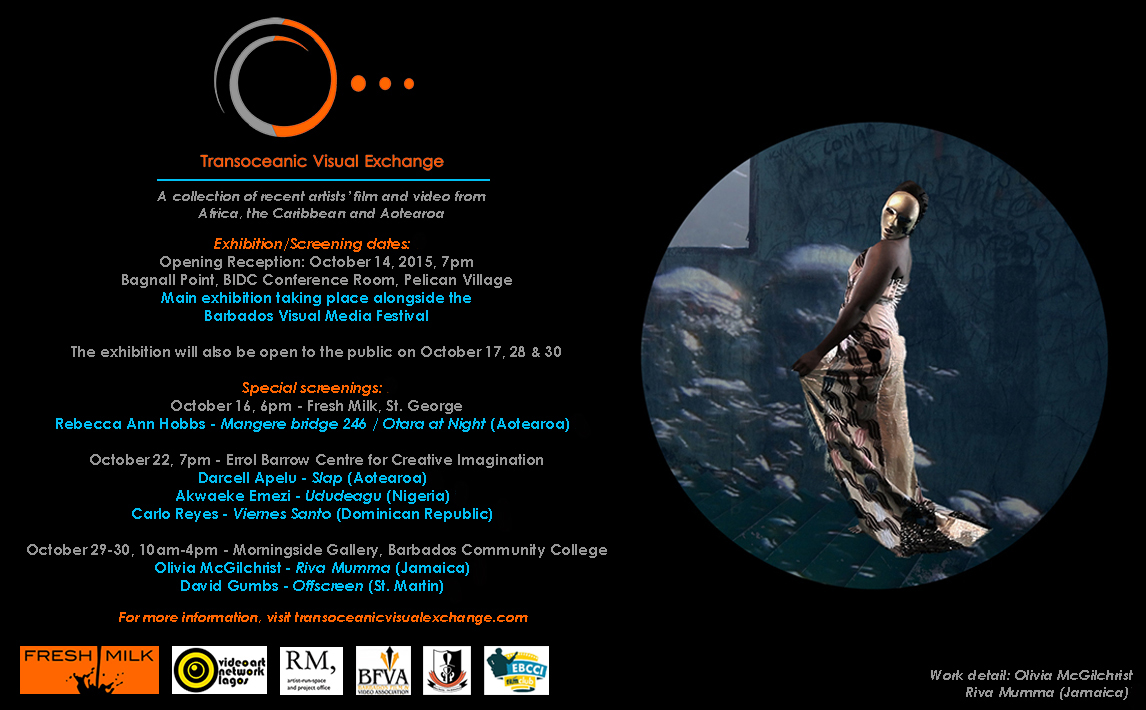
TVE flyer McGilchrist

A survey of film and video works in the Caribbean, Africa and Aotearoa, Transoceanic Visual Exchange (TVE) aims to negotiate the in-between space of our cultural communities outside of traditional geo-political zones of encounter and trade. The three spaces involved – Fresh Milk (Barbados), Video Art Network Lagos (Nigeria) and RM (New Zealand) – first met as participants of International Artist Initiated (IAI), a programme organized and facilitated by David Dale Gallery, Glasgow, in July 2014. TVE intends to build upon these relations and open up greater pathways of visibility, discourse and knowledge production between the artist run initiatives and their regional communities through this laterally curated exhibition project, taking place in Barbados, New Zealand, Nigeria and online.

TVE Caribbean will launch at 7pm on October 14, 2015 at Bagnall Point, BIDC Conference Room, Pelican Village in Bridgetown, Barbados as part of the Barbados Visual Media Festival (BVMF). The exhibition will also be open to the public at that location on October 17, 28 & 30 and features works by:

Versia Harris (Barbados), Katherine Kennedy (Barbados), Michèle Pearson Clarke (Trinidad & Tobago / Canada), Romel Jean Pierre (Haiti), Nick Whittle / Alberta Whittle (Barbados), Rebecca Ann Hobbs (Aotearoa), Ngahuia Raima (Aotearoa), Louisa Afoa (Aotearoa), Nkechi Ebubedike (Nigeria) and Lambert Mousseka (Democratic Republic of the Congo).

There will be additional special screenings taking place at Fresh Milk, The Errol Barrow Centre for Creative Imagination (EBCCI) as part of their Film Club Screenings and Barbados Community College (BCC):

October 16, 6pm – Fresh Milk, St. George
Rebecca Ann Hobbs – Mangere bridge 246 / Otara at Night (Aotearoa)

October 22, 7pm – Errol Barrow Centre for Creative Imagination
Darcell Apelu – Slap (Aotearoa)
Akwaeke Emezi – Ududeagu (Nigeria)
Carlo Reyes – Viernes Santo (Dominican Republic)

October 29-30, 10am-4pm – Morningside Gallery, Barbados Community College
Olivia McGilchrist – Riva Mumma (Jamaica)
David Gumbs – Offscreen (St. Martin)

RSVP to the event on Facebook here.

For more information please visit www.transoceanicvisualexchange.com, or email Natalie McGuire at tveproject.caribbean@gmail.com.

Special thanks to the Barbados Film and Video Association (BFVA), EBCCI, BCC and Stansfeld Scott Inc. for making these screenings possible, and to Versia Harris and Katherine Kennedy for designing the logo, digital space and flyers.

Open Call: ‘White Creole Conversations’ – New ways of thinking about whiteness in a Caribbean context

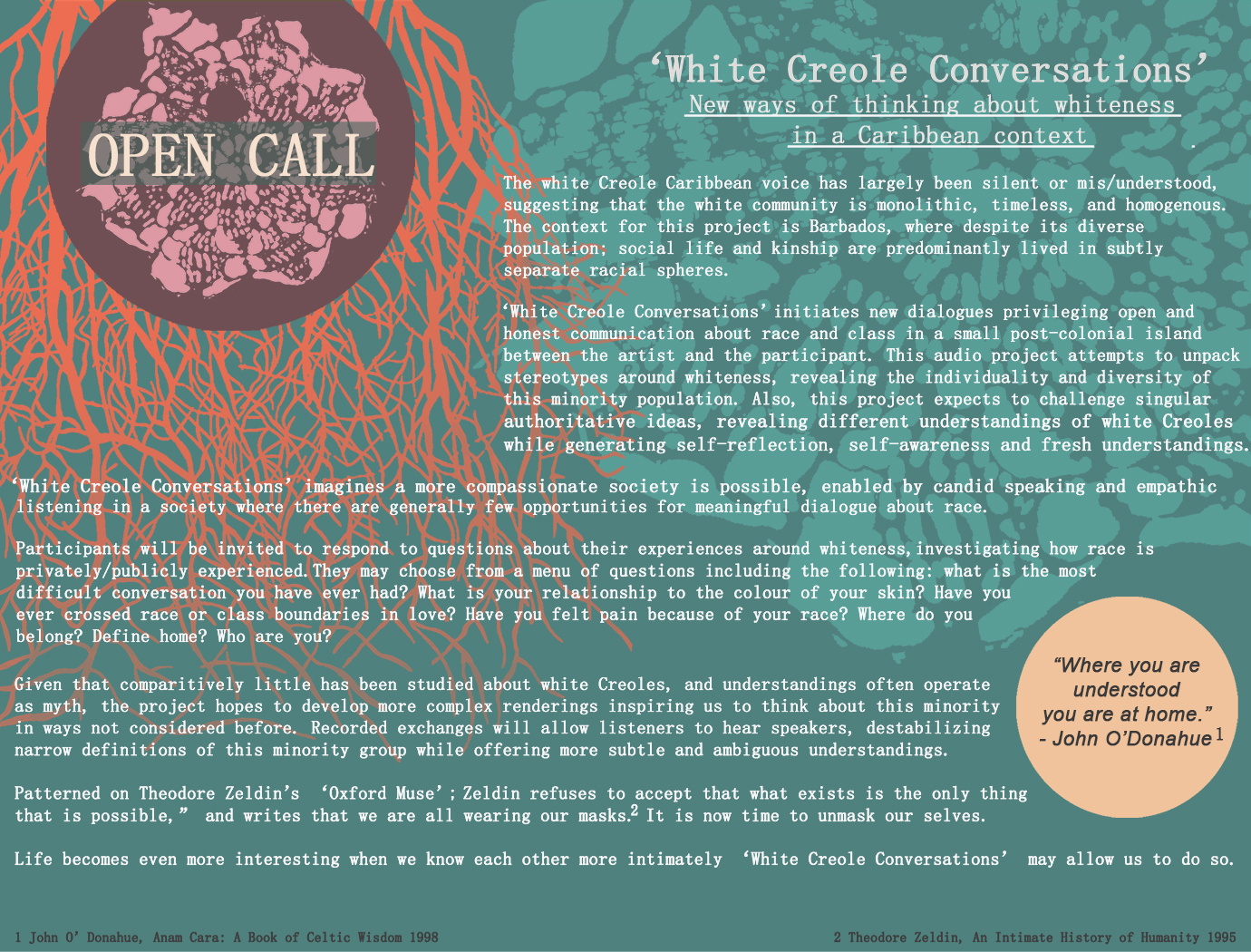
Barbadian visual artist & founding director of Fresh Milk Annalee Davis shares an open call for participation in ‘White Creole Conversations’: New ways of thinking about whiteness in a Caribbean context, a forum for honest communication that begins to unpack issues and stereotypes while facilitating understanding about whiteness in the region. These sessions with the artist will take place from August 4 through September, 2015 in Barbados. For those not in the island, Skype meetings can be arranged to discuss participation. Learn more below:
side1 150dpi

Where you are understood you are at home.”
– John O’Donahue [1]

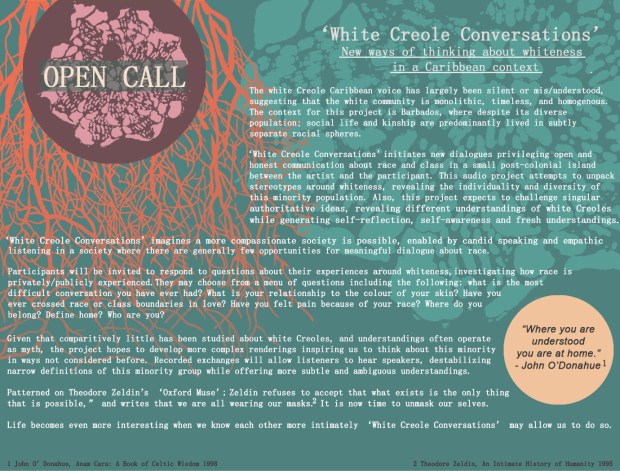
The white Creole Caribbean voice has largely been silent or mis/understood in ways that suggest that the white community is monolithic, timeless, and homogenous. The context for this project is the small island of Barbados, where despite its diverse population, social life and kinship are predominantly lived in subtly separate racial spheres.

‘White Creole Conversations’ initiates a new dialogue privileging open and honest communication. Rather than asking ‘who am I?’ the question posed might be ‘who are you?’ The focus of the conversations will pivot on issues to do with race and class in this small post-colonial island space and will take place between the artist and the participant.

This audio project attempts to remove the mask of the white Creole, unpack stereotypes around whiteness and reveal the individuality and diversity of this minority population. Also, this project hopes to facilitate exchanges that challenge singular authoritative ideas to reveal different understandings of the white Creole with a desire to generate self-reflection, self awareness and fresh understandings.

The medium in this artwork is ‘conversation’ which in and of itself becomes an aesthetic device in understanding and shaping civil society. The assumption is that there are generally few opportunities for meaningful dialogue about race in Barbados.White Creole Conversations’ imagines that a more integrated society on a small island is possible when enabled by candid speaking and empathic listening.

Patterned on Theodore Zeldin’s ‘Oxford Muse’, who reminds us that, “the most important networks are those of the imagination, which cross from the conventional to the unconventional, refusing to accept that what exists is the only thing that is possible”, Zeldin writes that we are all wearing our masks.[2] It is now time to unmask ourselves.

Engaging in meaningful discourse is one way of developing empathy and affinity. A menu of questions from which the participant may choose to respond to might include the following: what is the most difficult conversation you have ever had? What is your relationship to the colour of your skin? Have you ever crossed race or class boundaries in love? Have you felt pain because of your race? Where do you belong? Define home? Who are you?

Given that little has been studied about white Creoles and understandings often operate as myth, one goal for this discursive project is to develop more complex renderings that inspire us to think about this minority in ways we might not have considered before. The recorded exchanges will be accessible as portals allowing listeners to enter the world of the speakers with a view to destabilizing the often fixed, narrow definitions of this minority group while offering more subtle and ambiguous understandings.

As an artist, my intention is to use this audio project to invite participants to respond to questions about their experience as a white Creole and investigate how race is privately/publicly experienced. Phase II will open up the dialogue to all members of the island community.

It seems to me that life becomes even more interesting when we know each other more intimately.White Creole Conversations’ may allow us to do so.

[1] John O’Donahue, Anam Cara: A Book of Celtic Wisdom, 1998
[2] Theodore Zeldin, An Intimate History of Humanity, 1995
side 2 150dpi

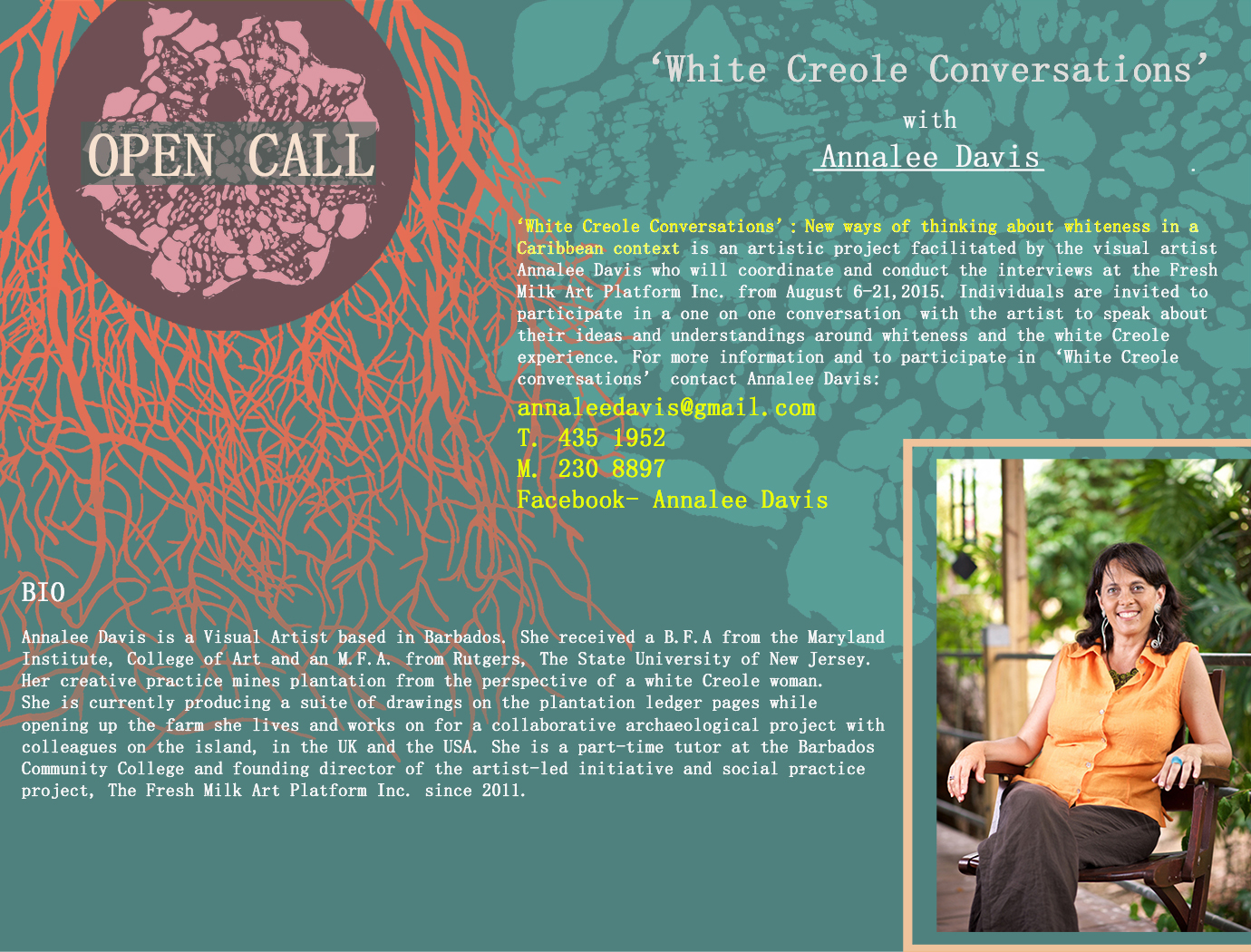
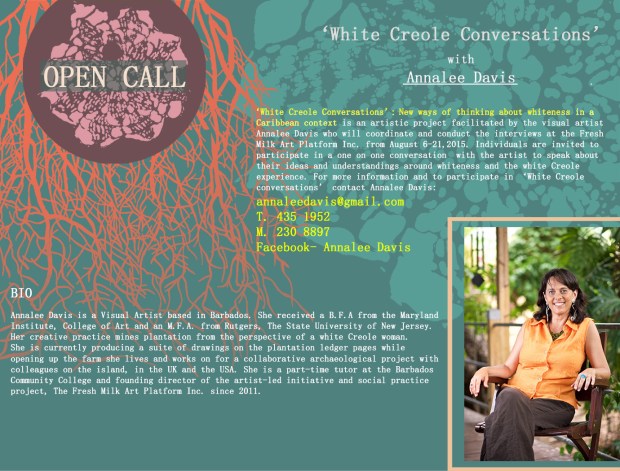
‘White Creole Conversations’: New ways of thinking about whiteness in a Caribbean context is an artistic project facilitated by the visual artist Annalee Davis who will coordinate and conduct the interviews at the Fresh Milk Art Platform Inc.

From August 4-21, 2015 individuals will be invited to participate in one on one conversation with the artist to speak about their ideas and experiences around the white Creole experience.

For those who are not in Barbados but want to participate remotely, an initial meeting via Skype to discuss the project can be arranged and responses to a menu of questions may be submitted in writing, audio or video files.

For more information and to participate in White Creole conversations’ from August 4 through September, 2015, contact the artist: Annalee Davis:

annaleedavis@gmail.com
T. 435 1952
M. 230 8897
Facebook – Annalee Davis
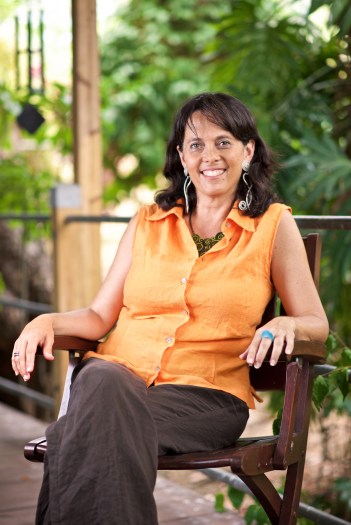
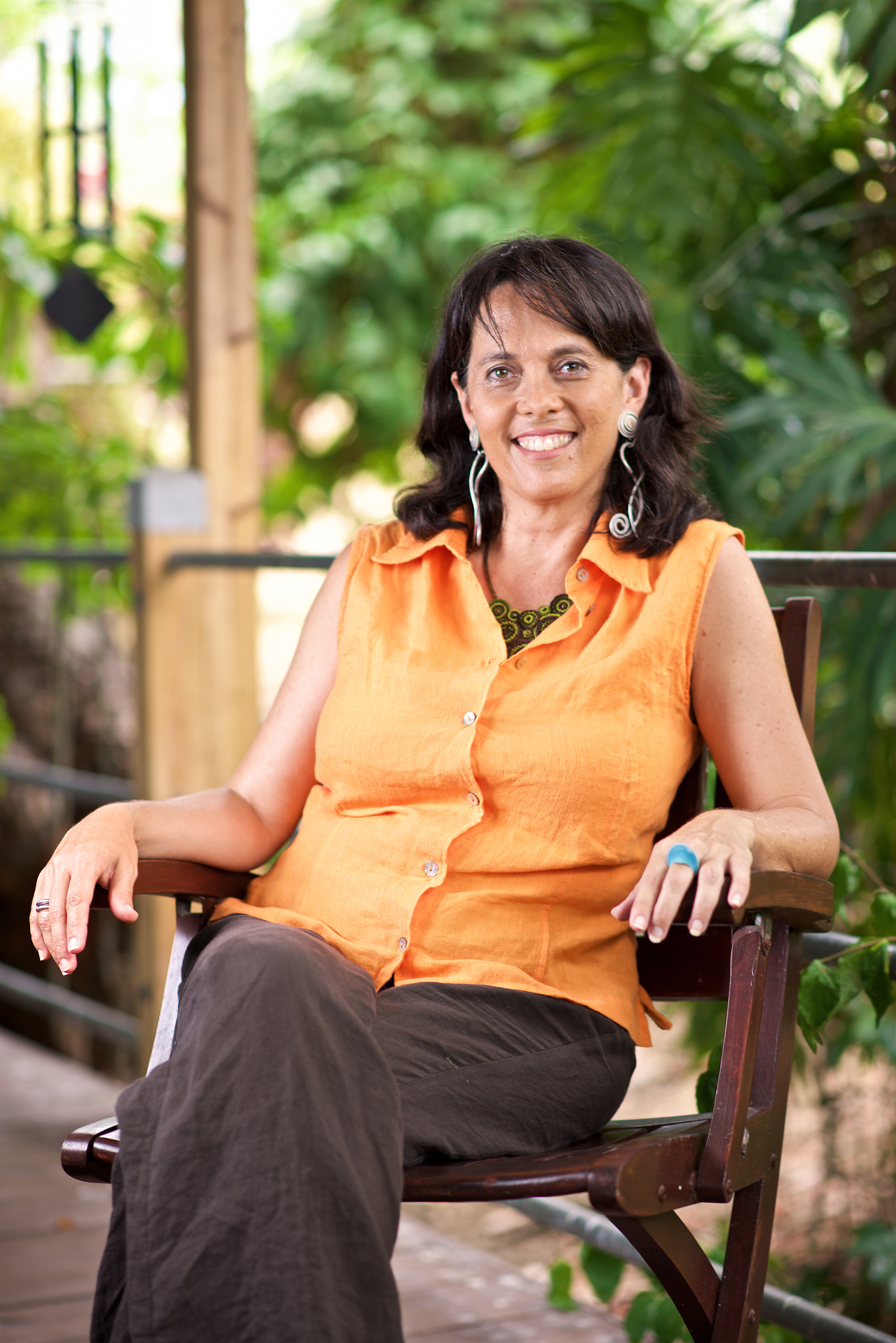
Director: Annalee Davis. Photo credit: Charles Phillips of Monochrome Media

Director: Annalee Davis. Photo credit: Charles Phillips of Monochrome Media

About the artist:

Annalee Davis is a Visual Artist based in Barbados. She received a B.F.A from the Maryland Institute, College of Art and an M.F.A. from Rutgers, The State University of New Jersey. Her creative practice mines the plantation from the perspective of a white Creole woman. She is a part-time tutor in the BFA programme at the Barbados Community College and has been the founding director of the artist-led initiative and social practice project – The Fresh Milk Art Platform Inc. since 2011. An experiment and cultural lab, Fresh Milk supports excellence among emerging contemporary creatives locally, throughout the Caribbean, its diaspora and internationally. Located on a working dairy farm and a former sugar cane plantation, Fresh Milk is a nurturing entity; transforming a once exclusive space to become a freely accessible platform with programming supportive of new modes of thinking and interfacing through the arts. Through Fresh Milk she currently co-directs Transoceanic Visual ExchangeTilting Axis and Caribbean Linked, a regional residency programme.
Alice Yard announces the results of their inaugural Prize for Art Writing

alice yard prize winners

From L-R: Winner Stephen Narain (Bahamas) and Honourable Mentions Nicole Smythe-Johnson (Jamaica) and Katherine Kennedy (Barbados)

The co-directors of Alice Yard are pleased to announce that the winner of the inaugural Alice Yard Prize for Art Writing is Stephen Narain, born in the Bahamas and now living in the United States.

From the shortlist of five writers, two more have been selected for honourable mention: Katherine Kennedy of Barbados and Nicole Smythe-Johnson of Jamaica.

The other shortlisted writers are Brandon O’Brien of Trinidad and Tobago and Aiko Maya Roudette of St Vincent and the Grenadines.

Narain will receive a cash award of US$1,000, and his essay, along with Kennedy’s and Smythe-Johnson’s, will be published in The Caribbean Review of Books.

Launched by Alice Yard in 2014, the prize is an annual award for an original piece of critical writing on contemporary Caribbean art by a Caribbean writer aged 35 or under. It aims to encourage new writing on Caribbean art and artists, and to identify emerging voices in contemporary Caribbean art criticism. Originally it was expected that the winner of the inaugural prize would be announced in late 2014. Despite the delay in the timetable, the prize will continue to be awarded annually, and the 2015 Alice Yard Prize for Art Writing will open for entries in September.

The co-directors of Alice Yard wish to thank the 2014 prize judges — Krista Thompson, Charles Campbell, and Courtney J. Martin — for their time and critical engagement.

Read more on the Alice Yard website here.

Colección Cisneros shares the debate ‘The Tropical: Resistance or Cultural Tourism?’

Colección Patricia Phelps de Cisneros, a platform for debate concerning the immense contributions of Latin America to the world of art and culture, shares the online debate ‘The Tropical: Resistance or Cultural Tourism?‘ featuring input by Fresh Milk‘s Founding Director Annalee Davis.

Leandro Cardoso Nerefuh, Churrasco Tupinambá, 16th Century (Variable dimensions). Part of the Arquivo Banana [Banana Archive].

Leandro Cardoso Nerefuh, Churrasco Tupinambá, 16th Century (Variable dimensions). Part of the Arquivo Banana [Banana Archive].

About the debate:

The “tropical” has helped to increase visibility in the global art market for contemporary art produced in Latin America (particularly from the Caribbean, Central America, and Brazil). Its vibrant, colorful, and extravagant iconography can be easily read by a broad audience. On one hand, the tropical can empower a worldview that is different from the “western” mainstream that dominates the global art world. On the other, it can be accused of reproducing an exotic colonial gaze that has historically constructed the tropics as only a place of desire and leisure. Has the tropical become a contemporary aesthetic trend that continues to primitivize the “Other”? How has the Latin American art market boom contributed to promoting a particular form of legibility for practices made in tropical climates? Can the tropical be a useful artistic strategy today or is it condemned to banality?

Join the debate here.

Moderators: Carla Acevedo-Yates and Cristiana Tejo carla and cristiana Participants: Mario García Torres, Moacir dos Anjos, Annalee Davis and Leandro Nerefuh

Director: Annalee Davis. Photo credit: Charles Phillips of Monochrome Media

Annalee Davis. Photo credit: Charles Phillips of Monochrome Media

About Colección Cisneros:

The Colección Cisneros website was created to offer a forum for information about, a platform for debate concerning, and a spark for the ignition of interest in the immense contributions of Latin America to the world of art and culture. The site’s inspiration and launching point is the Colección Patricia Phelps de Cisneros (CPPC), but its ambition is discovery, and its mission is to weave a multi-lingual, virtual network for people and ideas. Founded in the 1970s by Patricia Phelps de Cisneros and Gustavo A. Cisneros, the CPPC is based in New York City and Caracas. Its mission is to enhance appreciation of the diversity, sophistication, and range of art from Latin America, and to advance scholarship of Latin American art. The CPPC achieves these goals through the preservation, presentation, and study of the material culture of the Ibero-American world—ranging from the ethnographic to the contemporary.