Fresh Stops: Matthew Clarke up next!

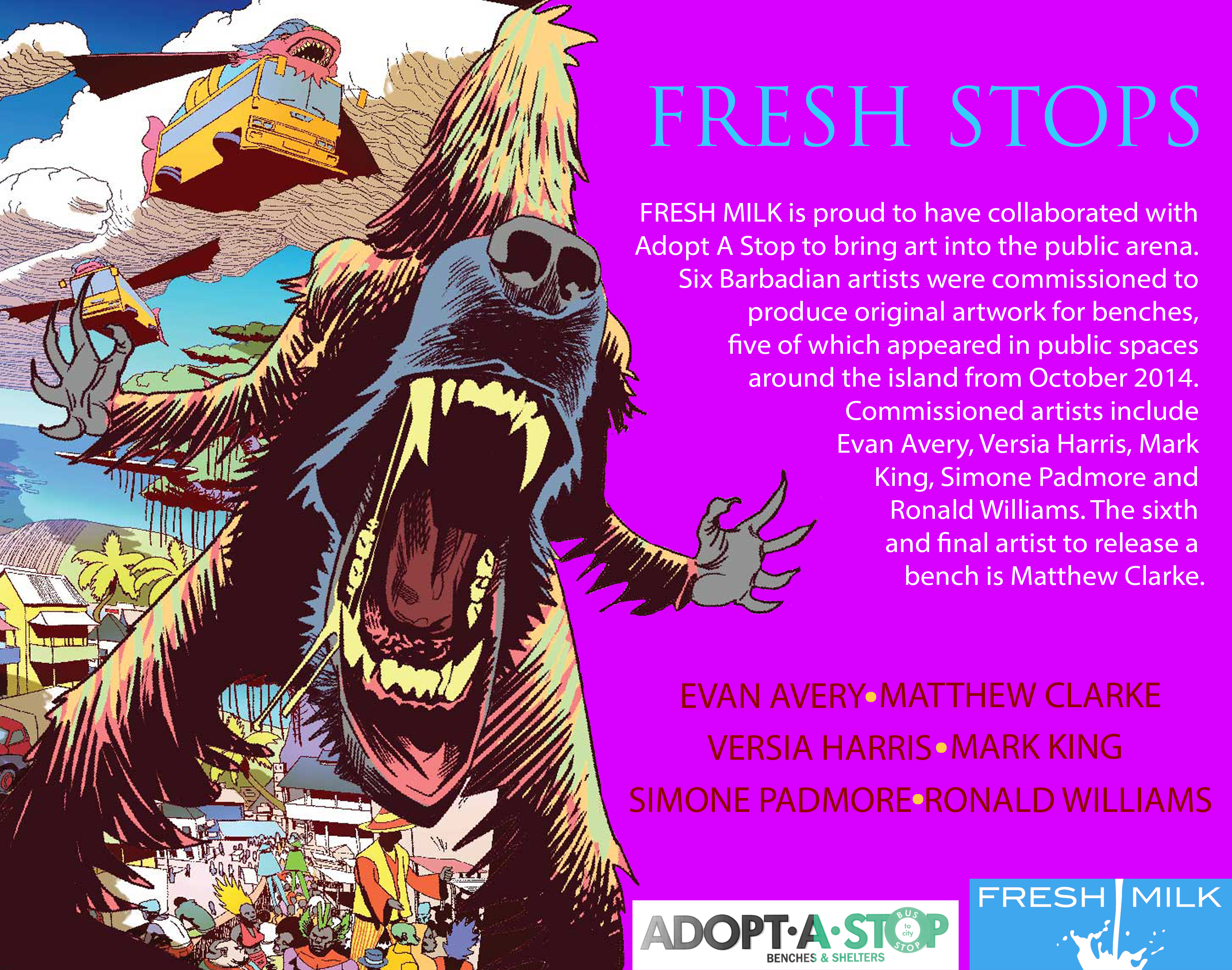
Matthew Clarke poster

Fresh Milk  and Adopt A Stop conclude the first edition of the Fresh Stops collaborative project with Matthew Clarke‘s piece ‘Hardears Universe’. In an attempt to bring art into the public space, six artists were commissioned to produce original artwork for benches that have been appearing at varied locations around the island. ‘Hardears Universe’ will soon be revealed at a location near you.

The other participating artists included Evan Avery, Versia HarrisMark  King, Simone Padmore and Ronald Williams. This project creates visibility for the work of emerging creatives, allowing the public to encounter and interact with their pieces in everyday life, generating interest and inviting dialogue about their practices.

About ‘Hardears Universe’:

Hardears Universe showcases a collection of characters from the ‘Hardears World’ featured in my graphic novels. It is a place of fantasy populated by characters from Caribbean folklore.

About Matthew Clarke:

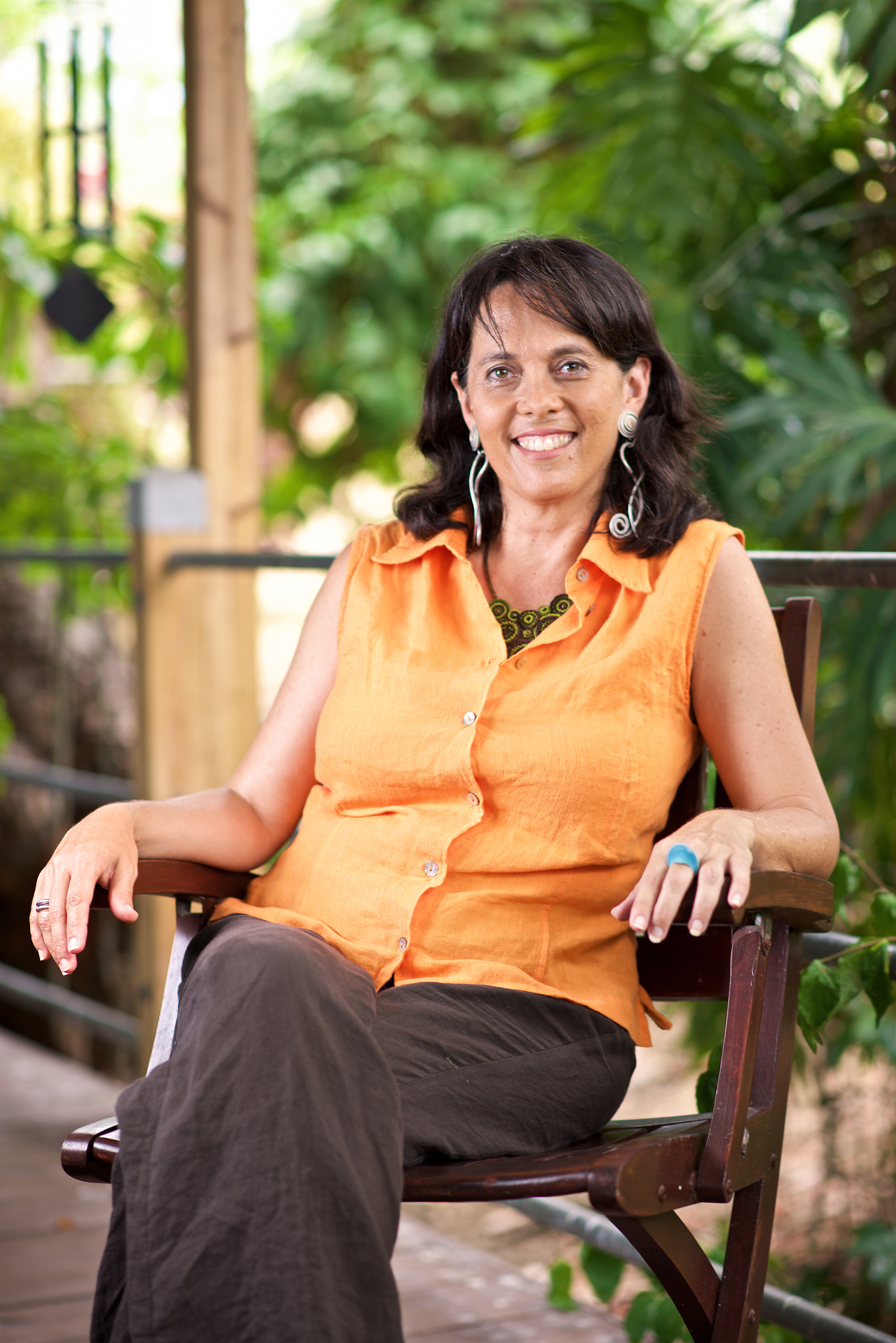
Matthew Clarke portrait

Matthew Clarke‘s passion for art started at a young age, and he began participating in the National Independence Festival of Creative Arts (NIFCA) while attending St. Michael’s School. Through the Festival, he achieved bronze, silver, gold and incentive awards, and went on to be the recipient of the Prime Minster’s Scholarship for Visual Art in 2003. Clarke completed his Associate Degree in Visual Art at the Barbados Community College (BCC) which earned him a Barbados Exhibition for tertiary studies, and in 2009 he obtained a Bachelor Degree with honours in Graphic Design at the same institution. He has freelanced for various design agencies (Virgo, 809, RED Advertising, G and A Communication, RCA) and worked at the Nation Publishing Company on the Attitude Magazine, creating its logo and design. He has also worked at Banks Holdings Limited (BHL), where he was appointed Internal Web Designer in charge of the Banks Beer website.

In addition to working on independent projects, he has been working as a graphic designer at RED Advertising and PR Agency as of 2011, where he is currently Deputy Creative Director. He is the co-owner and principle of a Caribbean comic company called Beyond Publishing, which has published over 22 books sold digitally and in print, both locally and internationally.

Halcyon Macleod and Willoh S. Weiland’s Residency – Week 4 Blog Post

Australian resident artists Willoh S. Weiland and Halcyon Macleod share their fourth blog post about their Fresh Milk residency. This week Willoh & Halcyon continued their search for the elusive ghost of Jean Rhys, hoping to get clues from the “Queen of Barbados.” Rhys’ life is used as a metaphor for feelings of displacement and as a reminder that the personal voice is indeed political, particularly regarding the validity of art. Read more below:

Jean Rhys & Wide Sargasso Sea

Jean Rhys & Wide Sargasso Sea. Portrait by Teresa Chilton

Our last week in Barbados has seen a wonderful anxiety as the process has been accelerated and we realise that we have only moments left on this island before we fly home. The growing cache of audio files have started to appear in their true form, as an incomplete sketch of a place and people, with some parts coloured-in vividly and the rest remaining an outline.

The week has forced reflections on the interview process and how this is best done. At the end of every hour we spent interviewing, we wished for more. More time, more thought, better questions, less politeness, more anecdotes, and more friction. We have learnt that the peculiar intimacy of the interview is a whole art in itself. Coming to like each other is a quicker process than how we come to disagree.

Writer and journalist Gay Talese, in an interview in New New Journalism talks about ‘the art of hanging out’ and how he followed Frank Sinatra for two years to write his seminal essay Frank Sinatra Has A Cold. This was the art of both constantly reminding the subject that they are being watched, questioned, scrutinised and gently, gently disappearing into the background.

In our last interview we met the Queen of Barbados, a woman in her 80s who regaled us with her adventurous life story whilst sitting amongst an amazing collection of Caribbean modern art. Who can say they have lived in Casablanca? She told us about her mother who, at the turn of the century in Barbados, would jog miles in her swimsuit, and even started a women’s group as an avenue to write plays and look after other women’s children. She was another remarkable Bajan woman, ahead of her time. This same lady had also stayed in Jean Rhys’ house in Dominica. Our ghost hunting continued…

Jean Rhys' house in Roseau, Dominica. Image sourced from The Wander Life Blog

Jean Rhys’ house in Roseau, Dominica. Image sourced from The Wander Life Blog

We have looked for Jean Rhys everywhere. She is inimitable and elusive as ever. Yet she has permeated every interview, beyond questions of race and class. The feeling of being outside life or misplaced evoked the reflective state that we often enter in order to mine our own lives for meaning. As one woman we met this week described, she loved Wide Sargasso Sea because she belonged nowhere. This is so common a feeling to our century. It is what connects being Australian with the migration patterns of the Caribbean and the cultural hybridity of the islands.

What is so important about Rhys’ voice as a writer is the brutal gaze, which she turns on herself and her own experiences. It is the unflinching ability to ask what is this and why?

As we contemplate going back to Australia where the validity of art and, in particular, its ability to be political is being blatantly attacked by our government, we are reminded in these interviews that the personal voice is political. Each of these interviews and the stories they have shared has been individual examples of how each life, on reflection, shows clearly its own courage.

This residency is supported in part by the Australian Broadcasting CorporationThe Alcorso Foundation and Arts Tasmania.


Halcyon Macleod and Willoh S. Weiland’s Residency – Week 1 Blog Post

Current artists in the Fresh Milk International Residency Programme, Willoh S. Weiland and Halcyon Macleod, share their first blog post reflecting on the beginning of their time in Barbados. Written this week by Halcyon, we are given some insight into the origins of their collaborative project ‘Crawl Me Blood’, a sound installation inspired by Jean Rhys’ novel Wide Sargasso Sea, and how they are using their time at Fresh Milk to collect material and expand the piece. Read more below, and for information on how to get involved with ‘Crawl Me Blood’, click here. 

IMG_6353

I arrived in Barbados on Sunday afternoon after a whopping forty-seven hours of continuous transit with my three month old baby strapped to my front. Flights were delayed, flights were cancelled, connections were missed. When the luggage conveyor belt at Grantley Adams International Airport emptied and stopped and I was the last one standing there, it felt only right that yes, my suitcases and the baby’s cot were lost in transit. It really is a long way to come, from my home in Hobart Tasmania, the heart-shaped island at the bottom of Australia, to this warm, colourful and utterly compelling island of Barbados. I was met at the airport by  my collaborator, Belizean-Australian artist Willoh S. Weiland, who had made a similar journey from Melbourne with her boyfriend and 10 month old babe the week before. Why have we come all this way?

In a 1959 letter, whilst she was working on Wide Sargasso Sea, Rhys described her earlier novel, Voyage in the Dark, as expressing how “The West Indies started knocking at my heart.” She added that “the knocking has never stopped.”
– from The Cambridge introduction to Jean Rhys by Elaine Savory

IMG_8369

The writings of Jean Rhys and our families’ connections to this region have compelled and propelled Willoh and me across the globe and far from home more than once now. The germ of our current project Crawl Me Blood, took hold in 2011. We landed in Los Angeles and drove across the country to The University of Tulsa where the Jean Rhys Special Collection is housed. There in Oklahoma, is the unlikely home of a collection of Rhys’ correspondence, drafts, unpublished writings, a few personal effects and a touching recording of the author singing songs from her childhood in Dominican Patois. Our journey continued to Placencia, Belize, the village where Willoh was born and grew up, and then on to Black River, in the St. Elizabeth Parish, Jamaica, the origins of my Grandmothers family. Certainly, the Caribbean was knocking at our hearts. We had begun our research for a new Australian interdisciplinary arts project.

But Crawl Me Blood is not about us! Inspired by the Belizean Kriol phrase ‘what crawls your blood’ are the secrets you sense but are not told to you. This phrase is akin to saying ‘it gave me the shivers’. The Crawl Me Blood project reimagines the sinister eden of the tropical garden and draws on the medium of radio to explore the myths we make of paradise and the realities of living in some of the world’s most beautiful places.

Crawl Me Blood is a radio docu-drama which will be housed inside an immersive installation. Audiences will wander through the installation listening to the audio work via hand held radios which are tuned to pick up a localised FM radio broadcast – the Crawl Me Blood radio station. There are multiple transmitters and the audience wanders in and out of the range of each transmitter, creating an exciting compositional range for the creators of the work. This one month residency at Fresh Milk is a research and writing phase of creative development. We are conducting interviews with Bajan women of all ages, collecting field recordings from local sites and writing the text for the fiction elements of this layered audio work.

The audio work will be enriched by field recordings collected from the Caribbean region and will be intercut with carefully selected Caribbean music and readings from Jean Rhys’ Wide Sargasso Sea and Voyage in the Dark. These various components of the work are being developed alongside each other with a shared focus on the central themes of the work:

  • how do we imagine and romanticise the landscape of paradise, and how is this imaginary world destroyed by the realities of place?
  • the experience of women of all colours in the island nations of the Caribbean and in the countries that they migrate to
  • the responses that the tropical landscape and climate generate in people

Members of the Fresh Milk Books team with Willoh, Halcyon and little Raphaela.

It has been an incredibly productive start due to the ground work that Willoh was able to do in the previous week, and thanks to the assistance of the Fresh Milk Team in connecting us with amazing people. It has been our privilege to meet and interview some inspiring Bajan women. We have talked with a visual artist, a theatre practitioner, a poet and activist who have generously shared their perspectives with us. We have also interviewed Jamaican-Australian artist Zahra Newman this week in Melbourne via Skype. On Tuesday, we met with the Fresh Milk Books team and heard all about their reviews drawn from the Fresh Milk collection in the Colleen Lewis Reading Room. One of the team had recently reviewed Wide Sargasso Sea! We look forward to continuing the conversations and learning more about Bajan art and artists through our interviews and the collection.

A big thank you to Annalee and the Fresh Milk Team for making us feel welcome and introducing us to some inspiring Bajan artists this week.

This residency is supported in part by the Australian Broadcasting CorporationThe Alcorso Foundation and Arts Tasmania.

‘A thought on Mediating Matter(s) in Arab and Caribbean Contemporary Art’ by Natalie McGuire

Fresh Milk board member and contributor Natalie McGuire shares a review of the recent exhibition The Place of Silence at the Stal Gallery, Oman. While this show featured work by Middle Eastern artists, McGuire parallels their work with that coming out of the Caribbean, particularly between Iraqi-British artist Estabrak Al-Ansari and regional artists Nadia Huggins and James Cooper, all of whom deal with the materiality and implications of water as a medium. Read more below: 

Stal Gallery, Muscat, Oman. Photo credit: Natalie McGuire.

Stal Gallery, Muscat, Oman. Photo credit: Natalie McGuire.

Not work, taut, deaf, monotonous as a sea, endlessly sculpted—but
eruptions yielding to earth’s effervescence—that expose the heart, beyond
worry anguishes, to a stridency of beaches—always dislocated, always
recovered, and beyond completion—not works but matter itself through
which the work navigates—attached to and quickly discarded by some
plan—first cries, innocent rumors, tired forms—untimely witnesses to this
endeavor—perfectly fusing as their imperfections meet—persuading one to
stop at the uncertain—that which trembles, wavers, and ceaselessly
becomes—like a devastated land—scattered.

– Edouard Glissant, Poem for the World

Standing in the Stal Gallery, Muscat, in March 2015, the exhibition The Place of Silence exhumed an atmosphere so familiar to that of Caribbean art spaces. The works of six Middle Eastern artists commanded attention in the three enclave-spaced gallery, saturated in context and concepts that brought to mind Glissant’s phrase: “Not works, but matter itself through which the work navigates.” From Dada-inspired installations reviewing existence and death (Raiya Al Rawahi’s Life, Being and Death) to an unearthing of self-reflection, a photographic self-portrait mirrored and repeated almost to geometric abstraction (Ahmed Al Mullahi’s Gazing Through the Divine), there were challenging thoughts and narratives seeping through every pore of the walls. The exhibition was physically navigating through the matter of an upscale avenue in the heart of the city, sitting on Al Inshirah Street, a British Council Service Road.

Raiya Al Rawahi,  Life, Being and Death (detail). Installation: photographs, IV bags/stands, headphones, charts. Stal Gallery, 2015.

Raiya Al Rawahi, Life, Being and Death (detail). Installation: photographs, IV bags/stands, headphones, charts. Stal Gallery, 2015.

One in particular was the piece Sayed, a component of the series ‘Omani’s Under Water’, by Estabrak Al-Ansari, an Iraqi-British new media artist and filmmaker, who is currently at the centre of a surging movement in Omani contemporary art. The photograph depicts an underwater view of half the figure of an Omani man in his dishdasha, submerged and poised on the reef. The white gown plays with being transparent in the sunlight that penetrates the water, and clings to the backs of his legs and lower torso. In the accompanying wall text, Al-Ansari emphasized her exploration of “taboo concepts such as sexuality, privilege, oppression, power and understanding.” By having the body of her subject submerged in water, in this realm of nature that becomes somewhat abstracted from the landscape of society, she can unpack the restraints around its presentation and movement. Implementing her concepts ‘under the surface’, the discourse she wishes to raise is mediated by this matter. For Sayed, no conservative Omani could accuse Al-Ansari of presenting him in an immodest manner; it was a natural reflection of the current of the ocean she photographed him in. She later stated, “I might direct a person, an image with my camera, but natural elements like water take over, and the element of the water plays with what I want to convey.”

Estabrak Al-Ansari, ‘Sayed’, Omani’s Under Water. Limited Edition Photographic Prints, Stal Gallery, 2015.

Estabrak Al-Ansari, ‘Sayed’, Omani’s Under Water. Limited Edition Photographic Prints, Stal Gallery, 2015.

I had a chance to visit Al-Ansari at her sea-front studio in Al Bustan, and as she shared with me her thoughts about functioning in a Middle Eastern creative space, the familiarity of her new found artistic community with that of my own Caribbean one was undeniable.

Being her first exhibition in Oman, Al-Ansari believed some movements of the body encompassing a relationship with the sea would be acceptable for display outside of the water. At the opening of The Place of Silence, she presented her live projection painting piece Djinn and Motion. She explained:

Djinn is huge here. It’s in the Qur’an and states that Djinn do exist, it is like the ‘other’, a spiritual world. In countries there can be voodoo, and in Oman there is a big history of that. One reason why the title Djinn and Motion came to me is because I live by the sea within the mountains…and I have friends who refuse to visit me, because the belief is that the Djinn prefer to chill out by the sea, especially at night. Whether or not you believe in it is irrelevant, to me this is all myth and story, and this is the part I enjoy, that has been translated in all of my work.

Live projection painting originated in Al-Ansari’s London work with the group Thre3 Strokes, and stemmed from a desire to connect oneself and one’s viewers with an alternate space of reality. And although response to the medium was positive, the Muscat-based audience had difficulty accepting the title Djinn and Motion. Al-Ansari elaborates, “I had an interview with a guy from one of the newspapers here who was fine with discussing Omani’s Under Water, but as soon as I talked about Djinn and Motion he refused to talk to me, he walked away. He didn’t want anything to do with it. It was weird because for me, I was just normalizing what is here and what people talk about.”

Continue reading