Aliyah Hasinah’s Fresh Milk Residency – Week 1 Blog Post

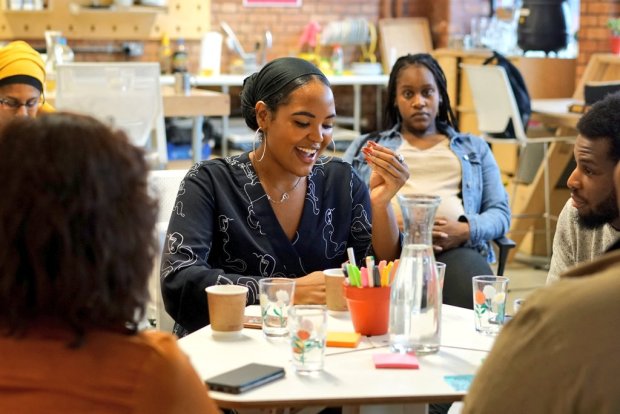
UK-based writer and curator of Bajan and Jamaican heritage, Aliyah Hasinah, shares her first blog post about her Fresh Milk international residency. Using this time primarily for research into the art scene and cultural policy in a Barbadian context, Aliyah kicks off her blogs by reflecting on some of the texts she has immersed herself in to ground her knowledge and understanding of the space, and looks forward to having more in-person discussions with artists, creatives and cultural practitioners as the weeks progress. Read more below:


It’s been a week since I started my residency at Fresh Milk with the intention of immersing myself in study to learn more about the art world and cultural policy in Barbados. Having not had the means to attend university, I’m always profoundly grateful for moments to study away from the day-to-day grind of trying to pay your rent in London, so hearing monkeys (my favourite animals) on the library roof has been a well welcomed change. I’d also like to thank Arts Council England for funding this residency because I’ve been LEARNING, I’ve been learning *Beyonce voice*. 

Prior to this, I met with Annalee Davis last year when starting my research into ‘Decolonising the Curatorial’, as funded by Arts Council England. My research was looking at the role of Crop Over as a space for exhibition outside the white walls of the gallery, a topic Claire Tancons discusses well in her essay ‘Curating Carnival’, and how galleries can never do justice to the embodied experience of carnival. 

Through my research, I sought to further understand the colonial history and how rebellions birthed art practices – or continued them – as we’ve always found ways to make art. Having only scratched the surface last year, I was keen to take more time to understand the layers and nuance of Bajan Art and cultural expression, outside of what was familial and familiar to me.

Just to prefix, I’m a loud mouth when it comes to explaining or calling out the manifestations of coloniality in the modern day in England. However, I’m very aware of my positionality as a curator from Britain researching in Barbados. My gaze does not come from one of authority but is an opinion formed from the research and conversations had with some of the island’s artists, art producers, essays as well as what I observe. 

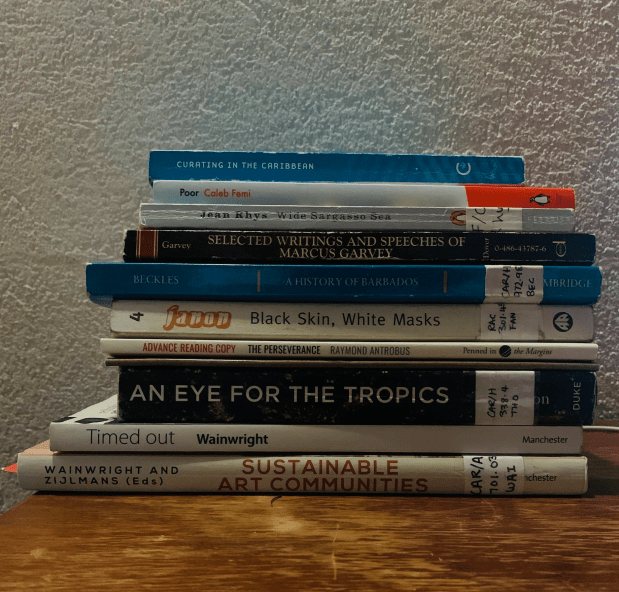
One of the writings I’ve been reading this week that deeply resonated with me was Winston Kellman’s Between A Rock And A Hard Place’ published in Sustainable Art Communities, as edited by Leon Wainwright and Kitty Zijlmans. Kellman explores several historical threads to bring us to the modern day, including the relationships with the UK and US following Barbados’ independence in 1966.

Kellman’s particular highlighting of how western modernity has shunned Caribbean art practice of landscape painting and sculpture, alluding to it being devoid of conceptual fervour is, in my mind, linked to a colonial mindset that deems ‘conceptual art’ in a particular way. 

This perspective ignores the context of the space and time that these artworks were created in, and instead attributes an archetypal aesthetic to the notion of contemporary art as opposed to understanding that sculpture and painting of the island has a deeper rooted contextualisation in the resources i.e. clay, and historical craftsmanship of the land – and is therefore contemporary if it is being made in the present. This disregard for painting and sculpture subconsciously alludes to artworks, often by Black artists, specifically in the Caribbean, being inferiorized because of a lack of contextual understanding of how the work came into being, and is additionally sidelined in national and international discourses surrounding contemporary conceptual art. All due to a lack of understanding of the context of the work. 

Anywho, I could go on for days about the learnings of the last week, all to say I’m very excited to deepen my study and continue learning about policy, sustainability and the hopes/dreams of emerging artists on the Island. The culture is very much being pushed forward by multiple artists. It is with thanks to those who have laid the foundations that younger artists today are scoping out what is possible in the process of building visual arts communities and infrastructures across Barbados that do not solely privilege the tourist economy (more on that real soon, hold tight tourism as neo-colonialism and insert Mo the Comedian saying ‘Barbados’).

I’m excited to start my new week, meeting more artists, collectors and academics. I may also post some of my readings and thoughts on my instagram (@aliyahhasinah) as I jump into my second week at Fresh Milk.

To end lightly here are 5 songs I’ve had on loop this week:

Until next week.

Lots of love and take care

Aliyah xx

P.s. Here’s some of what I’m reading / have been the last week and will continue to delve into this week, and hold tight Caleb Femi on the release of his new poetry book ‘Poor’ which everyone should cop if they can. (Feel free to send me reading and art recommendations on twitter @aliyahhasinah)
Announcing Fresh Milk’s November 2020 Artists in Residence!

Fresh Milk is delighted to welcome two creative practitioners to our International Artist Residency Programme from November 2nd – 28th, 2020! While our team made the decision to scale back our programming this year as we work to reconsider the future of the platform, Fresh Milk is honouring its previous commitments to pre-planned residencies.

As such, we are excited to introduce Haitian artist Pascale Faublas – who is joining us as part of an artist exchange programme with Le Centre d’Art, Haiti, to create opportunities for women arts practitioners, supported by UNESCO’s International Fund for Cultural Diversity (IFDC) – and UK-based writer and curator of Bajan and Jamaican heritage, Aliyah Hasinah.


About Pascale Faublas:

En français:

Pascale Faublas est née  à Port  au Prince en 1961, elle vit et travaille en Haïti. Après trois décennies d’une carrière artistique prolifique, PASKAL s’affirme comme  artiste plasticienne dans le paysage de l’art contemporain haïtien, développant une technique originale faite de collage de papier préalablement imprimés au moyen de techniques acquises en autodidacte : mixed media, encre et acrylique, batik, grattage, monotype, tout en se basant sur une recherche de matériaux issus de son environnement et sur les principes de l’art de la récupération.

In English:

Pascale Faublas was born in Port au Prince in 1961, and currently lives and works in Haiti. After three decades of a prolific artistic career, PASKAL is an established visual artist in the landscape of contemporary Haitian art, developing  original, self-taught techniques using collages of paper previously printed on, and working in mixed media, ink and acrylic, batik, scratching, and monotype. Their practice utilizes materials from from the environment, and is based and on the principles of the art of recovery.

FB: pascalefaublas
IG: @pascalefaublas

________

About Le Centre d’Art:

Le Centre d’Art in Port-au-Prince is an institution that works towards promoting artistic creations by Haitian practitioners on the basis of preserved heritage values. Since its creation in 1944, this atypical space with multiple missions has been at the heart of societal and artistic evolutions. As the major protagonist in the reconfiguration of the fine arts realm in Haiti, Le  Centre d’Art has been paving the way for several schools and artistic movements.

Despite the destruction of the infrastructure during the earthquake of 2010, Le Centre d’Art managed to save more than 5000 works and 3000 archive files, which are today preserved and valued. Since the reopening in 2014, Le Centre d’Art has once again become an essential part of Haitian culture.

Its mission is to support artists and their creations, and to conserve and disseminate Haitian visual arts. It is a resource space for artists, art students, art lovers, collectors and researchers alike.


About Aliyah Hasinah:

Aliyah Hasinah is a curator and writer of Bajan and Jamaican heritage, raised in Britain. Her practice focuses on decolonial approaches to amplifying nuanced Black storytelling through installation art, film and exhibition.

She has curated for Birmingham Museum & Art Gallery, Southbank Centre, Eastside Projects, Ort Gallery, Wolverhampton Museum and Art Gallery and more. In 2019 Arts Council funded her research in ‘Decolonising the Curatorial’ that took place in the UK, Barbados, New York & Bahia, Brazil.

Whilst on residency at Fresh Milk Aliyah aims to learn more about West Indian Art History and Black conceptual immersive art in the modern day.

We are not separate.

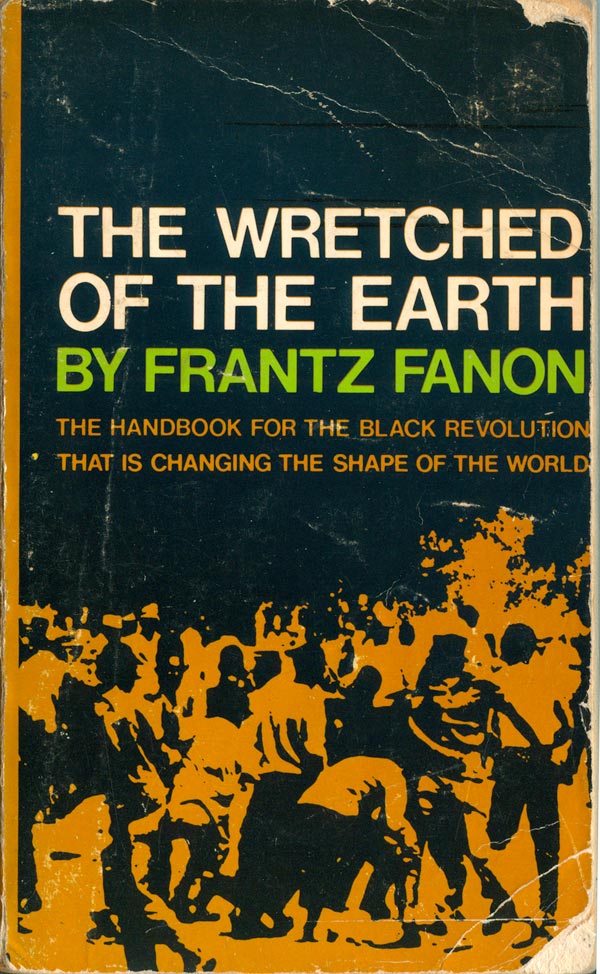
In May 2015, Barbadian artist Ronald Williams wrote a review about Frantz Fanon’s ‘The Wretched of the Earth‘ for the Fresh Milk Books platform; a book that addresses the complex role violence, protests and resistance play in decolonisation.

The Wretched of the Earth - Frantz Fanon

“My mind kept drifting across the Caribbean Sea as I read. It drifted and eventually channelled into the relatively recent acts of police barbarism in the U.S.A. It’s not because it’s a current issue that I feel connected, it’s slightly personal. I could just as easily be at the mercy of this brutality had I been born 20 degrees north and west.”

Five years later, Ronald’s words continue to ring true. We are not separate to this fight. Caribbean voices and experiences are a necessary part of the discourse as we not only empathise, but stand in solidarity against what is happening globally, and challenge the ways systemic racism has manifested and damaged our region.

Fresh Milk’s 2019 in Review

Thank you for your continued support of Fresh Milk!

At the Fresh Milk Art Platform, we believe in the visual arts and its capacity to empower young artists and bring the Caribbean closer together. Through our local, regional and international programming, we have witnessed the benefit of investing in the arts, a sector that is increasingly vital now more than ever before.

With your valuable support, we will continue to contribute to the professional development of visual artists in Barbados, the Caribbean and its diaspora through our streamlined programming in 2020. While hosting fewer artists on site at Fresh Milk, this year’s residency focus will be on Caribbean Linked – a regional residency uniting artists from all linguistic territories in the region. We’ll also be fostering new international residency opportunities for Caribbean-based professionals.

A special focus for Barbados is the We Gatherin’ project and Fresh Milk is keen to participate to this unique event. If you’d like to work with us to commission new work by local artists for the 2020 Fresh Stops project or support new work for the Fresh Milk Art Board,
click that donate button!

It’s very easy to support us by making a donation through this PayPal link. Your contributions make our programmes possible, and gifts of any size are welcome.

The Fresh Milk Team offers warm thanks and deep gratitude,
and invites you to reflect on 2019 with us in our annual
year in review newsletter!

TVE 2019 Online Exhibition

Fresh Milk is excited to launch the Transoceanic Visual Exchange 2019 Online Exhibition, which will be available for viewing between November 23rd – December 21st.

Exhibiting artists include:

Wang Chen (China/Australia) – My Little Brother and Secret
Chen Dandizi (China) – Deep Relax
Luk Gama (Guadeloupe) – Tan boudé chiré…
Versia Harris (Barbados) – For Peace
Zhiliang Jin (UK/China) – Shareable Horizons
Kadiejra O’Neal (Barbados) – Gestation Period
Ada M. Patterson (Barbados) – Buchibushi and Rammelaar
Richard Mark Rawlins (Trinidad & Tobago) SUGAR
Kia Redman (Barbados) – Roots | Routes and Surround Sounds
Sucheng (China) – 一千零一夜 (At This Moment)
Zhao Xu (China) – Stranded Dreams

_____________________

Have a Question about TVE?

If you have a question about the TVE programme, or want to engage directly with the Caribbean and Chinese artists about their work, the #askTVE form lets you submit your feedback and questions directly to our team, and we will share the artists’ responses with you in an open forum!