Caribbean Linked VI – Live Conversation II

The regional residency Caribbean Linked VI, co-managed by Ateliers ’89 (Aruba), The Fresh Milk Art Platform (Barbados) and ARC Magazine is conducting all of its programming and support virtually this year, with live public conversations between the artists taking place on Wednesday, August 11th and Tuesday, August 31st. As usual, the residency’s programming supports creatives across the French, Spanish, English and Dutch speaking Caribbean.

The second conversation will feature  Claudio Arnell (Saint Martin), Romelinda Maldonado (Aruba), John Reno Jackson (Cayman Islands), Samuel Sarmiento (Aruba/Venezuela) and Béliza Troupé (Guadeloupe)..

Watch the conversation on live on YouTube on August 31st from 4:00 pm – 5:00 pm AST at the link above!

For more information, please visit the Caribbean Linked website.

Caribbean Linked VI – Live Conversation I

The regional residency Caribbean Linked VI, co-managed by Ateliers ’89 (Aruba), The Fresh Milk Art Platform (Barbados) and ARC Magazine is conducting all of its programming and support virtually this year, with live public conversations between the artists taking place on Wednesday, August 11th and Tuesday, August 31st. As usual, the residency’s programming supports creatives across the French, Spanish, English and Dutch speaking Caribbean.

The first conversation will feature  Taisha Carrington (Barbados), Akley Olton (St. Vincent and the Grenadines), Susana Pilar (Cuba), and Sarabel Santos-Negrón (Puerto Rico).

Watch the conversation on live on YouTube on August 11th from 4:00 pm – 5:00 pm AST/EST at the link above!

For more information, please visit the Caribbean Linked website.

Caribbean Linked VI Launches Virtual Edition

The regional residency Caribbean Linked VI, co-managed by Ateliers ’89 (Aruba), The Fresh Milk Art Platform (Barbados) and ARC Magazine will be changing its focus this year in light of the severe impacts that the COVID-19 pandemic has brought upon the lives of artists regionally. Caribbean Linked VI will be conducting all of its programming and support virtually from July 30th – August 31st, 2021, with live public conversations between the artists taking place on Wednesday, August 11th and Tuesday, August 31st from 4:00 pm – 5:00 pm AST on each day. As usual, the residency’s programming supports creatives across the French, Spanish, English and Dutch speaking Caribbean.

Participating artists for Caribbean Linked VI include Claudio Arnell (Saint Martin), Taisha Carrington (Barbados), Romelinda Maldonado (Aruba), Akley Olton (St. Vincent and the Grenadines), Susana Pilar (Cuba), John Reno Jackson (Cayman Islands), Sarabel Santos-Negrón (Puerto Rico), Samuel Sarmiento (Aruba/Venezuela) and Béliza Troupé (Guadeloupe).

This residency will allow the participants to be exposed to the practices of other emerging Caribbean artists, providing an opportunity to strengthen regional connections and cultural understanding. This edition of Caribbean Linked is being conceptualised as a bridging year, with participating artists still scheduled to meet physically in August 2022 at Ateliers ’89 in Oranjestad, Aruba.

Now more than ever in light of COVID-19, it is critical to mitigate isolation and use available technologies to advance creative production, critical thinking and engagement. This preliminary remote encounter is focused on provisioning artists with dedicated studio time to make new works, while reinforcing the value of Caribbean artists’ practices and enabling their growth and development.

The writer in residence for the virtual edition will be Ethan Knowles, an emerging scholar and writer from The Bahamas currently studying in Rome, Italy. This year’s specially invited curators will be Sofia Olascoaga, an academic curator at MUAC (Museo Universitario de Arte Contemporáneo – UNAM) in Mexico City, where she coordinates Campus Expandido an academic programme of critical theory, and Miguel A. López, former chief curator of TEOR/éTica turned independent curator living and working in Lima, Peru.

The month long residency will be supported by the generous funding provided by BankGiro Loterij Fonds, Mondriaan Fonds and UNOCA.

For more information or to request interviews with any of the participating artists, please contact the Caribbean Linked Team at caribbeanlinked@gmail.com, and visit our website caribbeanlinked.com to learn more about all editions of the Caribbean Linked residency programme.

Matilde dos Santos writes on CATAPULT Awardee Gwladys Gambie for Madinin’Art

Martinique based historian, art critic and independent curator Matilde dos Santos, who was one of the guest curators/mentors selected to conduct studio visits with 6 of the 24 CATAPULT Stay Home Artist Residency participants, has generously offered to write features on each of the artists she engaged with during the programme. The fourth piece focuses on the practice of Martinican artist Gwladys Gambie!

Read the article, originally published in French on Madinin’Art: Critiques Culturelle de Martinique (January 10th, 2021), in English below!

Gwladys Gambie, Incandescent scars

In August 2020, Fresh Milk (Barbados) and Kingston Creative (Jamaica), with the support of the American Friends of Jamaica (United States), launched CATAPULT | A Caribbean Art Grant, a programme which, through six initiatives, provided direct financial support for five months to more than 1,000 Caribbean artists and creatives affected by the pandemic. One of these initiatives was the Stay Home Artist Residency (SHAR). Twenty-four artists were selected and the residencies were spread out into three groups from September 21 to December 11. I was delighted to be one of the visiting curators, and it is a pleasure to share the outcomes of these meetings with you.

Cartographie sensible (detail) SHAR residency November 2020, courtesy of the artist

Gwladys Gambie, an artist from Martinique, was selected for the home residency opportunity, so I was able, between one confinement and the other, to visit her studio in person.

Gwladys was born in Fort de France in 1988. After studying literature and education, she entered the Caribbean Arts Campus and obtained her DNSEP (Master) in Visual Arts in 2014. Gwladys’ work explores her own body and revolves around the character Manman Chadwon (mother sea urchin), a kind of divinity invented by the artist. Through drawing, collage, sculpture, sewing or embroidery, the artist works with voluptuous body shapes adorned with thorns, forceful yet evanescent. In recent years the artist has participated in several residencies, including Création en cours initiated in 2018 by the Ateliers Médicis in Guadeloupe and Caribbean Linked V organized by Ateliers’ 89 and Fresh Milk in Aruba. She has also participated in the Fountainhead Residency, in Miami (2019) and most recently the CATAPULT SHAR. Gwladys also participated in the international exhibitions Désir Cannibale at the Little Haiti Cultural Center in Miami, as part of the Tout-Monde Festival (2019), and in the Mercosur Biennale (2020), held on-line due to the COVID pandemic.

Corps paysage, felt on paper, 2018, 65 x 50 cm. Courtesy of the artist.

Corps paysage, felt on paper, 2018, 65 x 50 cm. Courtesy of the artist.

In her drawings, the female body is laid out into a dreamlike landscape. All-powerful femininity displays full bodies assuming their sensuality. Paradoxically, the delicacy and precision of the drawing impart a kind of harshness. It’s Manman Chadwon, Afro-Caribbean deity, a bit Mami Wata, a bit Manman Dlo, her body bristling with quills. An avatar of the artist that incorporates both softness and pain.

In her drawings, black and white dominates. Color comes in small touches and until recently, almost always by collage. Then, there is the red ink, connecting her work to the present day violence: against women, or the soil in Martinique poisoned by chlordecone. Emanating from these bodies drawn in black or red are real ecosystems supporting minerals, plants, and animals. In an organic landscape, the body spreads out, secretly forming folds that both enclose and exhibit.

The birth of Manman Chadwon, 2018, ink, collage on paper, 75 x 100 cm, courtesy of the artist

Cartographie sensible (detail) SHAR residency November 2020, courtesy of the artist

We can link Gwladys’ work to that of female artists, who since the 1960s have built a feminist aesthetic designed to liberate women’s imagination. The work of many artists who do not claim to be feminists shares common traits none-the-less with the feminist movement as a whole, such as the affirmation of the body and the deconstruction of stereotypes, or in the practice of strictly feminine crafts, such as embroidery and sewing, which triggers a subversion of hierarchies by promoting what was usually considered as subordinate. A combined concern for issues of gender, race, ethnicity and social class forms the basis of a feminism that is reinventing itself today through the enhancement of an exacerbated femininity, which, rather than denying sexist stereotypes, reappropriates them and throws them back in the face of the public.  In its pop version, this appears in the form of vertiginous heels and superlative “bondas”. Gwladys’ femininity is radical, yet poetic; assuming violence portrayed by omnipresent thorns that render both pleasure and protection. Thus, we can compare her works to those of the Haitian artist, Florine Démosthène, and her round heroines endowed with monumental buttocks, as doubles of the artist. Her work is also comparable to White shoes (2015), a performance of the photographer Nona Faustine, who exposed her own ‘unconventional’ naked body perched on white pumps while she browsed places linked to slavery in New York, such as Wall Street, an ancient slave market. Or, yet again, to the drawings of black women by Rosana Paulino, their bodies always round, always a little the artist herself, or to Paulino’s use of sewing to roughly patch up photos of naked slaves, or the way she obliterates the eyes, throats or mouths of black women by stitching over them as if to emphasize the state of servitude in which they are found, while their photos are delicately presented on embroidery hoops.
Cartographie sensible (work in progress) SHAR residency November 2020. Photo by Matilde dos Santos

Gwladys’ works breed rebellion: against stereotypes of black women’s bodies, against objectification and fantasies of sexuality tainted with exoticism. The artist would like to reinvent eroticism, with drawings of a touching sincerity: full bodies, black skin, challenging the canons of beauty. Thorny bodies, triple breasts, powerful yet fragile bodies; vulnerability as a weapon. To make the body of the black woman, for a long time the territory of all oppressions, a decolonial body: neither in the Western norm, nor against it, but rather outside the norm. Rooted in ancestrality.

The link with African ancestrality has been widely claimed in recent years by artists from the diaspora. With Gwladys this demand is visceral, as the need to examine oneself, to express oneself. The use of Creole, and poetry, which invade certain drawings, goes without saying. This is because Creole goes straight to the heart of things. A language that is very imaginative yet straightforward, like the visual language of Gwladys.
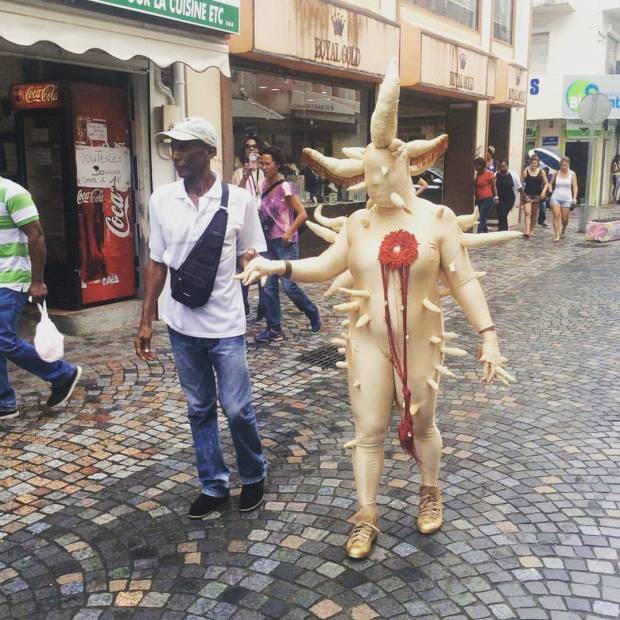
Ambulatory performance, The beautiful monster, FIAP 2017, Fort de France. Courtesy of the artist

For the SHAR programme, Gwladys experimented with needlework. Her particular affinity with sewing was noticeable in her work with “grennen” (frizzy) hair while she was still in art school. She built mole sculptures with hair; weaving, knotting and sewing, adding beads, fabrics, and frills. In the sequence, there were performance costumes, including that of FIAP 2017, a full leotard that she had personalized with rather coarse protuberances and adorned with pearls and fringes. Later on, after discovering the Moko Jumbie from Trinidad, she feminized the costume even more while keeping the thorns. It then became Moko Chadwon (2018). The Moko Jumbie is not just a dancer on stilts, the name retains its African origins, the idea of ​​a healer, and from the Caribbean, the word “jumbie” meaning spirit. This is probably why in 2020, to participate in Trinidad’s carnival, Gwladys added a fringed crown to her red costume; in it, I recognized the “odê” with “imbé”, which hides the face of certain orishas in Afro-Brazilian and Afro-Caribbean rites.

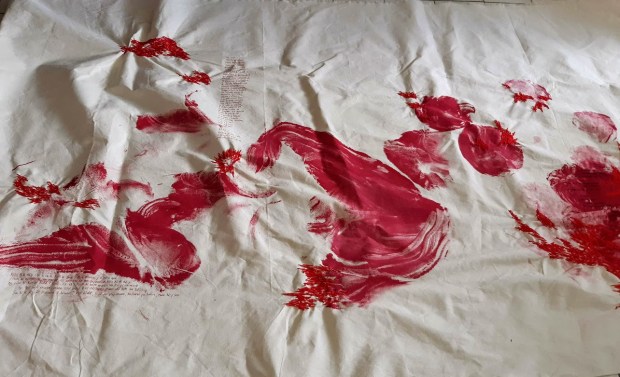
During the first part of confinement, Gwladys participated in a collective residency in the 16M2 art space in Fort de France. Since the shops were closed, she was forced to turn this constraint into an opportunity and use an old transparent curtain that was a little frayed as support. So she incorporated the holes of the fabric into her embroidery, a technique she was only just then discovering. The connection was immediate and very quickly her work was very successful. The idea of ​​reparation guided her. And while physically she was repairing the fabric, it was also the health of the world, the bodies of women, history itself, that was being symbolically repaired. In the SHAR residency, Gwladys wanted to give continuity to the embroidery work on two types of support: the first was an unbleached cotton fabric, a little thicker than a canvas, on which she made rough imprints of the erogenous parts of her body. (buttocks, breasts, thighs, crotch) in red ink. On these prints, she subsequently added random embroidery. On photos of fragments of the work, I imagined, with the help of red, that it was drawing a woman’s reproductive system; in front of the whole work, we can see that every figure is pure interpretation. The imprint is indeed that of the artist’s body, but deliberately they are fragmentary imprints whose shape cannot be easily identified and on which the embroidery is applied in a hazardous manner. The large size of the support allowed her to work on the idea of ​​a geography of emotions making an epidermis of the tissue, on which the artist embroidered scars. Fragments of texts add depth to the work and the color red gives them a false air of Chinese characters.

The second support was a banana leaf. The confinement once again forced the artist to review her way of creating. Working on a living natural object was a novelty for Gwladys. Laying the leaf flat on a stand, she felt like she had a body on the operating table, ready to respond to a double health emergency: Covid and chlordecone. Find an antidote for the poisoning? Circumscribe it? Talk about it anyway. And always this idea of ​​repair. The leaf is fragile, so the artist wanted to embroider the edges to prevent them from fraying. As she embroidered it, the leaf followed its natural process of deterioration, which the artist documented in photographs. The intense red magnifies the wound as the leaf gently rots. A first draft, beautiful and moving, which resonates with a poem by Brazilian Cristiana Sobral that I have only just discovered:

I have an incandescent scar of pain
But it’s only inside
Outside I drew a flower

– Matilde dos Santos – Historian, art critic and independent curator

Appreciation to the partners of the CATAPULT programme: The American Friends of Jamaica, Kingston Creative and Fresh Milk.

The SHAR participants described their experiences in blogs that you can read on the Fresh Milk platform here.


For further information:

Artist Gwladys Gambie’s website: http://gwladysgambie.blogspot.com/

Website of the artist Florine Démosthène: https://florinedemosthene.com/home.html

On the performance White shoes by Nona Faustine: https://africanah.org/nona-faustine-white-shoes-project/

On Rosana Paulino and other women artists of Brazil and the Caribbean: https://aica-sc.net/2018/01/28/femmes-artistes-noires-bresiliennes-et-caribeennes-defier-linvisibilite/
Matilde dos Santos writes on CATAPULT Awardee Camille Chedda for Madinin’Art

Martinique based historian, art critic and independent curator Matilde dos Santos, who was one of the guest curators/mentors selected to conduct studio visits with 6 of the 24 CATAPULT Stay Home Artist Residency participants, has generously offered to write features on each of the artists she engaged with during the programme. The third piece focuses on the practice of Jamaican artist Camille Chedda!

Read the article, originally published in French on Madinin’Art: Critiques Culturelle de Martinique (December 11, 2020), in English below!


Last August, Fresh Milk (Barbados), Kingston Creative (Jamaica) and The American Friends of Jamaica (USA) introduced CATAPULT | A Caribbean Arts Grant. This program, through six different initiatives, directly provided financial support for five months to over 1000 artists and other Caribbean creative practitioners confronted with the COVID-19 pandemic. One such initiative was the Stay Home Artist Residency (SHAR). Twenty-four artists were chosen, and the residencies spread out over three groups from September 21st to December 11th. I was lucky enough to be one of the visiting curators, and am pleased to share these virtual visits with you.  Each meeting brought me something different; each artist moved me in their own way. I was particularly pleased to meet Camille Chedda, whose work I knew only through photographs.

Camille Chedda, Untitled, 2020, Installation on view at The Olympia Gallery, Kingston. Photo by Charles Allen. Courtesy of the artist.

Camille Chedda (Manchester, Jamaica, 1985 ) lives and works in Jamaica. She is a Visual Arts graduate of Edna Manley College and holds a Master’s degree in Fine Arts from the University of Massachusetts at Dartmouth. Her work is polymorphic and questions the post-colonial identity. Using materials from everyday life, she traces the decomposition inherent in all construction, notably in the perpetually ongoing construction: identity; her own personal identity merged with a possible Caribbean identity. Her works have been exhibited at the National Gallery of Jamaica, the Museum of Latin American Art, the Portland Museum of Art, and at the Wallach Art Gallery at the University of Columbia, among others. Recipient of numerous awards, such as the Albert Hume prize, the Reed Foundation scholarship, the first prize in commemoration of Dawn Scott, and the TAARE program prize from the British Council, she was also a resident artist at Alice Yard in Trinidad and Tobago, Art Omi in New York and at Hospitalfield in Scotland. A teacher at the Edna Manley College, in 2016 she became the director of the artistic and social project InPulse Collective, financed by Rubis Mecenat to support young Jamaican artists.

I was familiar with Camille’s paintings on plastic bags, such as Shelf Lives (2011), where she painted in acrylic a whole series of mini portraits of ordinary people on transparent plastic bags.  These portraits on disposable bags produced the disturbing sensation of lives also being disposable, expressing, in a simple yet highly effective way, the little value that can be given to the lives of the most precarious populations. I left Brazil a long time ago, but Brazil never left me, and everything I see reminds me of my country. That is surely why these characters, drawn with a few simple strokes, ready to be used and replaced, upset me so. On the same support, the artist created Wholesale dégradable, a series of portraits of people who have been killed by Kingston police, taken from official statistics and drawn from photos. Some of the characters, those for whom the artist could not find any photos, were replaced by other acts of violence, not necessarily current or Jamaican. In this way, the artist established a link between actual ordinary violence and the systemic violence of colonial history. There too, I can’t help but explain recurrent police brutality as a product of colonial history perpetuating itself.  The idea of a throw-away society is accentuated by the evanescence of the portraits evoked in Built-In obsolescence. Acrylic paint on plastic can break up in pieces, and this allowed her to play with time, notably with the notion of the expiry date.

Camille Chedda, Untitled (Built-in Obsolescence series, 2011-12), mixed media on plastic bag.

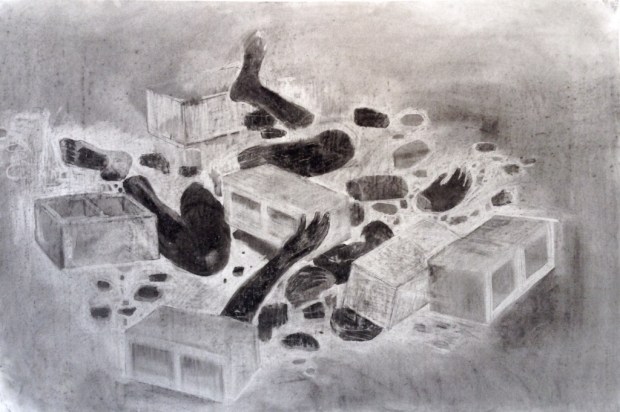
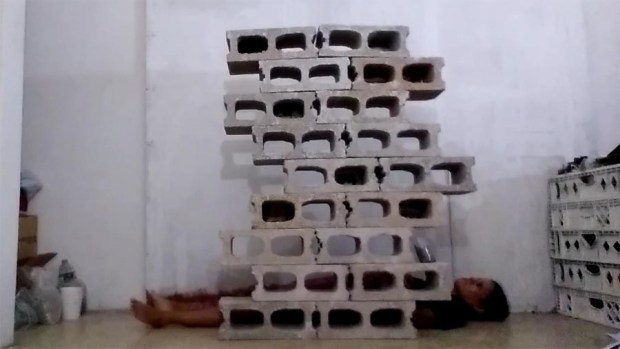
Another material very present in her work, the one she will use while in the CATAPULT residency, is cement blocks or cinder blocks. Depicted on carbon drawings in the series  Drop it low, 2016, these blocks refer back to videos that went viral in Jamaica in 2015 showing women lying on the ground on their backs during dancehall block parties, breaking cinder blocks between their thighs. Dancehall is often presented as a place for women to liberate themselves; but, these videos depicted mainly simulations of violent sex and women earning small change from the public for displaying their talent for breaking concrete blocks with their crotch, talents that can lead to serious health problems. For a black woman in Jamaica to criticise dancehall is not a comfortable position; but, it is the one Camille chose to take by showing her drawings of a woman destroying herself only to please others. And when we speak of self-destruction of black bodies, coloniality surely has something to do with it. Cinder blocks were also present in the installation Rebuild, shown at the Ghetto Biennale 2017 in Haiti. The piece referred back to the destruction of the city of Port-au-Prince in 2010 and its rebuilding still in progress, but also to the fragility of cement blocks, generally believed to be resistant but made fragile by the greed of manufacturers who put sub-standard blocks on the market. Such imitations were probably implicated in the destruction of Haiti by the 2010 earthquake. This material has accompanied Camille since 2016, and recently, on the Net, I saw her photos of body parts buried in a sea of sand and cinder block. I very much like the idea of construction/deconstruction and the link the artist makes with the body (and indeed the spirit, which she does not state, but very well could have).

Camille Chedda, Drop it Low at famous Wednesday,  2016. Charcoal on paper

For her CATAPULT residency, Camille chose to work with a stack of cinder blocks, a work that I discover at its very beginnings and which will develop quickly, to be shown first in a collective exhibit “…And I Resumed the Struggle at the Olympia Gallery, in Kingston from December 10th. The work, in its current state, was entirely done in the framework of the CATAPULT residence, also with the support of WARE (The Wattle and Red Earth). At the time of the visit, the piece was still in the early stages, and it’s still a work in progress.

Camille Chedda, work in progress. Screen shot.

In this work, Camille wanted to explore the notion of heritage in decolonial terms. The artist sees heritage as a sort of construct, an exogenous gangue totally oriented towards tourism and that does not consider (nor honour) the black population, which comprises the majority of the Jamaican population.

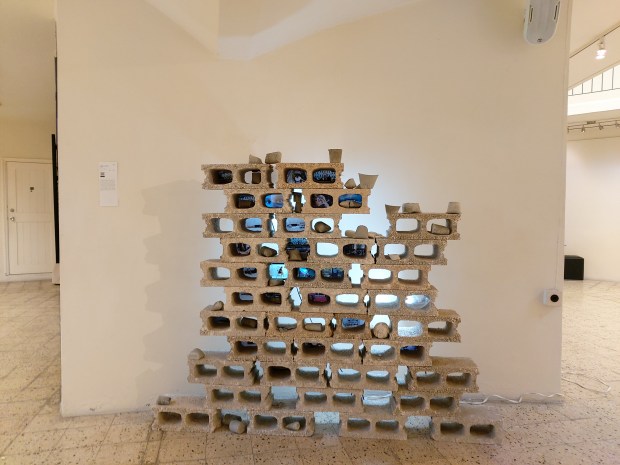
The origin of the piece goes back to 2019, but the actual making of it began last October. This piece is to be considered in association with The Three Disgraces, a collage from 2019, showing a wall being climbed over, at the same time blocking out three dancehall dancers, surrounded by images of money, the public, and children. According to the artist, these children are exposed to something presented to them as their culture and heritage. Starting from the idea of the wall and heritage, Camille began to conceive her new piece about the social construction of identity.  The cement blocks are stacked into a wall, and the openings in each concrete brick are filled either with tablets playing videos or with photos or objects… When seen from far away, it gives the impression of a tower of apartments from the outside. This evokes, simultaneously, the notion of construction and compartmentalisation, foundation and immuration; the raw finish and the unfinished assembly imply construction, the small occupied nooks, and the visible defaults suggest a ruin. This all made me think of the popular song by Caetano Veloso: “Here all seems to still be in construction but it’s already a ruin.” Caetano was speaking of Rio de Janeiro, but it is reminiscent of Camille’s work. Ruins under construction. A construction that breaks down in the very process of being constructed. More than programmed obsolescence, a sort of denaturalisation; where the foundation of ruins, that which builds, demolishes; that which elevates, cuts down.

During our conversation, Camille, who first wanted to depict the sea at the top of the wall, changed her mind and thought instead to perhaps fill in the top part with photos of heritage buildings, notably Rose Hall, an ancient mansion dating from the first half of the XVIII century.  Very imposing, the Georgian style home had been abandoned and fell to ruins in the ’60s, then renovated near the end of the ’70s by Americans who made a museum out of it. This museum displays a story of the plantation and the legend of the white witch of Rose Hall, a fiction. And it is this kind of fictional character who romanticised colonial heritage that Camille would like to question. Built during the pandemic, the piece evolved to give more and more space to screens, which with the pandemic have become practically the only means of socialisation for the confined population. On the theme of social and memorial constructions, the piece made me think of the installation sculpture of Cildo Meireles, Babel (2001). This monumental installation (over 9 meters high) is composed of a pile of 800 radios from different brands and epochs, tuned to different radio stations set at distinct yet hardly audible volumes.  Around the room, a bluish penumbra immersed the audience in the sound of languages from all over the world. I also thought, from having seen it in another CATAPULT program, the Lockdown Virtual Salon, of the piece Grand Crus, appellations contrôlées le retour by Richard-Viktor Sainsily Cayol, which is also a construction based on materials that have built our memory. The work of Sainsily Cayol has two versions, both made of oak barrels organised in pyramids placed on a triangular base under blue light. The first version (Dakar Biennale, 2014) presented barrels marked “compagnie des indes,” and on which are also engraved various names of African ethnic groups.  In the second version (Havana Biennale, 2019), unmarked barrels are bristling with prickles.

Camille Chedda, Untitled, Installation, The Olympia Gallery, Kingston, 10 décembre 2020. Photo by Veerle Poupeye.

Because memory is also a construction, sometimes with blocks of bad quality, Camille made me think of  Cahier d’un retour au pays natal, where Aimé Cesaire praised  those who have never invented or tamed anything. Perhaps we are not builders of cathedrals, but we do build, never-the-less.

– Matilde dos Santos – Historian, art critic and independent curator

Appreciation to the partners of the CATAPULT programme: The American Friends of Jamaica, Kingston Creative and Fresh Milk.

The SHAR participants described their experiences in blogs that you can read on the Fresh Milk platform here.


For further information:

On the work Babel by  Cildo Meirelles: https://www.tate.org.uk/art/artworks/meireles-babel-t14041

On Grands Crus versions 1 and 2,  see the artist’s website: https://sainsily-cayol.com/

Aimé Césaire, Cahier d’un retour au pays natal, 1956 © Seuil, 2006.

*Nous ne sommes pas des bâtisseurs de cathédrales is the title of a work by the Martinicain artist  Jacqueline Fabien