Sonia Farmer’s Residency – Week 3 Blog Post

Sonia Farmer writes about her third week in residence at Fresh Milk. Continuing her erasure poetry project using the text ‘A True and Exact History of the Island of Barbadoes’ by Richard Ligon while conducting her own exploration of the island, she contemplates the loaded act of ‘discovery’ and the implications it carries. She also shares the outcome of the challenging but successful third week of her book-binding workshop ‘The Art of the Book‘, which saw the students begin to create their own hardcover notebooks and leather journals. Read more here: 
1

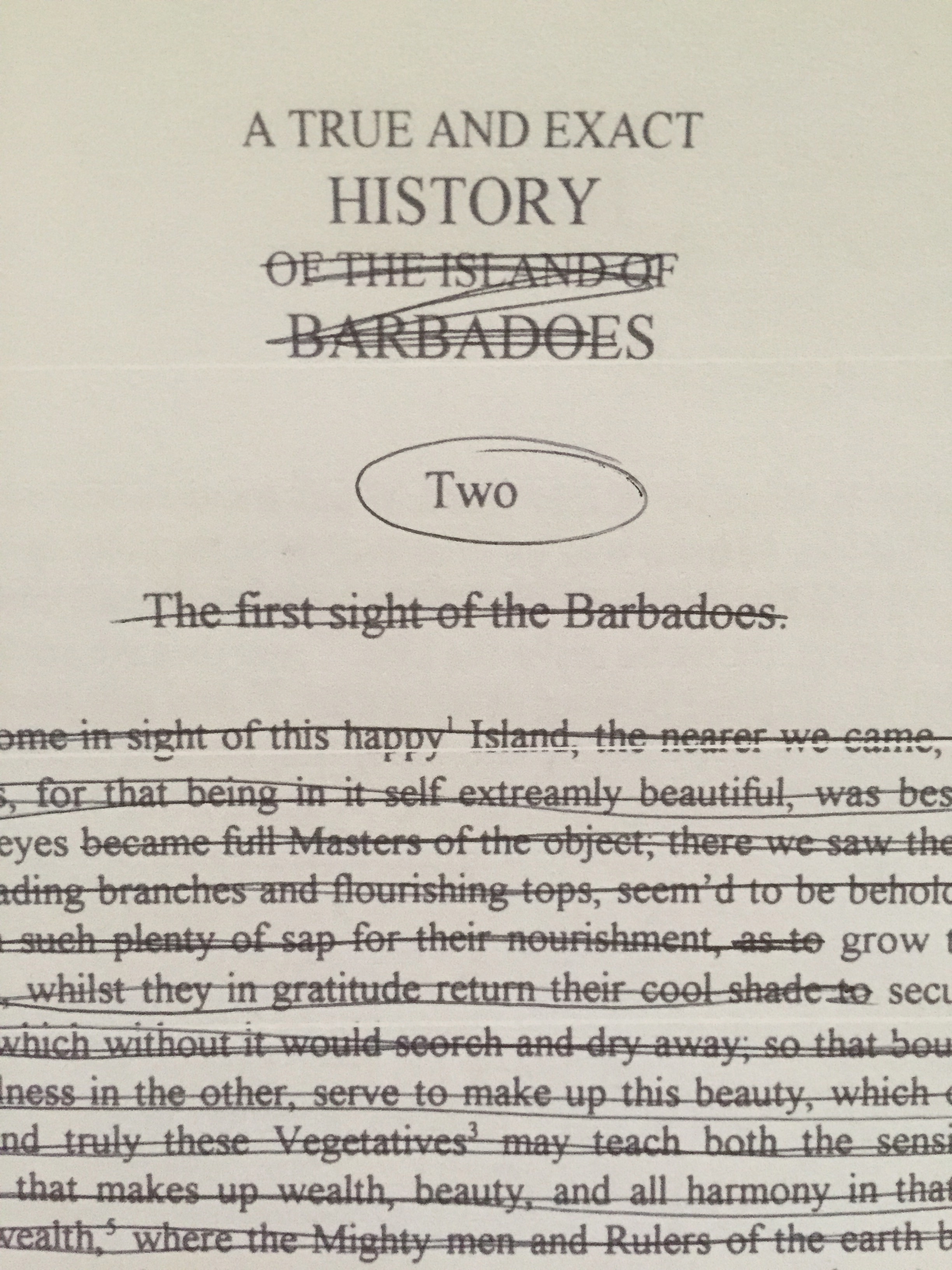
Lives in and out of the studio are converging in interesting ways given my chosen project. I’m still working my way through an erasure of A True and Exact History of the Island of Barbadoes by Richard Ligon, but also discovering more of the island myself. The week began with thrilling visits to Harrison’s Cave, Hunte’s Gardens, and Bathsheba, all self navigated with a car rental rather than a pre-arranged tour. We became dreadfully lost on the way to the cave, got soaked in one of those short-lived island downpours in the gardens, and found our recommended lunch place closed due to construction with dangerously low blood sugar levels—but we could say we had a pretty fantastic adventure. Similarly, I’m reconnecting with a Bahamian friend who lives here in Barbados. When she asks what I would like to do around the island, I answer, “Anything.” I’m hungry to see and do it all.

These moments bring out the romantic in me, even though I know all too well the often-frustrating realities of island living and rolling stone travel. But just as I felt during our Week One island tour, exploring a new space is a thing of wonder and an entirely individual experience, something that I am trying to honor and witness in my personal journey as well as my creative practice. I want to be an explorer, not only of physical space, but emotional space too—to study how we meet new experiences with both head and heart.

Is discovery the endgame? Discovery is a problematic word for me, but one that I have been turning over in my head as I think about what it means to write “a true and exact history” of anything: the weighty privilege of it, the naiveté, the narcissism, the violence, all inherent in that word as we have learned it, especially in the Caribbean. We all know the story: In 1492, Columbus sailed the ocean blue. Good for him. Not so great for others. Because we know that no place can be “discovered” that has already existed in the minds and hearts of others. What maybe can be discovered is something entirely individual and emotional, found on an inward journey while on the outward journey, and that discovery is completely personal. The “true and exact history” of the world as we have learned it is a myth. I don’t think discovery is an endgame here. Exploration and deconstruction, perhaps.

Because when I revisit this historical text by Richard Ligon, a man who, by his privilege, has found a spot in this island’s history, I am interested in deconstructing and reconstructing through the act of exploration. I’m drawn to finding a new narrative within the existing narrative, one that touches upon emotional landscape. And one that honors the fact that if I had approached the text on any other given year, or day, or hour, I could pick up on a completely different set of words and perspective. And that would be true for any other person I hand the text over to.

So I don’t want to think about the history of discovery, I want to think about the discovery of history. I want to think about the act of exploring. I want to explore what we carry and what we choose to include vs. what we overlook and what we choose to leave out. I want to think about the fragility of the moment in the process of choosing one story over the other, and why we are drawn to that. I want to think about making space and leaving room. I want to think about the stories we tell ourselves when we only have one version of history to work from, and how we can still find power and wonder and self-discovery in that. Or not. I have my own set of privileges guiding my through the process behind this project. So overall, I want to keep it personal, because there is no true and exact history.
10

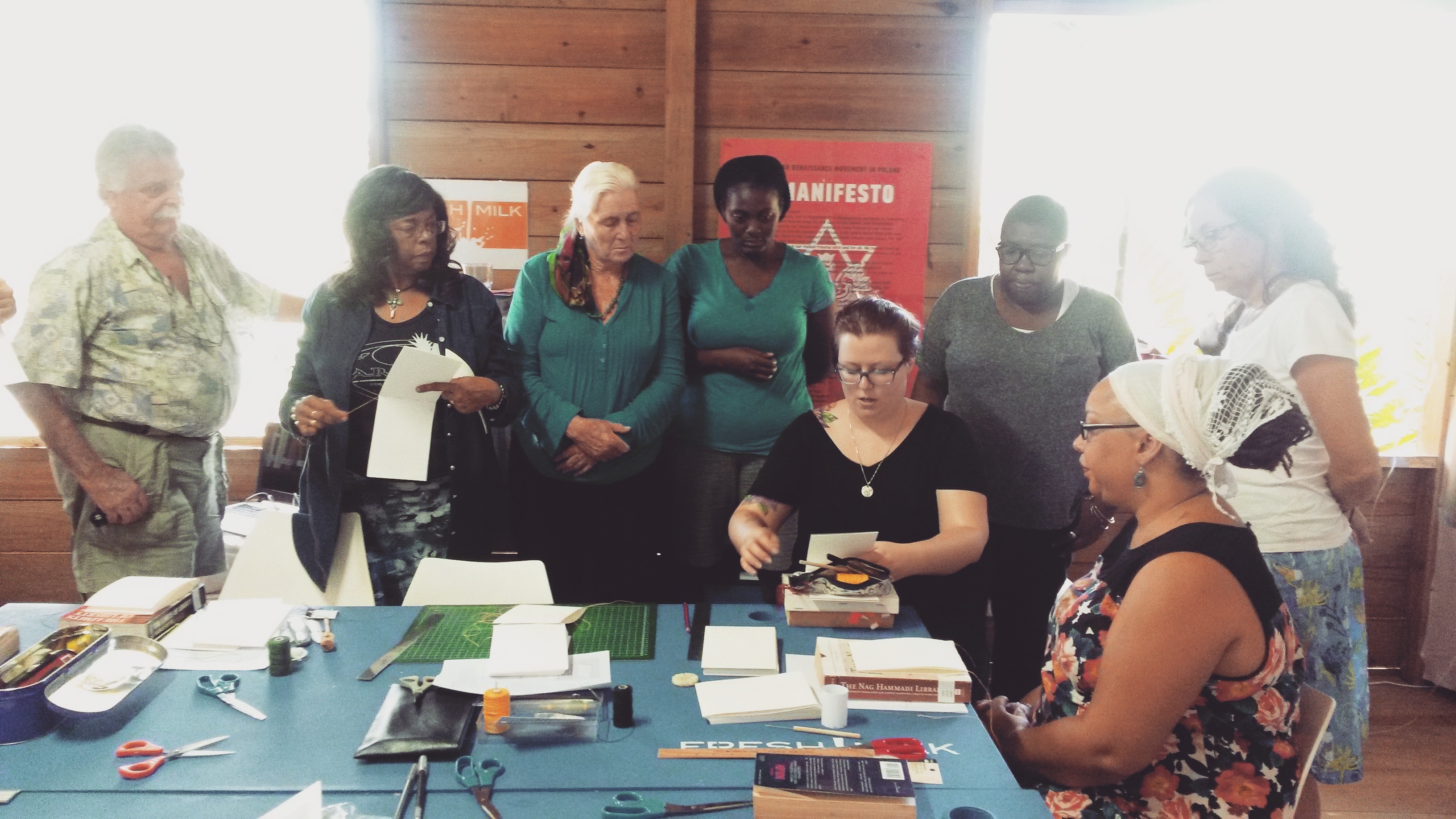
Meanwhile, setting aside the 24 hours I thought I was coming down with a flu but somehow gained strength from a fantastically indulgent meal at Chefette, my students crushed week three of our workshop when they sewed their first multi-signature text blocks to create two different blank notebooks. One will be an exposed-stitch hardcover, while the other will be cased into leather for a travel-notebook. As usual, I was completely too ambitious within my given time-frame, even though we extended the class by an hour. Luckily, week 4 is a catch-up class as well as a fun final class, so we will case in our notebooks, revisit a group project, and then make some quick fun book structures. Also luckily, they all had a blast even though I know it was a very challenging class and I couldn’t split myself into three people to assist everyone, but they passed with flying colors. I’m so proud of them!

Alex Kelly’s Residency – Week 2 Blog Post

Fresh Milk resident artist Alex Kelly shares some reflections from his second week in Barbados. In looking at some of the connections and common threads he has noticed in the region, he has revisited his use of a shipping pallet as a symbol of our reliance on imported goods. He has also been looking at the similarities and issues within the Caribbean’s educational systems, and the importance of encouraging critical thinking to avoid perpetuating unproductive cycles of action and thought. Read more here:

Image (3)

I’ve discovered for the second time how a change of environment can help to refocus my thoughts about work and about the space that I am discussing. I suppose the conscious act of applying for and participating in a residency is a way of surrendering myself to possibility. I become more in tune to the elements that potentially connect to define Caribbean people and their environment.

Within the boundaries of this particular space, where you can find water from Jamaica, films from the USA, dried seasonings from Puerto Rico and I shop in a supermarket chain from Trinidad and Tobago, the wooden shipping pallet that I had been working with since last August becomes significant yet again. It is a symbol of dependence on imported goods and cultural influences. In a moment of economic and political uncertainty, the lack of self reliance suggested by the pallet is noteworthy. It is quite striking that this symbol would be the one to connect my practice in three separate Caribbean territories.

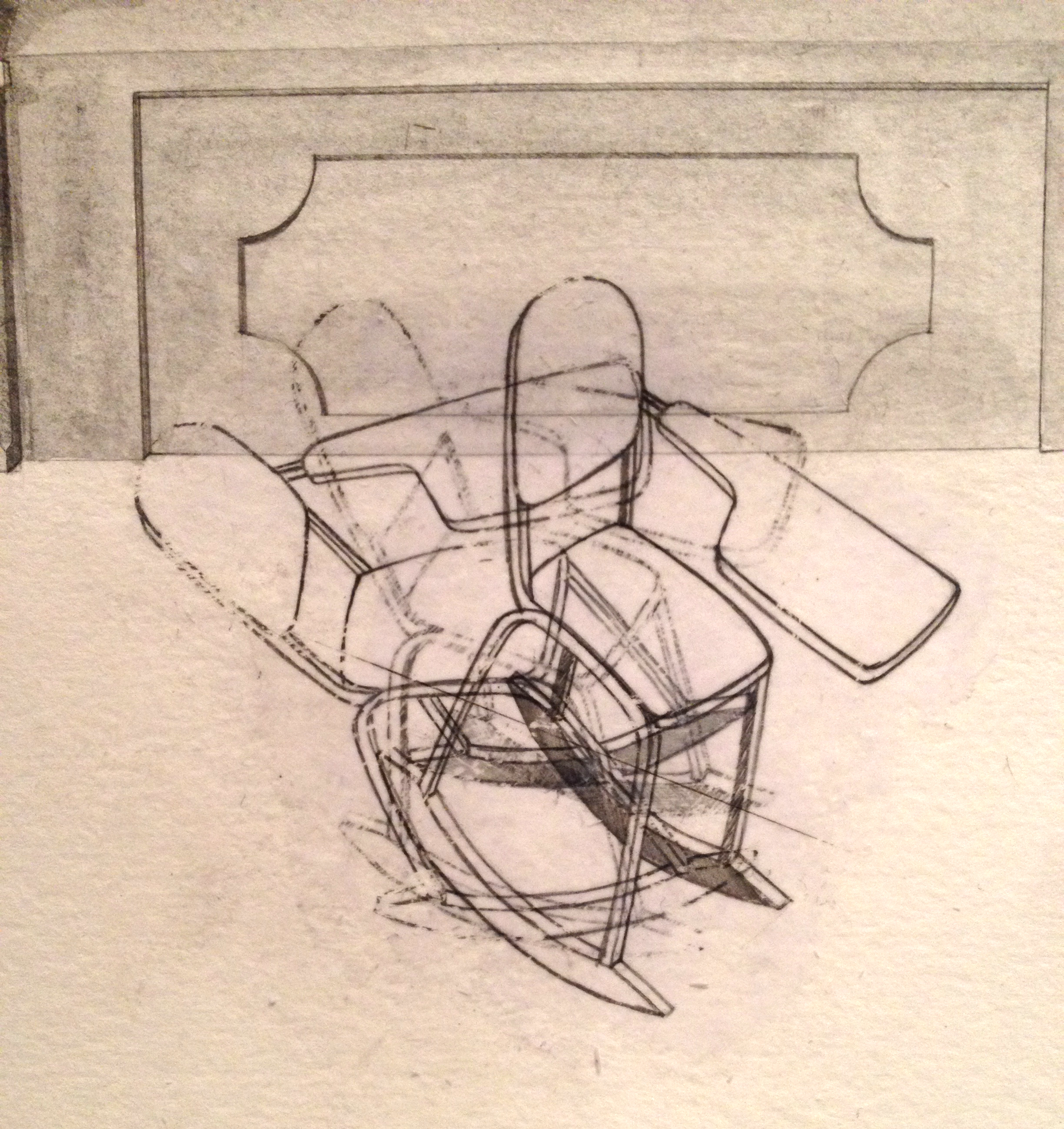
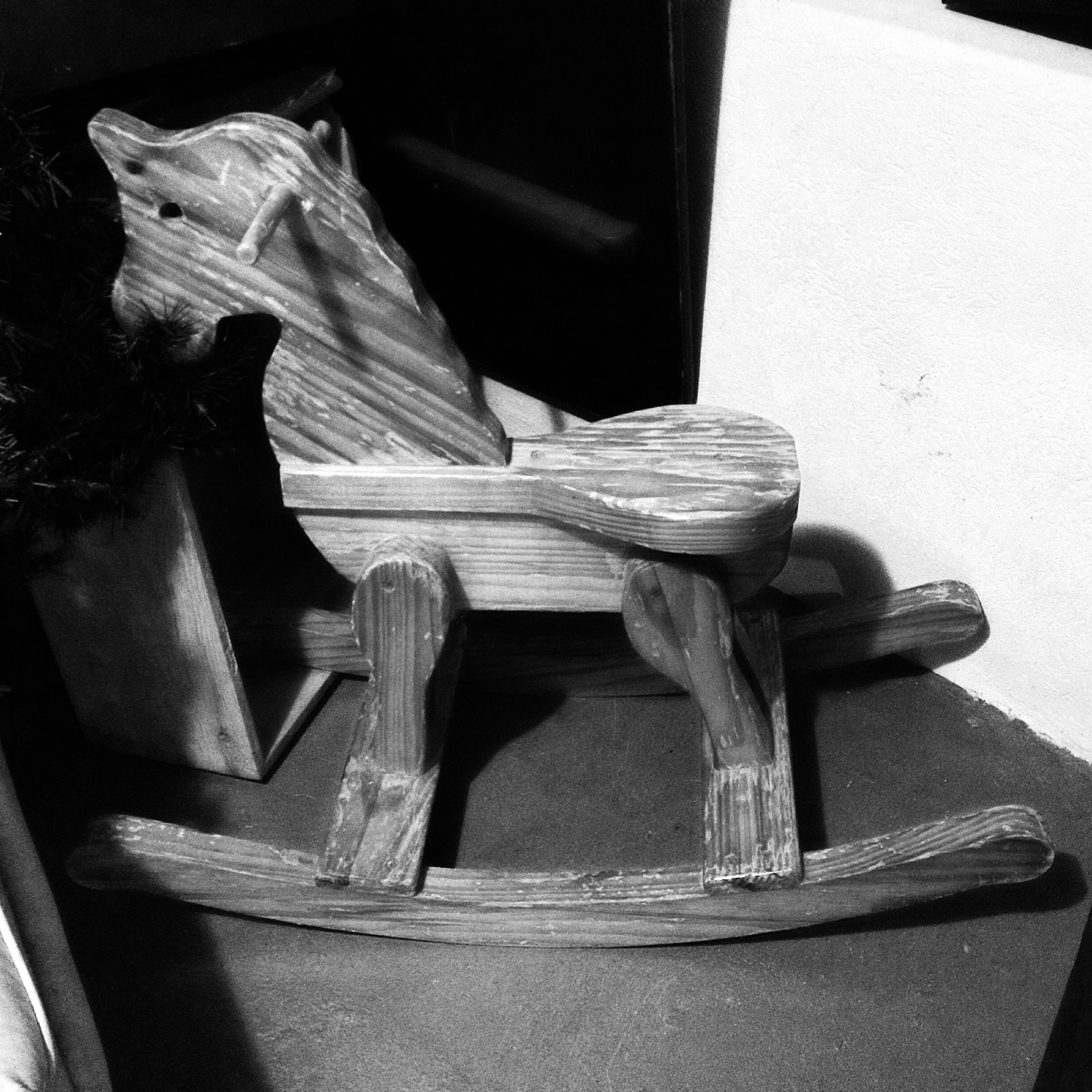
What has also struck me as significant is the shared education system and the role it plays in shaping the kind of citizens that individuals become. A conversation I recently had has  reminded me that the education systems of many Anglophone Caribbean islands are ultimately geared towards the same goal. So that each of the countries are equally influenced by a curriculum that was not designed to foster critical and creative thought or to nurture citizens capable of shaping the kind of environment that they desire. We are sitting in a rocking chair, moving vigorously back and forth, but making no progress. It begs the question, what effect might decades of this kind of action have on a people and their culture.

chair

Still, in spite of these and other similarities I have discovered, I find that my work represents a reality of life that seems frightfully specific to Trinidad and Tobago. In questioning how this work might be relevant in a wider Caribbean context I can only hope that a possible answer is, that it acts as an account of how we made it to where we are and as such provides a means by which other territories might avoid such a fate.

________________________

Tridium

This residency is supported by Tridium Caribbean Limited

Sonia Farmer’s Residency – Week 2 Blog Post

Fresh Milk resident artist & writer Sonia Farmer shares her second blog post. Although she came to Barbados with a specific project in mind, she has found herself drawn to a new idea based on a book in the Colleen Lewis Reading Room collection – ‘A True and Exact History of the Island of Barbadoes’ by Richard Ligon, originally published in 1657. Using a method of  found poetry called erasure, she is responding to the text by identifying words and phrases that stand out to her, changing the meaning and context to create an entirely new piece. She also hosted day two of her book-binding and design workshop ‘The Art of the Book‘. Read more below:

“I found myself a stranger in my own Countrey.”

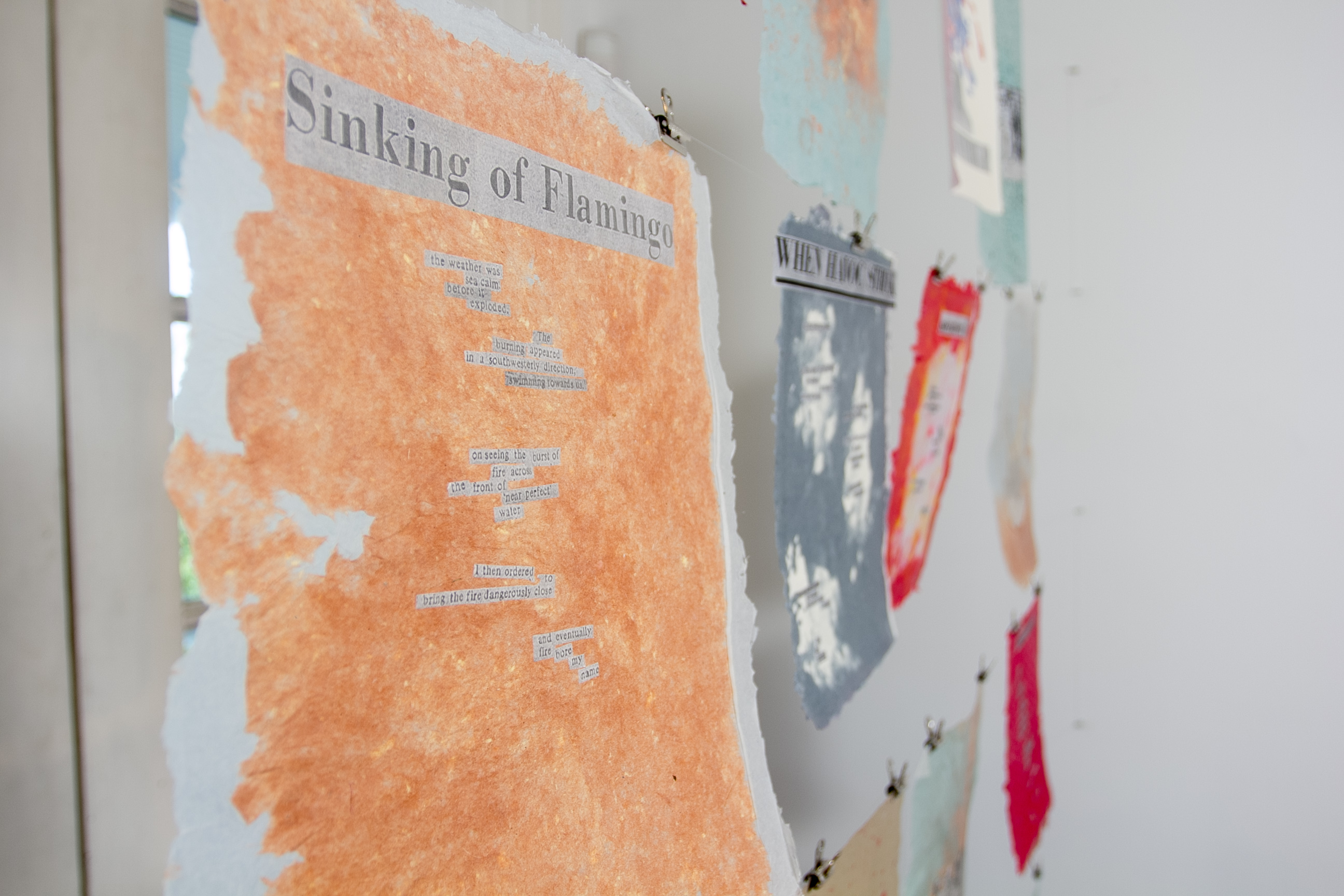
That line jumped out at me as I combed through the book, A True and Exact History of the Island of Barbadoes by Richard Ligon pulled out of the Colleen Lewis Reading Room library by Annalee when I asked if she had any old local texts. I had planned to use it for an erasure exercise in my first class, which I did, but immediately became obsessed with creating my own response to the book. I could see a new poem emerging from the strange story told from an Englishman’s perspective in the 1600s. Putting aside the project I had planned to focus on in my time here, I’ve allowed this new endeavor to drive my inspiration for the time remaining: an erasure called A True and Exact History, gleaned from this delightful account.

An erasure, as I explained to my students, is the act of removing words from an existing piece of text in order to create a new poem. I’ve always admired the method, specifically in the brilliant ways writer and artist Jen Bervin has used it, but didn’t explore it much myself until a few years ago. I’ve found more and more that I enjoy using one part erasure, one part found language to drive the content of my work—not because I find it difficult to use my own words, but because I love the challenge of such an exercise, finding new narratives from often outdated accounts to construct a contemporary response. I also enjoy using language against itself and out of context to bring attention to its disparities and contradictions.

I used this method a few years ago to form the collection of poetry in ‘Clipping Feathers’, taken from newspaper stories surrounding a major event in Bahamian history shortly after our Independence. With the fantastical narratives I constructed out of sensationalized accounts, I found a way to address the lack of contemporary Bahamian history studies—since, like me, many young Bahamians may not even know about this groundbreaking event, we are left to create our own fictions, a dangerous place from which to glean our national identity.

5

I’m coming from a similar place of ignorance with A True and Exact History. Purposefully, I am not “reading” the text as I seek out its underlying narratives. I also don’t yet fathom how important it has been in Bajan history, though through informal conversations with Bajans, I am starting to get the picture. I did read a little bit into Ligon’s background, finding that he arrived in Barbados late in his life after political upheaval in his home, built a sugar plantation, and then wrote this book in jail upon returning to England from Barbados. I don’t want to research too far, however, holding myself back so as not to directly influence my exercise, not yet anyway. The reason is because I want to be an explorer here in an unknown territory—as I am in these new surroundings. I’d like the narrative to form organically out of that experience.

The resulting narrative so far has been exciting to me in its abstracted exploration of emotional landscapes. I had said before that as a person from the Caribbean, visiting other islands in the region is an exercise in magical realism. This new poem is helping me to explore that and deconstruct it. After all, what does it mean to write a “True and Exact History” of anywhere or anything or anyone? How conceited is that? Recognizing the importance of this text is necessary, but not without the lens of colonialism and privilege. With his own biased eye and with centuries between its inception to now, the text is strangely poetic even at its most problematic moments. It’s a gorgeous text to explore and consider, and I hope it yields an interesting result by the end of my stay.

Week two of my Art of the Book class found us exploring the wonderful world of chapbooks, small presses, and simple sewn binding structures. I gave everyone a crash course in chapbook history and highlighted the work of a number of small, independent presses. Then we reviewed some student projects completed at home using last weeks’ structures and writing challenges. All I can say is I’m one proud teacher! The books they’ve made are awesome, fully engaging with everything these structures have to offer to their individual narratives.

Then we got to work on sewn structures, including the Japanese stab-binding and pamphlet stitch. In order to register for the class, students had to submit a poem of their choice. I gathered these into a simple chapbook called “Fresh Verse” and also made us a special press name, “Fresh Chaps,” under which we made twelve copies—one for every contributor, and two for the Colleen Lewis Reading Room itself. So by the end of the class, everyone got to bind a limited edition anthology of class poems. Who knows, maybe there will be a volume two someday?

Alex Kelly’s Residency – Week 1 Blog Post

Trinbagonian artist Alex Kelly shares his first blog post about his Fresh Milk residency. In the first week, he has been observing his surroundings in Barbados, drawing parallels to his own experiences of his home Trinidad and Tobago and even to Aruba, where he took part in the regional residency Caribbean Linked III in 2015. These familiarities and shared histories, which manifest in different ways and yet connect the region as a whole, have already become a source of inspiration for the artist during his short stay. Read more below:

IMG_2578

Exit the airport, navigate the roundabout and head past the rows of identical houses on route to your destination. Quick stop at a gas station convenience store to collect imported bananas, Blue Waters and a pack of Devon biscuits to hold you over for the night. At some point you pass cane fields and former cane fields only illuminated by the moon and by headlight. All the while you’re discussing economics; the collapse of the sugarcane industry and the ever present anxiety about the need for foreign revenue. One would be forgiven for assuming I was talking about Trinidad.

I have seen landscapes that take me back to Aruba, driven through memories of St George’s and Scarborough and I’ve walked back to my flat at night, under the blessing of a gentle shower of rain, looking over what I might mistake for the Queen’s Park Savannah, if I would only allow it. And in the distance, witnessed hills ablaze with light, as though I were admiring east Port of Spain from afar. And although I’ve developed a curious fixation on identifying the direction of Trinidad and Tobago from whatever spot on the island I might be occupying, I’ve discovered that I’m not so far from home.

I came to Barbados seeking to discover some connective tissue between the islands. I expected that it would be tight and pulled thin under the strain of decades of movement in independent directions. But at every moment I am reminded that I am in the presence of a people whose history is my own and who are shaped by the same education, so that no matter how opposing the forces of change may be, the direction of travel remains tangential to the same circle. The call of history rings out loudly in Barbados. It is a familiar tune, but one that I have never heard as clearly as I do on this island. Except for a few power lines, there are passages through cane fields where one is easily transported to 1816, and “their history” becomes my history.

IMG_2743

These experiences are not nostalgia. Nor do they represent a longing to be elsewhere. Rather, they speak to the wealth of inspiration that I have encountered in my short stay. If I were to return home tomorrow, I would do so satisfied that the ideas given life here would bear fruit for some time to come. One can scarcely imagine what wonders the three remaining weeks will have to offer.

________________________

Tridium

This residency is supported by Tridium Caribbean Limited

Sonia Farmer’s Residency – Week 1 Blog Post

One of Fresh Milk‘s residents for the month of March, Bahamian artist and writer Sonia Farmer, shares her first blog post. Arriving in Barbados at a time in her life when several things are shifting, this residency marks the beginning of  a number of new journeys, including her recent acceptance into the MFA programme in Book Arts at the University of Iowa for later this year. Her first week also kicked off The Art of the Book workshop, which Sonia is leading each Friday during her stay. Read more below:

What a joy to finally be in Barbados, and how quickly this first week has breezed by in a whirlwind of new faces and places. When I applied to the International Residency opportunity almost six months ago, I was in a strange place: frustrated and defeated by events out of my control at the disastrous hotel development Baha Mar, and overall uninspired and lacking in the drive to pick up and start over. All I knew was that I wanted to change my context and find inspiration again, so I applied to the open call at Fresh Milk; designed a several month odyssey to visit Book Arts Centers across the United States; and put my hat in the ring for an MFA in Book Arts at the University of Iowa—all things I had always wanted to pursue, but found circumstances contradictory to taking those steps. Rock bottom is a great foundation for building the life you want, and I’m glad I found the courage and support to pick up the sledgehammer. Because here I am, finally in Barbados, the first leg of the next chapter in my creative life, with an exciting schedule of travel to look forward to afterwards, and finally, acceptance into the graduate program of my dreams just three days ago.

Fresh Milk is a true blessing.  I already feel as though I have been made new. Every morning I enjoy my coffee outside while I work on my artist pages, listen to the sounds of the farm, and enjoy cuddles from resident cat Tiger or dog Rudy. Then I head to the breezy studio and work on one of several writing projects at a cheerful blue desk, or surrounded by books in the Colleen Lewis Reading Room. A writer’s dream! I’m already working my way through their fiction and poetry section in my spare time. Though this first week has been more about finding my “sea legs” in a new context than diving full on into my own work, I’m so overjoyed to have this space to tap into my writing more fully now that I feel truly settled.

I spent most of my time in the studio this week preparing for my first class in many years. As part of my residency, I had committed to teaching a four-part workshop on the Art of the Book, whereby I give my students a crash course in handmade book structures and the ways they can drive or interact with narrative. It’s similar to the course I took during my junior year at Pratt Institute with Miriam Schaer that changed my trajectory. I’d like my students to walk away after every class with a new perspective on books and narrative and how these things can function in their own creative practices. But it’s been ages since I have taught a workshop, so I was very nervous! Not only is my class over capacity—already a great sign!—but it is composed of a fantastic cross-section of artists eager to see how Book Arts can function in their creative lives. If the success of our first class is any indication, I am going to have a great time with them this month.

For week one, I started with a quick slideshow examining book arts throughout various art movements, including a few contemporary examples, in order to broaden their understanding of books and how much control they can have over narrative. We also covered resources for book artists, including vendors for supplies, book arts centers around the world to visit, and retreats and fairs should my students ever want to explore more.

Then we shifted into hands-on practice, breezing through the one sheet/8 page “Instabook” structure as well as the accordion fold, which they nailed. Since my workshop is also about narrative, we explored several experimental writing challenges to engage with the forms they just learned. We started with an erasure of “A True and Exact History of Barbadoes”—a vintage text by Richard Ligon from the Colleen Lewis Reading Room that I’ve become a little bit obsessed with—whereby students erase parts of the existing text to reveal a new poem. Then we all took part in an “exquisite corpse” poetry exercise where each of us contributed a line to a poem in response only to the line before ours, which will be turned into a group accordion fold book at a later date since we ran out of time before the end of class. The theme, fittingly drawing upon the current environmental crisis in Barbados, was “The Drought”, and I think you can see how much we are all in sync by the final product. I’m looking forward to spending more time with them next week when we engage with simple sewn structures and chapbook culture!

The week closed with a very exciting island adventure with a group of wonderful artists and creative thinkers from the Bajan community. We were quite ambitious in our itinerary—visiting a couple of the Fresh Stops benches as well as key sightseeing points at literally every corner of this beautiful island—however we managed to cover enough that I have a good sense of the gorgeous expanse of Barbados as well as feel connected to some dynamic individuals who call this place home.

Hailing from a Caribbean island myself, I find visiting other islands an exercise in magical realism: familiar elements approached with the same level of wonder as every encounter in a foreign land, a welcome strangeness in some alternative universe of our lives. In every Caribbean island lives another version of a history which we all share, expressed in our industries and infrastructure and shared ghosts. I am most struck by the ubiquitous old sugar mill here, haunting its rural and suburban landscapes alike. I feel confronted so boldly by a path of colonial history we have not experienced in The Bahamas, and also fascinated by how this has informed the trajectories of our island’s individual histories and subsequently our social identities today. How do we intersect, how do we divide? And how does this exercise, in exploring these differences, actually help us as a region to overcome our internal prejudices? The Bahamas occupies a strange role in this conversation. One of my students told me what other Caribbean people have told me before: that they don’t consider The Bahamas a part of the Caribbean. I think things are shifting though, especially through the exciting amount of region-driven cross-cultural platforms and conversations taking place, and I’m thrilled to be a Bahamian artist taking a seat at the table.