Daisy Diamond’s Fresh Milk Residency – Week 2 Blog Post

Fresh Milk shares the second blog post by US-based international resident artist Daisy Diamond. Inspired by material in the Colleen Lewis Reading Room, Daisy has continued to research the Caribbean, Barbados, and Judaism’s role in society. She has been reflecting on the tremendous effects of complex histories on contemporary realities, and questioning how we can acknowledge this impact while reclaiming, reinventing and growing through our lived experiences and practices. Read more below:

My notebook and sketches from the synagogue and visual motifs from the graveyard

As a medium that lends itself more to imperfect (incomplete) exploration, drawing doesn’t allow for erasure or concealment. To draw could mean to visually conjure something from will or to extract something (meaning, guidance, connection) from a source (history, art, conversation). ‘Drawing’ is a tool, a verb, to pull on a thread and weave together thematic threads gradually. Midway through this residency at Fresh Milk, I continue to build on the ‘spine’ of my visuals and learn more about Barbados beyond what can be discovered at the easel.
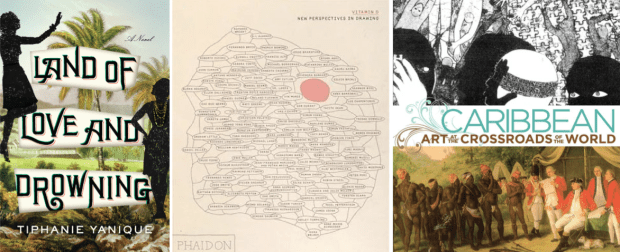
Books I’ve been reading from the Colleen Lewis Reading Room collection

One of the books I’ve been reading is The Land of Love and Drowning by Tiphanie Yanique, an author from St. Thomas, an island in the U.S. Virgin Islands. Annalee Davis, artist and founder of Fresh Milk, recommended this incredible work of magical realism and generational family sagas when I asked for an introduction to contemporary Caribbean literature. The novel is a collage of ideas and experiences with shifting perspectives and a variety of writing styles.

Here are two quotes I’ve been thinking about from this book:

“History could do that, change a person’s name. History was something so simple and insistent that none of us has escaped it.”

“People can need each other like water.”

The water that surrounds each island shapes and serves as a witness to its history. A collective history “so simple and insistent that none of us has escaped it,” not our own, each other’s, or the one being written now. In what ways do acts of artistic creation and consumption situate us in a dialogue with history? Rather than in a position of repression or swallowing the legacies of colonialism? The water that swallows the lives of several characters in this story is impartial to their guilt, innocence, or their value to the people who depend on them, who might “need each other like water.”

I recommend this book for its poetic language and thought-provoking, critical analyses of intersecting family histories as Dutch rulers gave way to American ones in the early 1900s in the Virgin Islands. Here is a video of Yanique reading from a passage about protests, beaches, tourism, and so much more.

I also spent one morning this week walking on Bathsheba beach alongside a few swimmers who seemed intimately knowledgeable about the water’s tides and sweeping currents. We were all there, but had acutely different relationships to the waves cyclically consuming themselves. But perhaps not? Maybe they were visitors and in awe just as I was (the limitations of projection). I was reminded of a quote by Hilton Als from an essay, “Islands,” published in 2014. “The sky’s largeness and generosity reminded me of how pitiful I can feel on islands, where one’s ideas about the place amount to so much sentimental or ideological bullshit.” Similarly, Barbados occupies an active place in many imaginary realms as a ‘paradise.’ I have found powerful counterexamples to this homogenous narrative daily through literary, political, and artistic communities and news while at Fresh Milk.
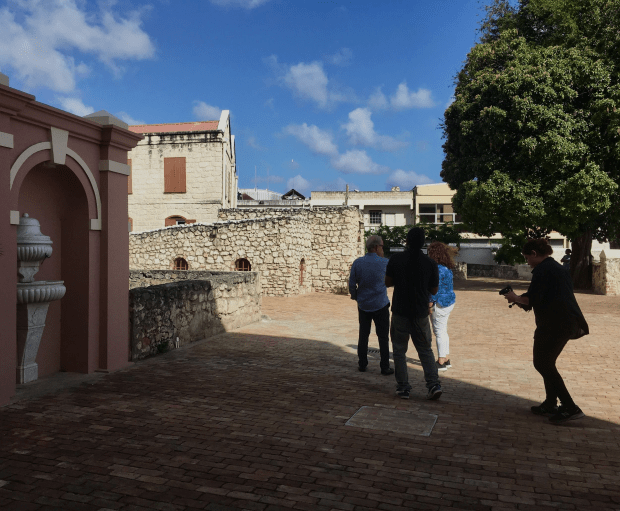
Sir Paul Altman (left), walking on the grounds by the cemetery during a filmed interview

Later in the week, I returned to the Nidhe Israel Synagogue to listen in on an interview of Sir Paul Altman, a leading advocate for the restoration efforts of the synagogue that began in 1986, by Judy Dennison, a cinematographer from Trinidad, and her film crew. Sir Altman described his efforts with the restoration of the synagogue as a “labor of love.” It was fascinating to learn more about the Altman family’s advocacy for the Jewish community and their dedication to preserving history.

During the interview, I also learned more about connections between Barbadian Jews and synagogues in the United States. America’s oldest synagogue, the Touro Synagogue in Rhode Island, where I spent eight months this past year as a student, was founded by Jewish settlers from Barbados. A synagogue in Philadelphia, where I grew up, was financially supported by and had a rabbi who spent years in the Jewish community in Barbados. Again, I was reminded of how this small group of individuals has had a disproportionately large impact across time and geography.

Sir Altman also discussed his horror at the city’s one time plan to build on top of the sacred land where the Jews are buried outside the synagogue. This notion raised a lot of questions for me about how to memorialize sacred land within and beyond this graveyard that was also the site of so much historic trauma and violence – slavery, mass murders, and the displacement of communities. How does the absence of a memorial to this terrible legacy get in the way of a community’s understanding of their ties to history and prevent healing? I have so many questions about how echoes of colonialism and political control are used as justifications for ownership (of land, people, and history) in Barbados and across the world.

In this landscape of sand, sun and sea, I can’t help but think of other ancient land with thousands of years of conflicted ownership and migrations from stolen land to stolen land. Here, we are witnesses through our screens to the horror of the deaths and injuries at ongoing protests in Palestine against the jarring backdrop of formalities performed at the opening of the new US Embassy in Jerusalem.

I am reminded over and over again of Tiphanie Yanique’s insight that “history was something so simple and insistent that none of us has escaped it.” I am thinking of the ongoing protests in Palestine and the land theft justified in the legacy of colonialism and in the name of religion. Reconstructionist Judaism at its core acknowledges our history as one religious civilization among many with parallel histories. It also explicitly seeks to reinterpret and reject Jewish thought that has been historically used to justify the oppression of others. My background in this relatively recent branch of Judaism (founded in 1968) has spurred my interest in ways to engage with spiritual traditions to bring meaning, understanding, and community into daily, and perhaps even explicitly secular, life.

I hope to explore and experiment with religious techniques outside their original contexts to draw meaning and everyday relevance from a text we collectively decide on (poetry, short story, essay, etc.) this Thursday evening, May 17th from 6-8pm, at the Fresh Milk studio space in St. George. Information about this Sacred Practices Reading Group can be found here. Please be sure to RSVP to freshmilkbarbados@gmail.com if you are interested or have any questions! Again, no religious practice or belief is required, just an open curiosity! Hope to see you there.

Ronald Williams’ Fresh Milk Residency – Week 2 Blog Post

Barbadian artist Ronald Williams, the recipient of the 2018 Fresh Milk ‘My Time’ Local Artist Residency, shares his second blog post. In addition to catching up on his research using publications in the Colleen Lewis Reading Room, Ronald made site visits to the St. James and St. George Parish Churches as part of his interest in religious iconography and the relationship between spirituality, decadence and materialism. These visits, while awe-inspiring on the one hand, also prompted further thought around the role of organized religion in Barbados’ colonial history. Read more below:

Since week 1 didn’t go exactly as planned, week 2 was spent playing catch up on the research I wanted to do the prior week. In my mind that leaves me square with where I wanted to be at this point when the residency started. In reality, I’m probably quite a ways off the mark, but I won’t realise that until later when I can’t do anything about it. No sweat, right?

The highlight of the week was definitely my field trips to the St. James and St. George Parish churches. I intended to do St. John’s as well but time didn’t permit. Maybe I’ll do that this weekend. Those spaces felt like an alternate reality; the contrast from the draining heat outside to the refreshing chill inside, the various sounds of life outside to the deafening silence of reverence.

There’s something to be said, for me at least, about the energy in the Parish churches when you’re completely alone. There was a pressure I can’t quite describe; I felt small, like who I am was insignificant in the light of those grandiose stained glass renderings. Maybe I am.

I understand the effect those structures are meant to have—and boy do they work—but it’s my knowledge of this that makes it hard for me to ignore the fact that the churches were built in the 1600s, that in their pomp and circumstance are enduring symbols of colonialism and imperialism.

The architecture, which carries specific elements which have endured through every great period of history was also very interesting to me. That led me to do some research on sacred geometry and the symbolism of shapes.

As it is, I believe I’ve got enough pieces to play with so it’s time to make this work. I think this week will be good.

Ronald Williams’ Fresh Milk Residency – Week 1 Blog Post

Barbadian artist Ronald Williams, the recipient of the 2018 Fresh Milk ‘My Time’ Local Artist Residency, shares his first blog post. Fresh Milk is by no means foreign territory for Ronald, as he has volunteered with us and participated in a number of our projects in the past, but as this is his first residency within the space, the focus of his work while here has shifted – leaving a familiar platform open for new encounters & experiences. Read more below:

A new old space. That’s how this familiar environment feels. I’m used to the wind chimes, the mahogany pods licking shots on the roof intermittently and the moo-mooing along with the rest of nature, but something‘s different in this country atmosphere. It’s not a sense of purpose, as I’ve always felt that here, nor would I call it pressure; but maybe it’s an accountability/responsibility to get cracking and produce as much as possible in these four weeks. This is perhaps/most definitely driven by the fact that I’ve got a certain goal by the end of the year. More on that later.

My initial plan was to gather as much potential reading material from the Colleen Lewis Reading Room and start doing some research in this space that I’m sharing with the quiet (as far as I can tell) and quite nice international resident artist Daisy Diamond. Given her focus on Judaism in Barbados and my ideas of decadence, materialism, mortality and their relation to religion/spirituality, I think there are interesting things to come.

I must confess to veering from my plan, as Sonia Farmer’s extremely dope work and setup kept calling for my attention. As a result, I put more of my energy into working on a piece I’d laid the foundation for just before the residency started. My time since has been split unevenly between producing and research.

Then Friday came, and with it Amanda Haynes who was setting up for Fresh Milk’s reading room open day. And the critical conversations started, with it the jokes came too, and it was a throwback…no, a Flashback Friday if you will. An old face in an old space where new things are happening.

Fresh Milk hosts ‘A True & Exact History’ by Sonia Farmer

On Monday, April 30th, 2018 Fresh Milk hosted an exhibition & panel discussion around ‘A True & Exact History‘ – an erasure poem by Bahamian writer & artist Sonia Farmer, using Richard Ligon’s publication A True & Exact History of the Island of Barbadoes (1657) as its source material.

Sonia was in conversation about her work with Ayesha Gibson-Gill, Cultural Officer for Literary Arts at the National Cultural Foundation, and Tara Inniss-Gibbs, Lecturer in the Department of History and Philosophy at The University of the West Indies, Cave Hill Campus.

Thanks as always to our photographer Dondré Trotman for these images!

Artist Statement for A True & Exact History

I consider my writing practice a tool for disrupting and investigating existing narratives, forming a response that is not necessarily preoccupied with making new narratives to replace them, but rather exposing different narratives as a parallel, ultimately calling into question the inherent power structure in the existing narrative (such as historical accounts, folktales, mythologies, canonical books, etc). Experimental process of generation, such as erasure, found text, mistranslation, technological intervention, or other restrictive methods, are especially exciting opportunities to create direct responses to existing narratives by using its own language against itself. The resulting text then becomes the content for my final projects.

The core of my artist book A True & Exact History is an erasure of one of the most formative descriptions of the English Caribbean in the seventeenth Century, Richard Ligon’s 1657 guidebook, “A True and Exact History of Barbadoes.” This project began during March 2016 at a writing residency at Fresh Milk, an art platform in St. George, Barbados, where I encountered Ligon’s book through their Colleen Lewis Reading Room. Using the language, imagery, and thematic drives at the core of this text to disrupt the teleology of colonial Caribbean history, these unbound poetic fragments scattered among a shifting landscape simultaneously re-create and resist narrative as a device of cohesive history, ultimately calling into question what it means to write “a true and exact history” of anything.

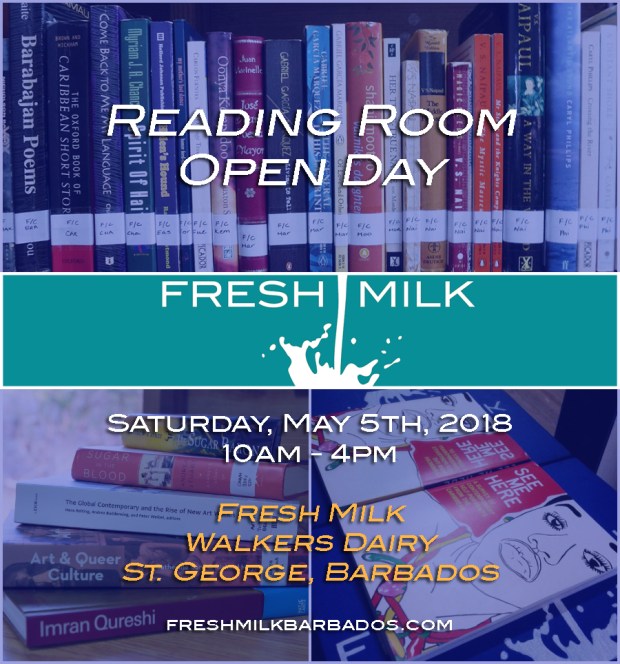
Reading Room Open Day – Saturday May 5th, 2018

Fresh Milk invites you to come check out our Reading Room Open Day, this Saturday, May 5th 2018, anytime between the hours of 10am-4pm!

The Colleen Lewis Reading Room at Fresh Milk is a mini-library of about 3,000 items, including books, films, journals, magazines etc. While there is a focus on contemporary arts publications, we also have a great selection of design, craft, fiction, non-fiction and history books among others. Our bibliography can be browsed online here.

Our team is working hard to improve how we share this material with creatives and researchers in Barbados. As practitioners ourselves, we know just how useful access to quality info about regional and international art worlds can be – whether for research, professional development or inspiration.

The aim of this open day is to create a space for dialogue; to not only run ideas we have had for the library by the public, but to really learn about the desires and needs of creative communities and find out if or how they can benefit from this resource.

Directions can be found on the ‘About Page‘ of our website. We hope to see you pass through to browse the collection and chat with us then!