Ark Ramsay’s Fresh Milk Residency – Week 1 Blog Post

Ark Ramsay shares their first blog post about the 2019 Fresh Milk ‘My Time’ Local Residency, which for the first time is focusing on research and writing practices. Ark speaks about the anxieties and concerns they have around returning to Barbados after completing an MPhil in Chinese Philosophy in Shanghai, while embracing the possibilities this residency has to offer and learning to re-inhabit the role of “Barbadian writer”.  Read more below:

Sonia Farmer’s “A True & Exact History of Barbados”

Honestly, I was worried about coming to Fresh Milk.

In the weeks before arriving, I burdened the space with a whole pantheon of anxieties. There were the familiar deities: Will-The-Work-I-Produce-There-Be-Any-Good (horned, feral, a biter); Is-This-Work-Even-Worth-Producing-At-All (tentacled, perpetually bored), and Will-I-Make-My-Page-Count (incarnated as everyone’s least favorite Primary School teacher).

I set about packing up my life in Shanghai, trying not to take notice of the fourth entity–larger than the others, skewed by perspective until all I could make sense of were the cracks in a cloven hoof–How-Do-I-Really-Return.

When I left Barbados, I abandoned writing altogether. I thought: “I’ll make a fantastic something-else”. I ditched narrative, dumped characters, and abandoned plots. I dislocated from the part of my brain that thought of itself as a ‘Barbadian writer’.

Or at least I tried to.

I still bought journals. Still scribbled notes in them. Still planned and orchestrated worlds. I could not seem to discard the machinery I had oiled so diligently for a decade.

So I returned to the island in the dark of memory. I smuggled back entire ships, boardwalks, car crashes, love stories, robots (who walked the length of Bathsheba), and dysfunctional families. I did all of this like a cat burglar until there were clear partitions between myself and the island. There was Ark the writer. Ark the islander. I began to feel like a tourist in my own dialect.

Arriving at Fresh Milk, under old-growth mahogany trees, I ruminated on what I hoped to achieve (and not achieve as in the ‘I’ of productivity, but achieve as in the summit that you reach in tandem with someone else)–I came to a realization. I wanted to be inundated with influences. To be upended.  To walk the long path home.

On the first morning, Annalee handed me a red box.
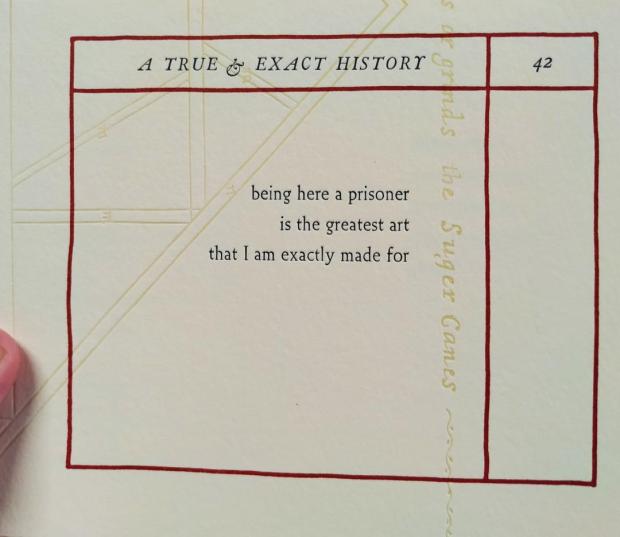
Even the design mirrors Ligon’s–even the paper feels like this text

It was Sonia Farmer’s strip-mining of Ligon’s “True & Exact History of Barbados”. She took his ‘accounts’ and reworked them, using his own words to uncover the silent-underneath. She questions the audacity of a “true” and “exact” anything. It was a simple gift: a reminder that the way back is via new trails in the oldest paths.

It liberated me into the rest of the week. I realized that this could become an artist’s retreat. The sense of retreat as wound-licking/marshalling the remaining forces/recalibrating. I looked around to find that the space was peopled not by anxiety-gods, but cows, and Mica–who must be some kind of Obeah Dog–because her presence brings with it an overwhelming calm.

Guarded by Obeah dog, Mica

I began to devour the library. It seemed to contain the exact mixture of books that I needed. I was handed a captivating review of Paulo Nazareth’s work–particularly News from the Americas (2011-2012)–where he left the state of Minas Gerais and travelled by bus and foot, traversing 15 countries before arriving in New York. He did this, without washing his feet, until he reached the Hudson. He carried the Americas on his body. Art as dirt that can be washed away.

This flowed into “Learning to Die: Wisdom in the Age of Climate Crisis”, meditative essays that try to retool traditional Socratic virtues so that they’re useful at the end of times–when the dirt of man catches up to the rest of us. Dirt. Dust. Carried on our skins or washed away forever. I read, surrounded by impossible beauty (and the lowing of cows), trying to bank all of these impressions.

No longer thinking, will this be useful, but trying to trust in the process.

On Wednesday, we were visited by Ewan Atkinson (visual artist/most engaging person in a room), who showed off one of the pieces from his mind-bogglingly intertextual work, “The Neighbourhood Project”. He built a board game that is a kind of ‘found object’ within the narrative of this fictional neighbourhood. While setting it up he reiterated what had become gospel by this point, that the filtration process–the coming together of ideas–is a slow, slow burn. Something found today can be used in twenty-five years.

The “unbeatable” Neighbourhood Game, “Peregrination!” by Ewan Atkinson

The lesson of week one seemed to be: time.

So I tried to give myself time, and space, to hack away at what I am working on. Hack being the right word, but a cruel word. To move from short story writing, to novel writing, feels like stripping naked in Broad Street–but forgetting (halfway through) how buttons on clothes work. It’s a fumbling, stumbling, soul-baring process.

But this seems a good place to begin.

Most complex problems become solvable if you add a dog to the equation

Ethan Knowles’ Fresh Milk Residency – Week 1 Blog Post

Bahamian photographer and writer Ethan Knowles shares his first blog post about his Fresh Milk residency. His first week has been spent familiarizing himself with Barbados and embarking on research into Caribbean identity, the archetypes/stereotypes associated with it, and how we see ourselves and shape our own identities from within the region. Read more below:

“Yet every place is both local and foreign. The same place is the site of two very different experiences.” – Lucy R. Lippard

Two planes took me from Bahamian to Bajan soil and soon enough I found myself in the shotgun of a friend’s car en route to Chefette. It was late, around midnight, and in my groggy but giddy state I chose the channa roti. It was a light unto my empty stomach.

The next day was a holiday, Whit Monday, so I started off the morning with a jog to get my bearings. I passed cows, fields of sugar cane, and more than a couple puzzled looks. It was a pretty hot day, so I’m guessing these guys were wondering why I was running. It wasn’t long before I began to ask myself the same question.

Around midday, I met the ever-welcoming Annalee Davis and went on a quick shopping trip with my flat mate during which I forgot many things and continued to fumble the rather simple currency conversion of 2:1. It didn’t matter though, because before long we were all at the beach in the glowing company of Annalee’s dog Mica. The afternoon wrapped up with calm thoughts about how Barbados and The Bahamas seem to have both more and less in common with each other than I expected.

The next day I met fellow resident researcher Kia Redman and Fresh Milk’s communications manager Katherine Kennedy. We discussed plans for the residency ahead before going on to explore the ample collection of the Colleen Lewis Reading Room.

The next few days would fly by as I read contentedly for hours on end, diving into everything from gender theory to regional tourism to the poetry of Andre Bagoo.

See Me Here: A Survey of Contemporary Self-Portraits from the Caribbean

One text which caught my attention in particular was See Me Here: A Survey of Contemporary Self-Portraits of the Caribbean. This collection, produced by Melanie Archer and Mariel Brown of Robert & Christopher Publishers, seeks to investigate how Caribbean artists are crafting their visual identities and, by extension, how the region constructs its own images. Beyond the one-dimensional idyllic representations of the tourism industry, how are we portraying and expressing our own diverse identities?

In considering this question, I began to think about how I navigate my own Caribbeanness. I began to think about all those Caribbean meme pages I follow, about how culture, history and lived reality intersect in my own life. About how, in some ways, I conform to the archetypal image of the Caribbean male and, in others – if such a model even exists – depart from it entirely.

Another day passed before I would settle on the idea of conducting a collage workshop on Caribbean identity as part of my residency at Fresh Milk. I brought this plan to Annalee and she gave me a wonderful book on the work of the Kenyan collage artist Wangechi Mutu to consult in my planning process (funnily enough she is also a UWC graduate!). It was in dialogue with her work, and in the ongoing planning of my workshop, that I examined Stuart Hall’s insightful essay “Cultural Identity and Diaspora” which discusses a less conventional view of cultural identities as “the names we give to the different ways we are positioned by, and position ourselves within, the narratives of the past.”

At this stage I am still working on finalizing the details of the workshop but look forward to it taking shape. Here ends my first week at Fresh milk, complete with raining mahogany pods, raining rain, and the occasional roar of a cow.


Kia Redman’s Fresh Milk Residency – Week 1 Blog Post

Barbadian artist Kia Redman shares her first blog post about her Fresh Milk residency, reflecting as the 2019 recipient of the Colleen Lewis Research/Writing residency programme. Writing has always been something Kia wanted to explore more within her growing creative practice, and she is taking this time to immerse herself within the material the reading room has to offer, with a particular focus on ideas of ‘paradise’ and ‘escapism’ in a Caribbean context. Read more below:

Writing is not something I have ever done for myself. There has always been an assignment, an application or a job providing the catalyst for me to flip the switch in my mind from visual to literary. As such, I have never presumed myself worthy of the title of writer, despite how much I enjoy the process. A title can often grow to become part of your identity. I could not, in good conscience, claim one that I had not had the courage to actively pursue…until now.

While I am not yet ready to claim the title, perhaps I will gain new perspectives by the end of this residency. For now, I will just embrace the joy of being able to write for myself.

My first week as the first Colleen Lewis Research/Writing Resident at Fresh Milk was liberating. There is a peculiar kind of freedom that comes with having a vast expanse of knowledge at your fingertips and a vast amount of time with which you can peruse it all. It is somewhat akin to living while time stands still. The construct of days and hours lose all meaning. The change in time now only marked by the end of a chapter, the occasional pang of hunger, and the draw of my bed as the light shifts gradually darker in the sky. Throughout that time only one thought occupied my mind: How to Escape from Paradise.

The irony of the topic of my research was never lost on me the many times I laid in the hammock strung up just outside the studio, basking in the breeze and lush foliage, with one of the many books I felt compelled to read nestled in my hands. It has been a near constant topic on my mind since the final year of my studio art degree, two years ago, when I wrote on it as part of an assignment for Ewan Atkinson’s Contemporary Issues class. It almost seems like it was an inevitability that I would confront it again after he suggested that I would be interested in applying to this residency.

Initially, I was a bit apprehensive when approaching the topic. It had been ruminating around in my head for two years and I was nowhere closer to being able to translate my jumble of thoughts into something tangible. Moreover, I had somehow convinced myself that the topic was limited and there were not many avenues down which I could pursue my ideas. I was proven wrong within the first few moments of stepping foot in the studio. Before I even fully unpacked, Annalee graciously provided me with many starting points and perspectives that gradually turned into large stacks of books on my desk as the week progressed. While the jumble of information in my head did increase, the breadth of my understanding deepened and the constraints I had unwittingly placed on the topic, fell away to make room for new pathways I will enjoy exploring in the coming weeks.

One of my goals for this first week was to delve into the Colleen Lewis Reading Room Collection and engage with books that caught even an ounce my interest. I wanted to start with an open mind. My next goal was to explore the vibrant surroundings I found myself in and feed off of the tropical energy I’m attempting to translate into words. My final goal was to develop a structure for what I plan on writing throughout the residency.

The first goal was met within moments of the start, while the last two came to be on the last day of the first week: Annalee had just suggested I read a piece by Colleen Lewis, the namesake of the residency and very reason I found myself sitting amongst her treasured books. She rummaged around the shelves until she found “Pictoral Depictions of the West Indian Landscape in the 18th Century and Early 19th Century: The Sublime, The Picturesque, The Romantic” in the fiftieth volume of the Journal of the Barbados Museum and Historical Society and placed it in my hands. Within moments, her vivid descriptions of the history and form of the earliest means of paradise marketing in the Caribbean had me yearning to consume the words surrounded by all that she spoke of. I immediately grabbed the journal and said my brief farewells to Annalee and Ethan as I strode out of the studio with a fierce purpose. Seconds later I was back to grab my pen and notebook. It had taken me a moment to realize that the intense familiar calling I felt was inspiration. A couple hours and a few heated conversations with some cows later, I was back in the studio. I felt accomplished. I had not only come up with a structure for what I plan to write, but the walk and Colleen’s words in the journal had helped to solidify two years-worth of jumbled thoughts in my mind. I could finally start to see the form my visual work, under the same topic, will take.

The next following weeks will find me exploring:

  • The link between Paradise and Escape
  • The methods and motivations behind the creation of the Caribbean as a Paradise
  • The realities that have paralleled the Paradise throughout the centuries
  • Paradise as an exotic escapist destination
  • The physical aspects of Paradise as a tool for escape and concealment, as seen with the Maroon societies, runaway slaves and escaped prisoners in more modern times.
  • Paradise as a prison, for indentured laborers and slaves
  • Paradise as a banal reality for those who live within its lush bounds and the means by which they indulge in their escapist fantasies.

It was a great first week. I can’t wait to begin the next!

Fresh Milk contributes to the 2019 Understanding Risk Caribbean Conference

The 2019 Understanding Risk (UR) Caribbean Conference took place May 27 – May 31 at the University of the West Indies (UWI) Cave Hill Campus, Errol Barrow Centre for Creative Imagination (EBCCI) in Barbados. This conference brought together representatives of government ministries and national disaster management agencies, disaster risk management practitioners, urban planners, insurance industry stakeholders, private sector organizations, academia, multilateral development banks, regional partners and donors to discuss the core theme ‘From Risk to Resilience: A Foundation for Action’.

Janot Mendler de Suarez, a consultant with the World Bank, most recently the Caribbean Technical Programme of GFDRR’s Disaster Risk Financing and Insurance initiative, and Pablo Suarez, Artist in Residence, National University of Singapore – Lloyd’s Register Foundation Institute for the Public Understanding of Risk, invited Fresh Milk to co-develop three artistic interventions for the conference. These projects acted as a way of translating and communicating key factors about environmental risks in the Caribbean into a visual language, as well as showing tangible examples of resilience within our culture and landscape in Barbados.

Photographs by Dondré Trotman unless otherwise specified.

__________

Risky Timelines:

Concept: Janot Mendler de Suarez & Pablo Suarez
artists: Akilah Watts, Alanis Forde, Anna Gibson in collaboration with Kia Redman and Kraig Yearwood
With thanks to: Harclyde Walcott, Joseph Spagnuolo, Kerri Cox, Mary Boyer, Rashmin Gunasekera, Thibaut Humbert, UWI EBCCI

Photo by Dondré Trotman

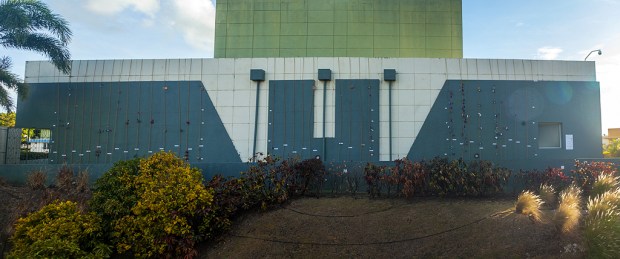
This project, conceived by Janot Mendler de Suarez and Pablo Suarez and created by Barbadian artists Akilah Watts, Alanis Forde and Anna Gibson with Kia Redman and Kraig Yearwood, saw the depiction of natural disasters which have taken place in 33 countries across the Caribbean in the form of a large data sculpture.

This piece showcases a timeline of these events spanning from 1990-2019, and communicates the breadth and impact of these catastrophes on the region. The artwork creates a visually intuitive juxtaposition of natural hazard data – on hurricanes from category 1 to 5, earthquakes, volcanic eruptions, landslides, and floods – with impact data on the number of people affected, the number of lives lost, economic losses and the amount of money invested in response and recovery efforts.

‘Risky Timelines’ was installed at the EBCCI between May 27th – June 3rd, 2019.

The Making

This slideshow requires JavaScript.

The Installation

This slideshow requires JavaScript.

The Finished Work

This slideshow requires JavaScript.

__________

Sargassum and Coral Reef Benches

Concept by Janot Mendler de Suarez & Pablo Suarez, Photography By Nadia Huggins & Data Story Layout by KAtherine Kennedy
A collaboration with Adopt A Stop Barbados
With thanks t:o Shelly-Ann Cox and Hazel Oxenford of CERMES, UWI Cave Hill Campus

Photo by Dondré Trotman

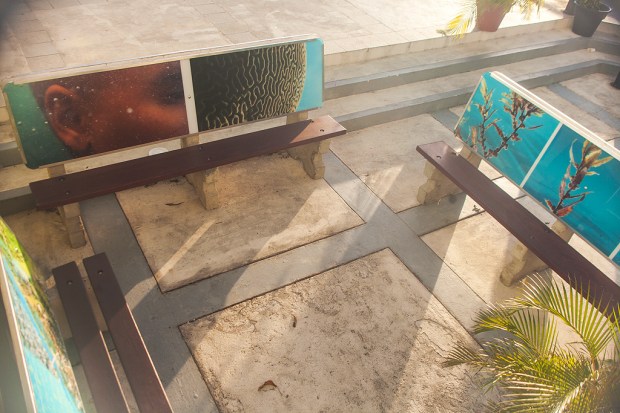
As an extension of our Fresh Stops public art project in collaboration with Adopt A Stop Barbados, the design and production of two benches to be permanent fixtures at the EBCCI were commissioned by the World Bank for the UR Caribbean Conference through Janot Mendler de Suarez.

Telling the stories of ‘Risk and Resilience’ within the Caribbean’s oceans, the backs of these two benches feature data stories about the properties and importance of coral reefs and Sargassum seaweed. These graphics were designed by Barbadian artist and Fresh Milk’s Communications & Operations Manager, Katherine Kennedy, using information largely provided by the Centre for Resource Management and Environmental Studies (CERMES), UWI Cave Hill Campus.

The fronts of each bench showcase photographs by Vincentian artist and photographer Nadia Huggins, depicting modified versions of photos related to her Transformations series, which she describes as “[exploring] the relationship between my identity and the marine ecosystem.”

This slideshow requires JavaScript.

__________

(Bush) Tea Plots – A Decolonial Patch

A Work by Annalee Davis in collaboration with Ras Ils and Kevin Talma

Photo by Dondré Trotman

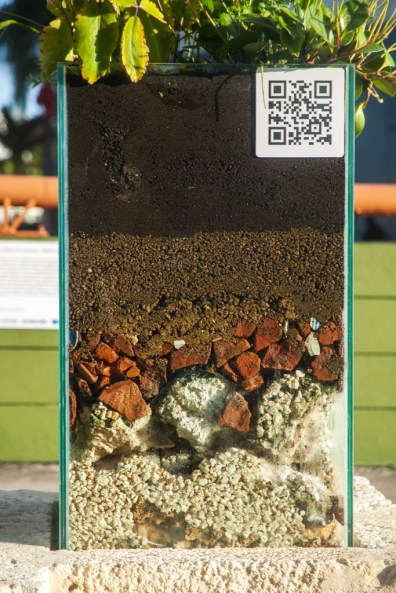
This artwork by Barbadian artist and Founding Director of Fresh Milk Annalee Davis in collaboration with Ras Ils and Kevin Talma, also commissioned by the World Bank for the UR Caribbean Conference through Janot Mendler de Suarez., sits within Davis’ larger artistic practice and confronts the historical imposition on this island of the monocrop–Saccharum officinarum–while recognizing nature as a radical maneuver against the singular model of the plantation. Observing how the natural world is threatened and degraded, (Bush) Tea Plots acknowledges the resilience of our regenerative biosphere and its inherent capacity for healing at the agricultural, botanical and psycho-spiritual levels.

The work creates visibility of near extinct (Bush) tea practices, appreciating biodiversity through dormant wild botanicals now resurfacing in abandoned sugarcane fields. This live restorative plot–an apothecary of resistance–is permanently installed at the EBCCI for the UR Caribbean Conference 2019, includes mobile accessibility via a QR code linked to the project’s web platform.

The Installation

This slideshow requires JavaScript.

The Finished Work

This slideshow requires JavaScript.

__________

UR Caribbean is organized by the World Bank’s Caribbean Disaster Risk Management team, in partnership with the Caribbean Disaster Emergency Management Agency (CDEMA) and the European Union (EU), and will be hosted by the Government of Barbados. This conference is co-financed by the European Union-funded Africa, Caribbean, Pacific – European Union (ACP-EU) and the Natural Disaster Risk Reduction (NDRR) Program and managed by the Global Facility for Disaster Reduction and Recovery (GFDRR).

Fresh Milk Welcomes a Trio of Residents for June 2019

Fresh Milk is excited to announce that we will have three writers/researchers in residence with us for the month of June, 2019: Bahamian writer and photographer Ethan Knowles (June 10th – July 5th) as part of our international residency programme; Barbadian artist Kia Redman (June 10th – July 5th) as the selected participant in the Colleen Lewis Research/Writing Residency; and Barbadian writer Ark Ramsay (June 17th – July 12th) as the sponsored participant in this year’s ‘My Time’ Local Residency Programme.

____________

About the Residents:

Ethan Knowles

Ethan Knowles is a writer and photographer from The Bahamas. His work, largely tied to the islands of the Lucayan archipelago on which he grew up, aims to decolonize and sensitize, paying particular attention to topics of cultural erasure, environmentalism and identity in the Caribbean. After completing his high school education in Nassau, he spent two years in Italy at the United World College of the Adriatic and graduated with his International Baccalaureate diploma in May 2018. He is now enrolled at Colorado College in the United States, working part-time as a photographer while pursuing a bachelor’s degree in English with a minor in Italian. Over the past few summers, he has published writing on tourism, culture, and neocolonialism in The Nassau Guardian, worked as a curatorial attaché for and exhibited at the National Art Gallery of The Bahamas and, most recently, been awarded the James Yaffe Prize for Short Fiction by the Colorado College English Department for a story set on the Bahamian island of Eleuthera.

____________

Kia Redman

Kia Redman is a creative professional living and working in Barbados. She attained her BFA in Studio Art from the Barbados Community College where she received an award from the Lesley’s Legacy Foundation for the highest GPA.

She has worked as a scenic painter for Operation Triple Threat, taught video marketing at the World University Service of Canada Caribbean, participated in an open studio residency with Punch Creative Arena and taken part in local group shows and screenings internationally. In 2018 her short film Roots|Routes won six awards including Best Short Film at the Barbados Visual Media Festival.

Kia currently works as a designer and videographer for Acute Vision Inc. and Bajans in Motion Inc. whilst cultivating her creative practice.

Being born into a post-independent nation in formation, Kia’s work focuses on issues of identity, defining culture and documenting histories. She aims to rewrite the blanket definition taught to be her Caribbean identity and discover the things unique to her lived experience.

____________

Ark Ramsay

Ark Ramsay is a 25-year-old Barbadian writer, currently completing an MPhil in Chinese Philosophy at Fudan University in Shanghai. Their short fiction has been published in Small Axe (50) in 2016, after winning that journal’s emerging writer’s contest. Ark’s writing is centered around queer, Caribbean identities and coping with the reality of a warming earth–the fragility of an island ecosystem that cannot fight back.

Ark will begin an M.F.A in creative writing at Ohio State University in the Fall.