Round 2: TENDER 2024 Grantee Interviews!

In 2024, Fresh Milk in partnership with the National Cultural Foundation, Barbados initiated the first iteration of TENDER: A Caribbean Arts Re-Granting Programme. The quality and variety of submissions was astounding, indicating an exciting future for the visual arts ecosystem emerging across all linguistic areas of the Caribbean.

We are excited to share the profiles and reflections from the twenty one successful TENDER 2024 grantees. These come in the form of written interviews, audio recordings or video logs – all available to view in full on our website.

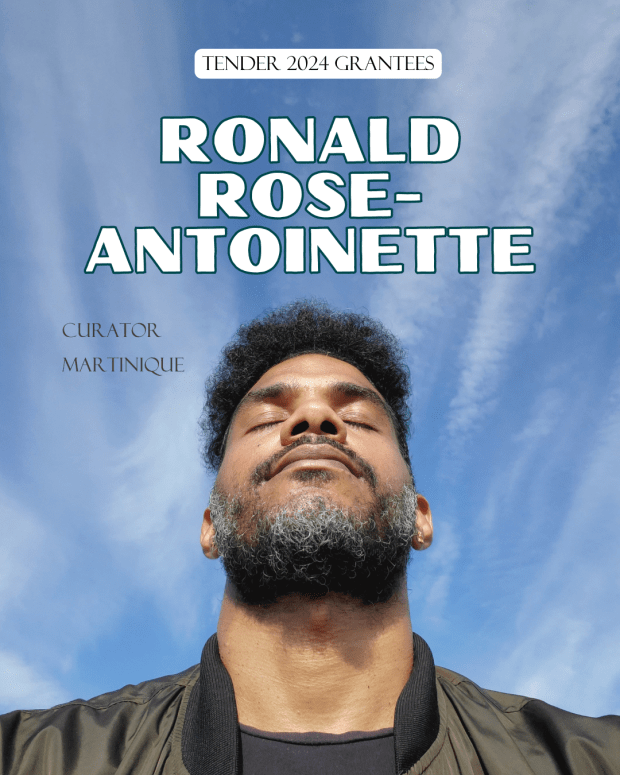
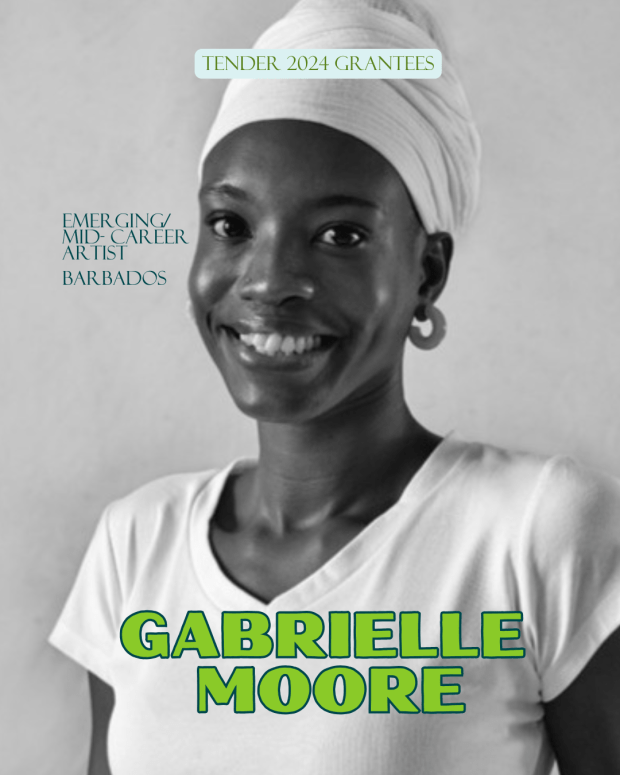
Today we continue with the next three profiles in this interview series: Ewan AtkinsonRonald Rose-Antoinette and Gabrielle Moore!


Read Ewan’s Full Interview here!

Read Ronald’s Full Interview here!

Read Gabrielle’s Full Interview here!

Ark Ramsay’s Fresh Milk Residency – Week 1 Blog Post

Ark Ramsay shares their first blog post about the 2019 Fresh Milk ‘My Time’ Local Residency, which for the first time is focusing on research and writing practices. Ark speaks about the anxieties and concerns they have around returning to Barbados after completing an MPhil in Chinese Philosophy in Shanghai, while embracing the possibilities this residency has to offer and learning to re-inhabit the role of “Barbadian writer”.  Read more below:

Sonia Farmer’s “A True & Exact History of Barbados”

Honestly, I was worried about coming to Fresh Milk.

In the weeks before arriving, I burdened the space with a whole pantheon of anxieties. There were the familiar deities: Will-The-Work-I-Produce-There-Be-Any-Good (horned, feral, a biter); Is-This-Work-Even-Worth-Producing-At-All (tentacled, perpetually bored), and Will-I-Make-My-Page-Count (incarnated as everyone’s least favorite Primary School teacher).

I set about packing up my life in Shanghai, trying not to take notice of the fourth entity–larger than the others, skewed by perspective until all I could make sense of were the cracks in a cloven hoof–How-Do-I-Really-Return.

When I left Barbados, I abandoned writing altogether. I thought: “I’ll make a fantastic something-else”. I ditched narrative, dumped characters, and abandoned plots. I dislocated from the part of my brain that thought of itself as a ‘Barbadian writer’.

Or at least I tried to.

I still bought journals. Still scribbled notes in them. Still planned and orchestrated worlds. I could not seem to discard the machinery I had oiled so diligently for a decade.

So I returned to the island in the dark of memory. I smuggled back entire ships, boardwalks, car crashes, love stories, robots (who walked the length of Bathsheba), and dysfunctional families. I did all of this like a cat burglar until there were clear partitions between myself and the island. There was Ark the writer. Ark the islander. I began to feel like a tourist in my own dialect.

Arriving at Fresh Milk, under old-growth mahogany trees, I ruminated on what I hoped to achieve (and not achieve as in the ‘I’ of productivity, but achieve as in the summit that you reach in tandem with someone else)–I came to a realization. I wanted to be inundated with influences. To be upended.  To walk the long path home.

On the first morning, Annalee handed me a red box.
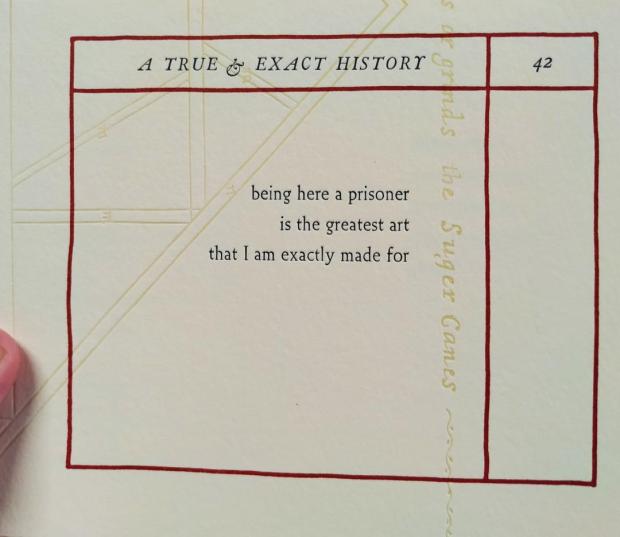
Even the design mirrors Ligon’s–even the paper feels like this text

It was Sonia Farmer’s strip-mining of Ligon’s “True & Exact History of Barbados”. She took his ‘accounts’ and reworked them, using his own words to uncover the silent-underneath. She questions the audacity of a “true” and “exact” anything. It was a simple gift: a reminder that the way back is via new trails in the oldest paths.

It liberated me into the rest of the week. I realized that this could become an artist’s retreat. The sense of retreat as wound-licking/marshalling the remaining forces/recalibrating. I looked around to find that the space was peopled not by anxiety-gods, but cows, and Mica–who must be some kind of Obeah Dog–because her presence brings with it an overwhelming calm.

Guarded by Obeah dog, Mica

I began to devour the library. It seemed to contain the exact mixture of books that I needed. I was handed a captivating review of Paulo Nazareth’s work–particularly News from the Americas (2011-2012)–where he left the state of Minas Gerais and travelled by bus and foot, traversing 15 countries before arriving in New York. He did this, without washing his feet, until he reached the Hudson. He carried the Americas on his body. Art as dirt that can be washed away.

This flowed into “Learning to Die: Wisdom in the Age of Climate Crisis”, meditative essays that try to retool traditional Socratic virtues so that they’re useful at the end of times–when the dirt of man catches up to the rest of us. Dirt. Dust. Carried on our skins or washed away forever. I read, surrounded by impossible beauty (and the lowing of cows), trying to bank all of these impressions.

No longer thinking, will this be useful, but trying to trust in the process.

On Wednesday, we were visited by Ewan Atkinson (visual artist/most engaging person in a room), who showed off one of the pieces from his mind-bogglingly intertextual work, “The Neighbourhood Project”. He built a board game that is a kind of ‘found object’ within the narrative of this fictional neighbourhood. While setting it up he reiterated what had become gospel by this point, that the filtration process–the coming together of ideas–is a slow, slow burn. Something found today can be used in twenty-five years.

The “unbeatable” Neighbourhood Game, “Peregrination!” by Ewan Atkinson

The lesson of week one seemed to be: time.

So I tried to give myself time, and space, to hack away at what I am working on. Hack being the right word, but a cruel word. To move from short story writing, to novel writing, feels like stripping naked in Broad Street–but forgetting (halfway through) how buttons on clothes work. It’s a fumbling, stumbling, soul-baring process.

But this seems a good place to begin.

Most complex problems become solvable if you add a dog to the equation
Mother Tongue’s Residency – Week 2 Blog Post

Mother Tongue, the curatorial duo of Jessica Carden and Tiffany Boyle, share a blog post about their second week at Fresh Milk, which kept them busy with a number of meetings and visits. These sessions were not only with artists, but also focused on the island’s history, geography and social environment; topics that feed into a number of the art practices they have encountered so far, and contribute to Mother Tongue’s overall understanding of the space. Read their report below: 

photo(7)

Whilst our first week in Barbados took the form of an introduction to Fresh Milk, the reading room collection and the studio space, our second week has been a flurry of meetings, studio visits and trips around the island to meet with various individuals, museums and organisations. It has been a week of connecting with a whole host of people who are instrumental to the arts scene here on the island – both in the past and in the present – with established and emergent practitioners. We have also consciously widened our scope to look at the rich histories outside of the arts, but which have been preoccupying local artists, such as the sugar industry, tourism and the colonial role in the horticulture of the island.

photo(5)

On Monday we met with the Barbadian artist Alberta Whittle, who we were originally introduced to in Glasgow whilst she was studying at Glasgow School of Art. Alberta gave us a tour of the National Museum of Barbados, and provided a brilliant insight into her position as a Barbadian artist who has become established outside of the island but returns regularly to make work here as an invested member of the arts community. Alberta also introduced us to our very first Caribbean snow cone, which consists of crushed ice, sugar syrup and condensed milk; perfect for a Scottish sweet tooth! We attended a lecture at the museum which was focused on the evolution of the tourist industry here in Barbados from the early 19th century onwards, and how it has become central for the islands’ economy, which was for such a long time monopolised by sugar cane.

Having become aware of their work through various Caribbean art publications in the Fresh Milk reading room, Director Annalee set-up studio visits with the artists Ewan Atkinson and Mark King. We were really lucky to have caught a sneak preview of Ewan’s exciting new work for the Havana Biennial which he will be taking over later this year. He also gave us some really interesting background information to his recent series ‘The Neighbourhood Report’, which comprises of several fictional characters exploring notions of identity, sexuality and gender representations. In our conversation with artist Mark King, he charted his journey from the US and Holland, and why he has chosen to return to Barbados to make it his base, while he continues to exhibit internationally.

This week we have also been really fortunate to spend some time with the artist Holly Bynoe, who is also the Co-Founder and Director of Caribbean Arts and culture magazine ARC. Throughout her career as an artist, researcher, curator and writer in the Caribbean, Holly has been an invaluable source in providing references and links to artists and projects across the region. We were able to discuss the role ARC magazine has been taking as a platform for many projects – written and beyond – over dinner with Holly and Assistant to the Director Katherine Kennedy, who is also an artist and an integral member of the Fresh Milk team.

On Friday we were introduced to the artist Denyse Menard Greenidge, who founded Dayrells Art Gallery in Barbados in the 70s, and continues to curate the work of Barbadian artists locally and internationally. Talking us through documentation from the 70’s and 80’s, Denyse was able to provide us with an overview of how governmental support for the arts has changed over the years and how this has impacted the current activity on the island. We visited her husband Newlands Greenidge‘s self-founded Springvale Indigenous Folk Museum, which is located in the Scottish district on the east of the island. The museum hosts a collection of artefacts which describe what life would have been like on the island in the early 19th century. Created through a labour of love by Newlands and Denyse, their passion for the island’s history is clear through the wealth of information they provided about the collection and its significance for Barbados.

In our second week, we were also visited in the Fresh Milk studio by Sean Carrington, Professor of Plant Biology at the University of the West Indies, Cave Hill Campus. We had a really stimulating conversation about the importation of species into the island, indigenousness and plant life, and the problems language causes between islands in the region, in terms of classification and keeping track of plant populations. Following our meeting with Sean, we went to meet Dr. Anthony Kennedy, Director of the West Indies Central Sugar Cane Breeding Station. The station is one of the most successful breeding centres in the world, whose work and research helps to develop sugar industries across the Southern Hemisphere. During our visit we were talked through the history of sugar on the island, and how it formed and influenced the way we see not just the agricultural formations but the human geography and architecture of the island too. This history is so significant for any attempt to understand the island, and it’s something that we’re trying to grasp as best as we can during our visit.

We look forward to a busy third week that will include two presentations at Barbados Community College on curating, and a re-screening of our ‘Afrofuturism’ programme, originally developed for the Africa in Motion Film Festival 2012.

FRESH MILK XVI Review

Fresh Milk Books‘ Team Leader Amanda Haynes reviews our last public event FRESH MILK XVI. Read more below:

Photograph by Dondre Trotman

Photograph by Dondre Trotman

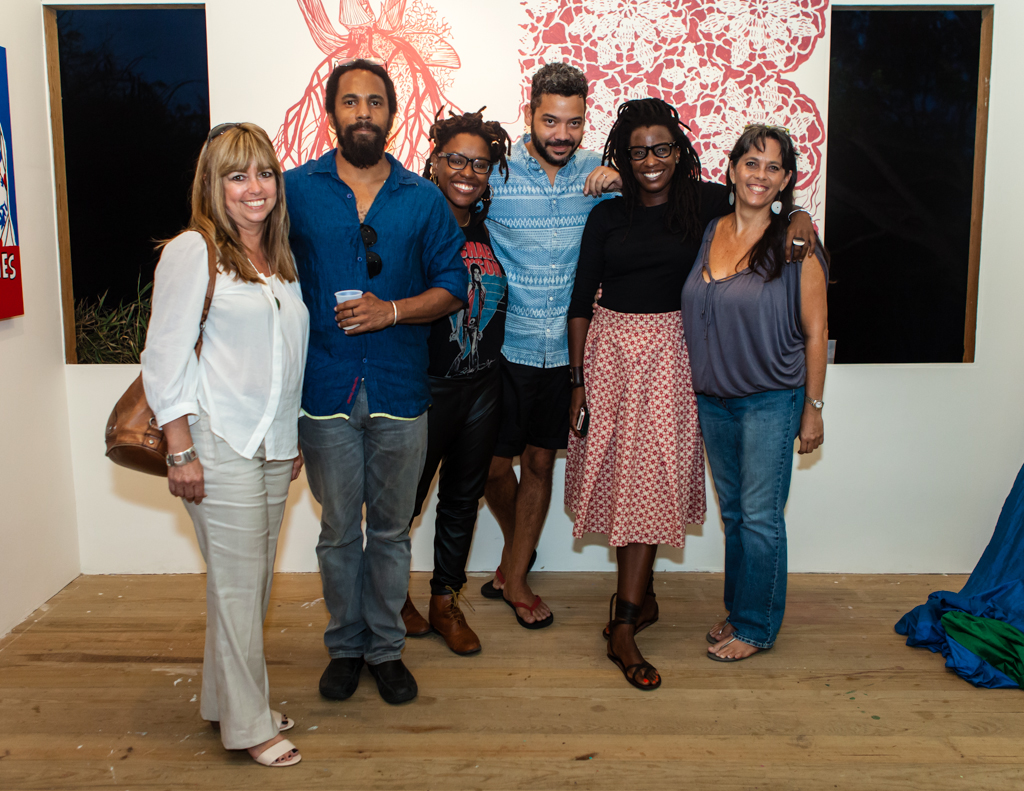
On Thursday June 26th, the Fresh Milk Art Platform hosted FRESH MILK XVI, the Barbados Launch of See Me Here: A Survey of Self Portraits from the Caribbean, edited by Melanie Archer and Mariel Brown of Robert and Christopher Publishers. Organised into a moderated panel discussion and an open Q & A, it was one of those rare times the second segment outran the first.

The event opened with a succinct presentation by visual artist Ronald Williams and my brief chat about Fresh Milk Books, before launching into the feature of the night: a conversation with See Me Here editor Melanie Archer and contributing Barbadian artists Ewan Atkinson, Annalee Davis, Joscelyn Gardner and Sheena Rose.

Skilfully moderated by Barbadian artist Russell Watson, dialogue revolved around the motivation and content of each artist’s unique self-portraiture, as well as the editors’ decision to compile an anthology with self-portraiture as its point of departure.

Annalee, Joscelyn, Ewan and Sheena’s responses were nuanced, embodying their personal expression of self and a distinct awareness of social identity as a political circumstance. In each case, their creative process reveals an understanding of this tension. For example, Joscelyn’s reflection on her work highlighted its ‘naïve’ perspective as she grappled to comprehend the complex racial and social climate of the Caribbean and being ‘white creole’. Similarly, Annalee shared her experience as being a white creole artist from Barbados, and the way in which Fresh Milk can be read as a self-portrait of this journey.

The more unapologetic, ‘socially vague’ visual art of Ewan and Sheena provoked especially provocative questions. As the discussion was opened to the audience, the question of self-portraiture as a zeitgeist of current Caribbean contemporary artists whirled into thoughtful questions and critically introspective answers. Major concerns expressed included the implications of this preoccupation with ‘self’ in today’s art practice, including the lack of a collective social agenda of current contemporary Caribbean art when compared to the socially oriented work of previous generations. Is this phenomenon indicative of an abandoning of ‘the national project’, or is it reflective of contemporary deconstructions of place as the root of one’s identity? How does this trend fit into the phenomenon of self-portraiture in general art history; is there a common social climate of these times?

In the context of contemporary mediated social media, the question of the performativity of art practice also raised poignant questions about the commodification of art, the role of the marketplace in the creative process, and criteria of authenticity: Who is the audience of this performance? How does this influence how, where and what we create? More importantly, what is the point of what we do? Should there be a point, anyway?

The mic was passed from artists, curators, scholars, students, men, women, the young, the older and the old. In a safe space for our perspectives to clash, clang and mingle, the night confirmed how much place does matter. In particular, the exchanges implied the radical potential of contemporary Caribbean art; more than ever before in the history of our region, we have the opportunity to create, control, consume and distribute perceptions of our visual and cultural identities. See Me Here signifies this moment—what comes next, we are not entirely sure.

Just after 9:30, Russell brought the lively conversation to a coherent close. Most of us stayed to mingle, purchase See Me Here, view the intimate exhibition and browse the CLRR. You wouldn’t guess that three hours before, FRESH MILK XVI was weary of the rain. Thankfully, Annalee and Katherine’s decision to host the night’s proceedings in the open space of the porch and lawn was magical. The atmosphere was relaxed and open, and the rain decided not to drench the projector or those of us sitting under the stars.

All photographs by Dondre Trotman 

FRESH MILK XVI Video

Check out our video from FRESH MILK XVI, the Barbados book launch for Robert & Christopher Publishers‘ (R&C) latest title, See Mere Here: A Survey of Contemporary Self-Portraits from the Caribbean, edited by Melanie Archer and Mariel Brown.

The event presented a small exhibition and panel discussion with the Barbadian artists featured in the publication – Ewan Atkinson, Annalee Davis, Joscelyn Gardner and Sheena Rose – and editor Melanie Archer, moderated by Barbadian artist Russell Watson.

Thanks to Sammy Davis for shooting and editing this video!