Matilde dos Santos writes on CATAPULT Awardee Gwladys Gambie for Madinin’Art

Martinique based historian, art critic and independent curator Matilde dos Santos, who was one of the guest curators/mentors selected to conduct studio visits with 6 of the 24 CATAPULT Stay Home Artist Residency participants, has generously offered to write features on each of the artists she engaged with during the programme. The fourth piece focuses on the practice of Martinican artist Gwladys Gambie!

Read the article, originally published in French on Madinin’Art: Critiques Culturelle de Martinique (January 10th, 2021), in English below!

Gwladys Gambie, Incandescent scars

In August 2020, Fresh Milk (Barbados) and Kingston Creative (Jamaica), with the support of the American Friends of Jamaica (United States), launched CATAPULT | A Caribbean Art Grant, a programme which, through six initiatives, provided direct financial support for five months to more than 1,000 Caribbean artists and creatives affected by the pandemic. One of these initiatives was the Stay Home Artist Residency (SHAR). Twenty-four artists were selected and the residencies were spread out into three groups from September 21 to December 11. I was delighted to be one of the visiting curators, and it is a pleasure to share the outcomes of these meetings with you.

Cartographie sensible (detail) SHAR residency November 2020, courtesy of the artist

Gwladys Gambie, an artist from Martinique, was selected for the home residency opportunity, so I was able, between one confinement and the other, to visit her studio in person.

Gwladys was born in Fort de France in 1988. After studying literature and education, she entered the Caribbean Arts Campus and obtained her DNSEP (Master) in Visual Arts in 2014. Gwladys’ work explores her own body and revolves around the character Manman Chadwon (mother sea urchin), a kind of divinity invented by the artist. Through drawing, collage, sculpture, sewing or embroidery, the artist works with voluptuous body shapes adorned with thorns, forceful yet evanescent. In recent years the artist has participated in several residencies, including Création en cours initiated in 2018 by the Ateliers Médicis in Guadeloupe and Caribbean Linked V organized by Ateliers’ 89 and Fresh Milk in Aruba. She has also participated in the Fountainhead Residency, in Miami (2019) and most recently the CATAPULT SHAR. Gwladys also participated in the international exhibitions Désir Cannibale at the Little Haiti Cultural Center in Miami, as part of the Tout-Monde Festival (2019), and in the Mercosur Biennale (2020), held on-line due to the COVID pandemic.

Corps paysage, felt on paper, 2018, 65 x 50 cm. Courtesy of the artist.

Corps paysage, felt on paper, 2018, 65 x 50 cm. Courtesy of the artist.

In her drawings, the female body is laid out into a dreamlike landscape. All-powerful femininity displays full bodies assuming their sensuality. Paradoxically, the delicacy and precision of the drawing impart a kind of harshness. It’s Manman Chadwon, Afro-Caribbean deity, a bit Mami Wata, a bit Manman Dlo, her body bristling with quills. An avatar of the artist that incorporates both softness and pain.

In her drawings, black and white dominates. Color comes in small touches and until recently, almost always by collage. Then, there is the red ink, connecting her work to the present day violence: against women, or the soil in Martinique poisoned by chlordecone. Emanating from these bodies drawn in black or red are real ecosystems supporting minerals, plants, and animals. In an organic landscape, the body spreads out, secretly forming folds that both enclose and exhibit.

The birth of Manman Chadwon, 2018, ink, collage on paper, 75 x 100 cm, courtesy of the artist

Cartographie sensible (detail) SHAR residency November 2020, courtesy of the artist

We can link Gwladys’ work to that of female artists, who since the 1960s have built a feminist aesthetic designed to liberate women’s imagination. The work of many artists who do not claim to be feminists shares common traits none-the-less with the feminist movement as a whole, such as the affirmation of the body and the deconstruction of stereotypes, or in the practice of strictly feminine crafts, such as embroidery and sewing, which triggers a subversion of hierarchies by promoting what was usually considered as subordinate. A combined concern for issues of gender, race, ethnicity and social class forms the basis of a feminism that is reinventing itself today through the enhancement of an exacerbated femininity, which, rather than denying sexist stereotypes, reappropriates them and throws them back in the face of the public.  In its pop version, this appears in the form of vertiginous heels and superlative “bondas”. Gwladys’ femininity is radical, yet poetic; assuming violence portrayed by omnipresent thorns that render both pleasure and protection. Thus, we can compare her works to those of the Haitian artist, Florine Démosthène, and her round heroines endowed with monumental buttocks, as doubles of the artist. Her work is also comparable to White shoes (2015), a performance of the photographer Nona Faustine, who exposed her own ‘unconventional’ naked body perched on white pumps while she browsed places linked to slavery in New York, such as Wall Street, an ancient slave market. Or, yet again, to the drawings of black women by Rosana Paulino, their bodies always round, always a little the artist herself, or to Paulino’s use of sewing to roughly patch up photos of naked slaves, or the way she obliterates the eyes, throats or mouths of black women by stitching over them as if to emphasize the state of servitude in which they are found, while their photos are delicately presented on embroidery hoops.
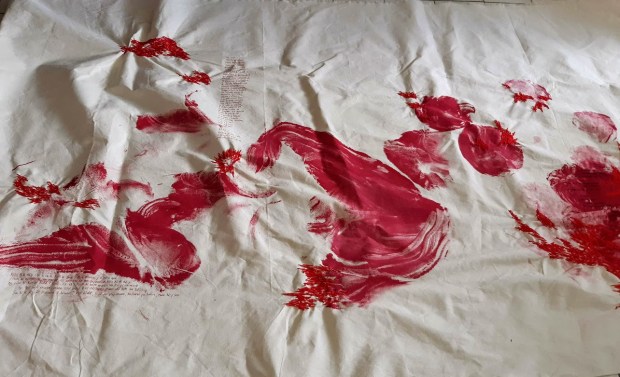
Cartographie sensible (work in progress) SHAR residency November 2020. Photo by Matilde dos Santos

Gwladys’ works breed rebellion: against stereotypes of black women’s bodies, against objectification and fantasies of sexuality tainted with exoticism. The artist would like to reinvent eroticism, with drawings of a touching sincerity: full bodies, black skin, challenging the canons of beauty. Thorny bodies, triple breasts, powerful yet fragile bodies; vulnerability as a weapon. To make the body of the black woman, for a long time the territory of all oppressions, a decolonial body: neither in the Western norm, nor against it, but rather outside the norm. Rooted in ancestrality.

The link with African ancestrality has been widely claimed in recent years by artists from the diaspora. With Gwladys this demand is visceral, as the need to examine oneself, to express oneself. The use of Creole, and poetry, which invade certain drawings, goes without saying. This is because Creole goes straight to the heart of things. A language that is very imaginative yet straightforward, like the visual language of Gwladys.
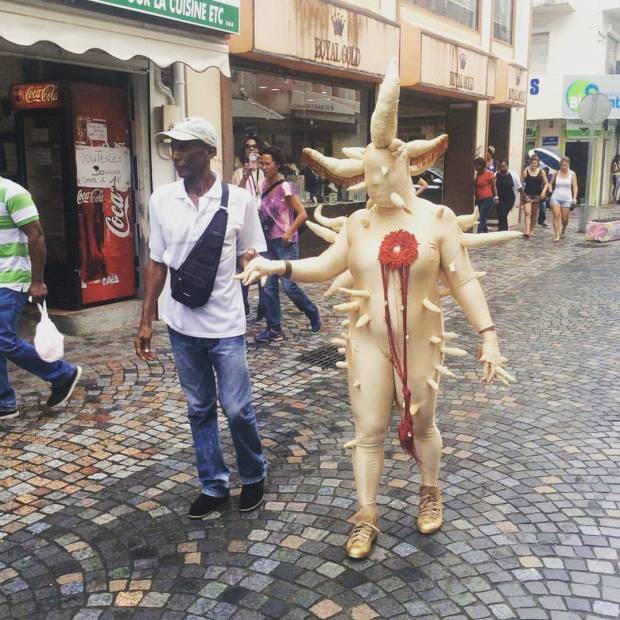
Ambulatory performance, The beautiful monster, FIAP 2017, Fort de France. Courtesy of the artist

For the SHAR programme, Gwladys experimented with needlework. Her particular affinity with sewing was noticeable in her work with “grennen” (frizzy) hair while she was still in art school. She built mole sculptures with hair; weaving, knotting and sewing, adding beads, fabrics, and frills. In the sequence, there were performance costumes, including that of FIAP 2017, a full leotard that she had personalized with rather coarse protuberances and adorned with pearls and fringes. Later on, after discovering the Moko Jumbie from Trinidad, she feminized the costume even more while keeping the thorns. It then became Moko Chadwon (2018). The Moko Jumbie is not just a dancer on stilts, the name retains its African origins, the idea of ​​a healer, and from the Caribbean, the word “jumbie” meaning spirit. This is probably why in 2020, to participate in Trinidad’s carnival, Gwladys added a fringed crown to her red costume; in it, I recognized the “odê” with “imbé”, which hides the face of certain orishas in Afro-Brazilian and Afro-Caribbean rites.

During the first part of confinement, Gwladys participated in a collective residency in the 16M2 art space in Fort de France. Since the shops were closed, she was forced to turn this constraint into an opportunity and use an old transparent curtain that was a little frayed as support. So she incorporated the holes of the fabric into her embroidery, a technique she was only just then discovering. The connection was immediate and very quickly her work was very successful. The idea of ​​reparation guided her. And while physically she was repairing the fabric, it was also the health of the world, the bodies of women, history itself, that was being symbolically repaired. In the SHAR residency, Gwladys wanted to give continuity to the embroidery work on two types of support: the first was an unbleached cotton fabric, a little thicker than a canvas, on which she made rough imprints of the erogenous parts of her body. (buttocks, breasts, thighs, crotch) in red ink. On these prints, she subsequently added random embroidery. On photos of fragments of the work, I imagined, with the help of red, that it was drawing a woman’s reproductive system; in front of the whole work, we can see that every figure is pure interpretation. The imprint is indeed that of the artist’s body, but deliberately they are fragmentary imprints whose shape cannot be easily identified and on which the embroidery is applied in a hazardous manner. The large size of the support allowed her to work on the idea of ​​a geography of emotions making an epidermis of the tissue, on which the artist embroidered scars. Fragments of texts add depth to the work and the color red gives them a false air of Chinese characters.

The second support was a banana leaf. The confinement once again forced the artist to review her way of creating. Working on a living natural object was a novelty for Gwladys. Laying the leaf flat on a stand, she felt like she had a body on the operating table, ready to respond to a double health emergency: Covid and chlordecone. Find an antidote for the poisoning? Circumscribe it? Talk about it anyway. And always this idea of ​​repair. The leaf is fragile, so the artist wanted to embroider the edges to prevent them from fraying. As she embroidered it, the leaf followed its natural process of deterioration, which the artist documented in photographs. The intense red magnifies the wound as the leaf gently rots. A first draft, beautiful and moving, which resonates with a poem by Brazilian Cristiana Sobral that I have only just discovered:

I have an incandescent scar of pain
But it’s only inside
Outside I drew a flower

– Matilde dos Santos – Historian, art critic and independent curator

Appreciation to the partners of the CATAPULT programme: The American Friends of Jamaica, Kingston Creative and Fresh Milk.

The SHAR participants described their experiences in blogs that you can read on the Fresh Milk platform here.


For further information:

Artist Gwladys Gambie’s website: http://gwladysgambie.blogspot.com/

Website of the artist Florine Démosthène: https://florinedemosthene.com/home.html

On the performance White shoes by Nona Faustine: https://africanah.org/nona-faustine-white-shoes-project/

On Rosana Paulino and other women artists of Brazil and the Caribbean: https://aica-sc.net/2018/01/28/femmes-artistes-noires-bresiliennes-et-caribeennes-defier-linvisibilite/

CATAPULT Stay Home Artist Residency Blogs – Issue 2, Vol. 3 & 4

The CATAPULT Stay Home Artist Residency (SHAR) provides opportunities for 24 cultural practitioners from the English, French, Spanish and Dutch speaking Caribbean to be supported while safely remaining in their studios/work-spaces, each of whom will receive a $3,000 USD stipend to produce work over a two-month period.

We are pleased to share Issue #2, Volume 3 and Volume 4 of the blog posts written by participating residents, documenting their experiences and processes during their residency. Issue #2 follows the journey of the second group of SHAR awardees: Camille Chedda (Jamaica), Lisa Allen-Agostini (Trinidad & Tobago), Joshua Clarke (Barbados), Sonia Farmer (The Bahamas), Jorge González (Puerto Rico), Gwladys Gambie (Martinique), Eliazar Ortiz (Dominican Republic) and Carol Joan Sorhaindo (Dominica).

Click on the images below to read these sets of resident blogs as e-zines!


Issue 2, Vol. 3

Issue 2, Vol. 4


ABOUT CATAPULT:

CATAPULT | A Caribbean Arts Grant is a COVID-19 relief programme conceptualised by Kingston Creative (Jamaica) and Fresh Milk (Barbados) and funded by the American Friends of Jamaica | The AFJ (USA). Designed as a capacity building initiative it will directly provide financial support to over 1,000 Caribbean artists, cultural practitioners and creative entrepreneurs impacted by the pandemic and working in the themes of culture, human rights, gender, LGBTQIA+, and climate justice.


ABOUT THE PARTNERS:

American Friends of Jamaica | The AFJ has a near 40 year history of funding charitable organizations in Jamaica in the fields of Education, Healthcare and Economic Development. A registered 501 c 3 nonprofit headquartered in New York City, AFJ relies on individual and corporate contributions made by donors who believe in our work and will advocate on our behalf. Part of the AFJ’s mission is to facilitate donor directed contributions which enables donors to support registered charitable organizations aligned with their own goals for philanthropy.


Kingston Creative is a registered non-profit organization founded in February 2017. Its mission is to enable creatives to succeed so that they can create economic and social value, gain access to global markets and have a positive impact on their community.


Fresh Milk is an organisation whose aim is to nurture, empower and connect Caribbean artists, raise regional awareness about contemporary arts and provide global opportunities for growth, excellence and success. Fresh Milk supports excellence in the visual arts through residencies and programmes that provide Caribbean artists with opportunities for development and foster a thriving art community.

CATAPULT Stay Home Artist Residency Blogs – Issue 1, Vol. 3 & 4

The CATAPULT Stay Home Artist Residency (SHAR) provides opportunities for 24 cultural practitioners from the English, French, Spanish and Dutch speaking Caribbean to be supported while safely remaining in their studios/work-spaces, each of whom will receive a $3,000 USD stipend to produce work over a two-month period.

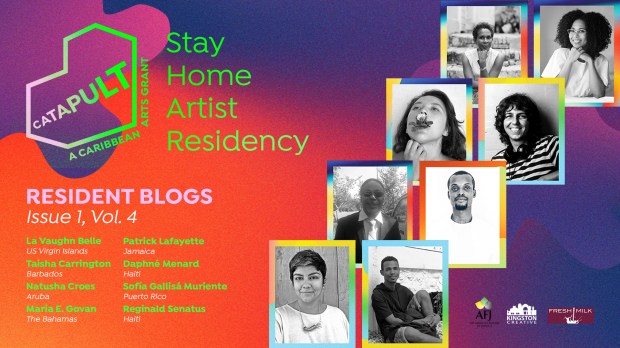
We are pleased to share Issue #1, Volume 3 and Volume 4 of the blog posts written by participating residents, documenting their experiences and processes during their residency. Issue #1 follows the journey of the first group of SHAR awardees: La Vaughn Belle (US Virgin Islands), Taisha Carrington (Barbados), Natusha Croes (Aruba), Maria E. Govan (The Bahamas), Patrick Jerome Lafayette (Jamaica), Daphné Menard (Haiti), Sofía Gallisá Muriente (Puerto Rico) and Reginald Senatus (Haiti).

Click on the images below to read these sets of resident blogs as e-zines!


Issue 1, Vol. 3

Issue 1, Vol. 4


ABOUT CATAPULT:

CATAPULT | A Caribbean Arts Grant is a COVID-19 relief programme conceptualised by Kingston Creative (Jamaica) and Fresh Milk (Barbados) and funded by the American Friends of Jamaica | The AFJ (USA). Designed as a capacity building initiative it will directly provide financial support to over 1,000 Caribbean artists, cultural practitioners and creative entrepreneurs impacted by the pandemic and working in the themes of culture, human rights, gender, LGBTQIA+, and climate justice.


ABOUT THE PARTNERS:

American Friends of Jamaica | The AFJ has a near 40 year history of funding charitable organizations in Jamaica in the fields of Education, Healthcare and Economic Development. A registered 501 c 3 nonprofit headquartered in New York City, AFJ relies on individual and corporate contributions made by donors who believe in our work and will advocate on our behalf. Part of the AFJ’s mission is to facilitate donor directed contributions which enables donors to support registered charitable organizations aligned with their own goals for philanthropy.


Kingston Creative is a registered non-profit organization founded in February 2017. Its mission is to enable creatives to succeed so that they can create economic and social value, gain access to global markets and have a positive impact on their community.


Fresh Milk is an organisation whose aim is to nurture, empower and connect Caribbean artists, raise regional awareness about contemporary arts and provide global opportunities for growth, excellence and success. Fresh Milk supports excellence in the visual arts through residencies and programmes that provide Caribbean artists with opportunities for development and foster a thriving art community.

CATAPULT Stay Home Artist Residency Blogs – Issue 3, Vol. 1 & 2

The CATAPULT Stay Home Artist Residency (SHAR) provides opportunities for 24 cultural practitioners from the English, French, Spanish and Dutch speaking Caribbean to be supported while safely remaining in their studios/work-spaces, each of whom will receive a $3,000 USD stipend to produce work over a two-month period.

We are pleased to share Issue #3, Volume 1 and Volume 2 of the blog posts produced by participating residents, documenting their experiences and processes during their residency. Issue #3 follows the journey of the third group of SHAR awardees: Franz Caba (Dominican Republic), Myrlande Constant (Haiti), Miguel Keerveld (Suriname),  Las Nietas de Nonó (Puerto Rico), Ada M. Patterson (Barbados), Kelly Sinnapah Mary (Guadeloupe), Shivanee Ramlochan (Trinidad & Tobago) and Angelika Wallace-Whitfield (The Bahamas).

Click on the images below to read these sets of resident blogs as e-zines!


Issue 3, Vol. 1

Issue 3, Vol. 2


ABOUT CATAPULT:

CATAPULT | A Caribbean Arts Grant is a COVID-19 relief programme conceptualised by Kingston Creative (Jamaica) and Fresh Milk (Barbados) and funded by the American Friends of Jamaica | The AFJ (USA). Designed as a capacity building initiative it will directly provide financial support to over 1,000 Caribbean artists, cultural practitioners and creative entrepreneurs impacted by the pandemic and working in the themes of culture, human rights, gender, LGBTQIA+, and climate justice.


ABOUT THE PARTNERS:

American Friends of Jamaica | The AFJ has a near 40 year history of funding charitable organizations in Jamaica in the fields of Education, Healthcare and Economic Development. A registered 501 c 3 nonprofit headquartered in New York City, AFJ relies on individual and corporate contributions made by donors who believe in our work and will advocate on our behalf. Part of the AFJ’s mission is to facilitate donor directed contributions which enables donors to support registered charitable organizations aligned with their own goals for philanthropy.


Kingston Creative is a registered non-profit organization founded in February 2017. Its mission is to enable creatives to succeed so that they can create economic and social value, gain access to global markets and have a positive impact on their community.


Fresh Milk is an organisation whose aim is to nurture, empower and connect Caribbean artists, raise regional awareness about contemporary arts and provide global opportunities for growth, excellence and success. Fresh Milk supports excellence in the visual arts through residencies and programmes that provide Caribbean artists with opportunities for development and foster a thriving art community.

Pascale Faublas’ Fresh Milk Residency – Week 2 Blog Post

Fresh Milk shares the second blog post by Haitian resident artist Pascale Faublas, who is joining us as part of an artist exchange programme with Le Centre d’Art, Haiti, to create opportunities for women arts practitioners. Pascale has had a productive second week, meeting a number of Barbadian creatives and having stimulating discussions about the regional art scene, as well as beginning to dive in to creating her own work in the Fresh Milk studio. This programme is supported by UNESCO’s International Fund for Cultural Diversity (IFDC) and the Foundation for Knowledge and Liberty (FOKAL). Read more below:


En français

Semaine 2

Fresh Milk Barbados est une ruche effervescente, une plateforme dynamique favorisant les rencontres, échanges  entre les  créatifs de la Barbade et d’ailleurs.  En effet,  ma deuxième semaine de résidence a été riche  en  rencontres, dialogues et discussions sur la réalité, et les problématiques spécifiques aux créateurs de la Caraïbes, leurs inspirations, aspirations, perspectives de création et de diffusion de l’art de la région.  Apres avoir visité l’exposition individuelle  «This is how our garden grows » de l’artiste barbadien Kraig Yearwood, celui ci nous a rendu visite a FreshMilk ou il nous a fait une brève et intéressante présentation de son travail et de son parcours, s’est entretenu avec ma co résidente, la conservatrice Aliyah Hasinah sur la situation de la présence de l’art de la Barbade localement, dans la région et sur la scène internationale, discuter de la nécessité de la décolonisation des Arts de la région caraïbes.

Un cocktail « Meet and Greet » organisé par FreshMilk m’a permis de rencontrer plusieurs milléniaux créatifs de la Barbade et de planifier des visites d’atelier pour la semaine a venir.

Au courant de cette 2eme semaine de résidence, riche de ces échanges, et mise à disposition de son atelier de rêve, j’ai  heureusement entamé ma première création artistique que j’ai hâte de vous présenter.


In English

Week 2

Fresh Milk Barbados is an effervescent hive, a dynamic platform promoting meetings and exchanges between creatives from Barbados and elsewhere. Indeed, my second week of the residency was rich in meetings, dialogues and discussions on our realities, and the specific issues of Caribbean creators, their inspirations, aspirations, perspectives of creation and dissemination of the art of the region. After visiting the solo exhibition ‘This is how our garden grows’ by Barbadian artist Kraig Yearwood, he visited us at Fresh Milk where he gave us a brief and interesting presentation of his work and his career. He spoke with my co-resident, curator Aliyah Hasinah about the status of Barbados’ art presence locally, in the region and on the international stage, discussing the need for the decolonization of the arts in the Caribbean.

A ‘Meet and Greet’ cocktail hosted by Fresh Milk allowed me to meet several creative Barbadian millennials and plan studio visits for the coming week.

During this 2nd week, rich in these exchanges made available in this dream studio, I fortunately started my first artistic creation, which I can’t wait to present to you.


About Le Centre d’Art:

Le Centre d’Art in Port-au-Prince is an institution that works towards promoting artistic creations by Haitian practitioners on the basis of preserved heritage values. Since its creation in 1944, this atypical space with multiple missions has been at the heart of societal and artistic evolutions. As the major protagonist in the reconfiguration of the fine arts realm in Haiti, Le Centre d’Art has been paving the way for several schools and artistic movements.

Despite the destruction of the infrastructure during the earthquake of 2010, Le Centre d’Art managed to save more than 5000 works and 3000 archive files, which are today preserved and valued. Since the reopening in 2014, Le Centre d’Art has once again become an essential part of Haitian culture.

Its mission is to support artists and their creations, and to conserve and disseminate Haitian visual arts. It is a resource space for artists, art students, art lovers, collectors and researchers alike.