Aliyah Hasinah’s Fresh Milk Residency – Week 1 Blog Post

UK-based writer and curator of Bajan and Jamaican heritage, Aliyah Hasinah, shares her first blog post about her Fresh Milk international residency. Using this time primarily for research into the art scene and cultural policy in a Barbadian context, Aliyah kicks off her blogs by reflecting on some of the texts she has immersed herself in to ground her knowledge and understanding of the space, and looks forward to having more in-person discussions with artists, creatives and cultural practitioners as the weeks progress. Read more below:


It’s been a week since I started my residency at Fresh Milk with the intention of immersing myself in study to learn more about the art world and cultural policy in Barbados. Having not had the means to attend university, I’m always profoundly grateful for moments to study away from the day-to-day grind of trying to pay your rent in London, so hearing monkeys (my favourite animals) on the library roof has been a well welcomed change. I’d also like to thank Arts Council England for funding this residency because I’ve been LEARNING, I’ve been learning *Beyonce voice*. 

Prior to this, I met with Annalee Davis last year when starting my research into ‘Decolonising the Curatorial’, as funded by Arts Council England. My research was looking at the role of Crop Over as a space for exhibition outside the white walls of the gallery, a topic Claire Tancons discusses well in her essay ‘Curating Carnival’, and how galleries can never do justice to the embodied experience of carnival. 

Through my research, I sought to further understand the colonial history and how rebellions birthed art practices – or continued them – as we’ve always found ways to make art. Having only scratched the surface last year, I was keen to take more time to understand the layers and nuance of Bajan Art and cultural expression, outside of what was familial and familiar to me.

Just to prefix, I’m a loud mouth when it comes to explaining or calling out the manifestations of coloniality in the modern day in England. However, I’m very aware of my positionality as a curator from Britain researching in Barbados. My gaze does not come from one of authority but is an opinion formed from the research and conversations had with some of the island’s artists, art producers, essays as well as what I observe. 

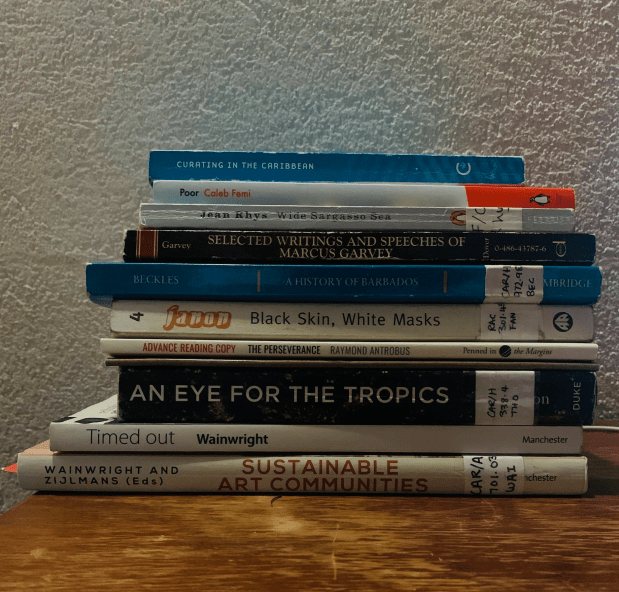
One of the writings I’ve been reading this week that deeply resonated with me was Winston Kellman’s Between A Rock And A Hard Place’ published in Sustainable Art Communities, as edited by Leon Wainwright and Kitty Zijlmans. Kellman explores several historical threads to bring us to the modern day, including the relationships with the UK and US following Barbados’ independence in 1966.

Kellman’s particular highlighting of how western modernity has shunned Caribbean art practice of landscape painting and sculpture, alluding to it being devoid of conceptual fervour is, in my mind, linked to a colonial mindset that deems ‘conceptual art’ in a particular way. 

This perspective ignores the context of the space and time that these artworks were created in, and instead attributes an archetypal aesthetic to the notion of contemporary art as opposed to understanding that sculpture and painting of the island has a deeper rooted contextualisation in the resources i.e. clay, and historical craftsmanship of the land – and is therefore contemporary if it is being made in the present. This disregard for painting and sculpture subconsciously alludes to artworks, often by Black artists, specifically in the Caribbean, being inferiorized because of a lack of contextual understanding of how the work came into being, and is additionally sidelined in national and international discourses surrounding contemporary conceptual art. All due to a lack of understanding of the context of the work. 

Anywho, I could go on for days about the learnings of the last week, all to say I’m very excited to deepen my study and continue learning about policy, sustainability and the hopes/dreams of emerging artists on the Island. The culture is very much being pushed forward by multiple artists. It is with thanks to those who have laid the foundations that younger artists today are scoping out what is possible in the process of building visual arts communities and infrastructures across Barbados that do not solely privilege the tourist economy (more on that real soon, hold tight tourism as neo-colonialism and insert Mo the Comedian saying ‘Barbados’).

I’m excited to start my new week, meeting more artists, collectors and academics. I may also post some of my readings and thoughts on my instagram (@aliyahhasinah) as I jump into my second week at Fresh Milk.

To end lightly here are 5 songs I’ve had on loop this week:

Until next week.

Lots of love and take care

Aliyah xx

P.s. Here’s some of what I’m reading / have been the last week and will continue to delve into this week, and hold tight Caleb Femi on the release of his new poetry book ‘Poor’ which everyone should cop if they can. (Feel free to send me reading and art recommendations on twitter @aliyahhasinah)
Pascale Faublas’ Fresh Milk Residency – Week 1 Blog Post

Fresh Milk shares the first blog post by Haitian resident artist Pascale Faublas, who is joining us as part of an artist exchange programme with Le Centre d’Art, Haiti, to create opportunities for women arts practitioners. In her first week, Pascale introduces us to the experience of coming to Barbados during these challenging times, following travel protocols and transitioning into the start of her residency. This programme is supported by UNESCO’s International Fund for Cultural Diversity (IFDC) and the Foundation for Knowledge and Liberty (FOKAL). Read more below:


En français

Semaine 1

A année exceptionnelle, décisions exceptionnelles! En cette année 2020 marquée par la pandémie du Covid 19, ma résidence artistique a Fresh Milk en Barbades a été exceptionnellement coordonnée par Le Centre d’Art en Haïti et Fresh Milk en Barbades avec le support de l’Unesco et de la Fokal dans l’objectif de rapprocher les artistes de la Caraïbe et d’’offrir des opportunités aux femmes artistes en particulier.

Arrivée en Barbades le 1er Novembre, et suivant les mesures  imposées par le gouvernement, les 6 premiers jours de mon séjour seront conditionnés par ce virus, confinée dans une chambre d’hôtel désigné a cet effet , avec interdiction de prendre contact physique avec quiquonque pas avant les résultats négatifs d’un test Covid PCR pris au 2eme jour et un report de température tous les jours 2 fois par jour pendant 14 jours. 

Je serai donc accueillie a distance par Annalee Davis, qui généreusement me pourvoira en  livres provenant de la bibliothèque de Fresh Milk , traitant de la culture, de l’art dans la Caraïbe et la Barbades, me mettra en contact avec des personnes ressources telles que Dr. Tonya Haynes and Taitu Heron pour une mise en contexte de mon projet de résidence : Fanm se poto mitan.

C’est ainsi que,  le 6 Novembre, je suis reçue par Anna Lee Davis et Katherine Kennedy a Fresh Milk sur son site la  Walkers Dairy , une ancienne plantation coloniale aujourd’hui convertie en ferme ou se trouve l’atelier et la résidence d’artistes.


In ENGLISH

Week 1

In an exceptional year, exceptional actions! In this year, 2020, marked by the Covid-19 pandemic, my artistic residency at Fresh Milk in Barbados was exceptionally coordinated by Le Centre d’Art in Haiti and Fresh Milk in Barbados with the support of UNESCO and Fokal with the objective of bringing artists from the Caribbean closer together, and to offer opportunities to women artists in particular.

I arrived in Barbados on November 1, and following the measures imposed by the government, the first 6 days of my stay were conditioned by this virus. I was confined in a hotel room designated for this purpose, with a ban on making physical contact with anyone before the negative results of a Covid PCR test taken on the 2nd day and a temperature report every day twice a day for 14 days.

I was greeted at a distance by Annalee Davis, who generously provided me with books dealing with culture, art in the Caribbean and Barbados, all from the Colleen Lewis Reading Room at Fresh Milk. Fresh Milk put me in contact with Dr. Tonya Haynes (Institute for Gender & Development Studies at the University of the West Indies) and Taitu Heron (Director of the UWI Women and Development Unit, University of the West Indies) for me to contextualize my residency project: Fanm se poto mitan.

On November 6, I was received by Annalee Davis and Katherine Kennedy at Fresh Milk on their site at Walkers Dairy, a former colonial plantation now converted into a farm, which hosts workshops and artist residencies.


About Le Centre d’Art:

Le Centre d’Art in Port-au-Prince is an institution that works towards promoting artistic creations by Haitian practitioners on the basis of preserved heritage values. Since its creation in 1944, this atypical space with multiple missions has been at the heart of societal and artistic evolutions. As the major protagonist in the reconfiguration of the fine arts realm in Haiti, Le Centre d’Art has been paving the way for several schools and artistic movements.

Despite the destruction of the infrastructure during the earthquake of 2010, Le Centre d’Art managed to save more than 5000 works and 3000 archive files, which are today preserved and valued. Since the reopening in 2014, Le Centre d’Art has once again become an essential part of Haitian culture.

Its mission is to support artists and their creations, and to conserve and disseminate Haitian visual arts. It is a resource space for artists, art students, art lovers, collectors and researchers alike.

CATAPULT Stay Home Artist Residency Blogs – Issue 1, Vol. 1 & 2

The CATAPULT Stay Home Artist Residency (SHAR) provides opportunities for 24 cultural practitioners from the English, French, Spanish and Dutch speaking Caribbean to be supported while safely remaining in their studios/work-spaces, each of whom will receive a $3,000 USD stipend to produce work over a two-month period.

We are pleased to share Issue #1, Volume 1 and Volume 2 of the blog posts written by participating residents, documenting their experiences and processes during their residency. Issue #1 follows the journey of the first group of SHAR awardees: La Vaughn Belle (US Virgin Islands), Taisha Carrington (Barbados), Natusha Croes (Aruba), Maria E. Govan (The Bahamas), Patrick Jerome Lafayette (Jamaica), Daphné Menard (Haiti), Sofía Gallisá Muriente (Puerto Rico) and Reginald Senatus (Haiti).

Click on the images below to read these first sets of resident blogs as e-zines!


Issue 1, Vol. 1

Issue 1, Vol. 2


ABOUT CATAPULT:

CATAPULT | A Caribbean Arts Grant is a COVID-19 relief programme conceptualised by Kingston Creative (Jamaica) and Fresh Milk (Barbados) and funded by the American Friends of Jamaica | The AFJ (USA). Designed as a capacity building initiative it will directly provide financial support to over 1,000 Caribbean artists, cultural practitioners and creative entrepreneurs impacted by the pandemic and working in the themes of culture, human rights, gender, LGBTQIA+, and climate justice.


ABOUT THE PARTNERS:

American Friends of Jamaica | The AFJ has a near 40 year history of funding charitable organizations in Jamaica in the fields of Education, Healthcare and Economic Development. A registered 501 c 3 nonprofit headquartered in New York City, AFJ relies on individual and corporate contributions made by donors who believe in our work and will advocate on our behalf. Part of the AFJ’s mission is to facilitate donor directed contributions which enables donors to support registered charitable organizations aligned with their own goals for philanthropy.


Kingston Creative is a registered non-profit organization founded in February 2017. Its mission is to enable creatives to succeed so that they can create economic and social value, gain access to global markets and have a positive impact on their community.


Fresh Milk is an organisation whose aim is to nurture, empower and connect Caribbean artists, raise regional awareness about contemporary arts and provide global opportunities for growth, excellence and success. Fresh Milk supports excellence in the visual arts through residencies and programmes that provide Caribbean artists with opportunities for development and foster a thriving art community.

Announcing the CATAPULT Stay Home Artist Residency & Lockdown Virtual Salon Awardees – Jury Report

The CATAPULT team is pleased to announce the Caribbean-based artists selected from across the English, Spanish, French, and Dutch-speaking territories who will participate in the CATAPULT Stay Home Artist Residency (SHAR) and Lockdown Virtual Salon (LVS) programmes!

Between the announcement of the Open Calls on August 5 and the submission deadline on August 21, 2020, these two CATAPULT initiatives received more than 260 entries from 28 countries across the Caribbean. All proposals were reviewed by the Fresh Milk Team (Founding Director, Annalee Davis, and Communications and Operations Manager, Katherine Kennedy, both practicing multidisciplinary visual artists) and an independent regional jury comprised of:

  • Edward Bowen (Trinidad & Tobago), Visual Artist and Educator – LVS;
  • Giscard Bouchotte (Haiti), Curatorial Director, Nuit Blanche and Social Entrepreneur – SHAR;
  • Loretta Collins Klobah (Puerto Rico) Poet and Professor of Caribbean Literature and Creative Writing at the University of Puerto Rico – LVS;
  • Sara Hermann (Dominican Republic), Chief Curator & Specialist of Visual Arts, Centro León in Santiago, and founder of Curando Caribe SHAR;
  • David Knight Jr. (US Virgin Islands), Co-Founding Editor of the arts & literary journal MokoSHAR;
  • Clara Reyes (Sint Maarten), Head of Department of Culture within the Ministry of Education, Culture, Youth – SHAR.

Candidates were assessed based on their artist statement, CV, portfolio, and a proposal outlining their preliminary concept of artistic or research activities pertaining to one or more of the programmes’ critical themes of culture, human rights, gender, LGBTQIA+, and climate justice.

Each of the 32 LVS candidates will participate in a one-hour live conversation with a co-discussant about their practice and will receive a $500 USD stipend. The 24 SHAR candidates will be supported to safely remain in their studios/work-spaces and will receive a $3,000 USD stipend to produce work over a two-month period. The two programmes will run on a staggered basis from September 21 through December 11, 2020.

General Comments

The submissions demonstrated a very wide variety of approaches to making or producing, and the applicants work across a diverse array of media, including dance, installation, music, painting, drawing, mixed media, textiles, animation, book arts, graphic novels, performance, theatre, film, research-based practices, sculptures, photography, literature, poetry, public engagement, and activism. The proposals demonstrate the quality and competence of the work currently being produced by Caribbean cultural practitioners.

The jury also recognised the relevance of the proposals to this particularly challenging time we are facing, as well as the expertise and dedication of the applicants who clearly articulated the devastating effects of the COVID-19 pandemic on this vulnerable sector, demonstrating the “ability to rise above [adversity] and share their human stories.” (Clara Reyes, CATAPULT jury member). Discussions during the jury convenings also took into consideration points such as the impact of support to artists at different stages of their careers and the nurturing of practices at pivotal moments, and commitment to and investment in the region as evidenced through the subject matter of their work, the consistent contribution to their local spaces, or pushing the boundaries, definitions, and trajectories of what is seen as possible for Caribbean artists.

The jury is humbled by the vast amount of talent, drive, strong voices, and art practices present within the Caribbean and appreciated the time each applicant took to submit their application. Every effort was made to be thorough and fair throughout the process, and while reaching the decision was extremely difficult, the jury is confident that the final selection demonstrates a breadth of practices, ideas, and themes put forward by creatives who are based in the four linguistic territories, originating from Aruba, Barbados, The Bahamas, Dominica, Dominican Republic, Grenada, Guadeloupe, Guyana, Haiti, Jamaica, Martinique, Puerto Rico, Saba, Sint Maarten, Suriname, Trinidad & Tobago, and the US Virgin Islands.

The CATAPULT team will be sharing news of these programmes in the coming months. See below for the complete list of CATAPULT SHAR and LVS selected candidates.


About CaTAPULT:

CATAPULT | A Caribbean Arts Grant is a COVID-19 relief programme conceptualised by Kingston Creative (Jamaica) and Fresh Milk (Barbados) and funded by the American Friends of Jamaica | The AFJ (USA). Designed as a capacity building initiative it will directly provide financial support to over 1,000 Caribbean artists, cultural practitioners and creative entrepreneurs impacted by the pandemic and working in the themes of culture, human rights, gender, LGBTQIA+, and climate justice.


About the Partners:

American Friends of Jamaica | The AFJ has a near 40 year history of funding charitable organizations in Jamaica in the fields of Education, Healthcare and Economic Development. A registered 501 c 3 nonprofit headquartered in New York City, AFJ relies on individual and corporate contributions made by donors who believe in our work and will advocate on our behalf. Part of the AFJ’s mission is to facilitate donor directed contributions which enables donors to support registered charitable organizations aligned with their own goals for philanthropy.


Kingston Creative is a registered non-profit organization founded in February 2017. Its mission is to enable creatives to succeed so that they can create economic and social value, gain access to global markets and have a positive impact on their community.


Fresh Milk is an organisation whose aim is to nurture, empower and connect Caribbean artists, raise regional awareness about contemporary arts and provide global opportunities for growth, excellence and success. Fresh Milk supports excellence in the visual arts through residencies and programmes that provide Caribbean artists with opportunities for development and foster a thriving art community.

We are not separate.

In May 2015, Barbadian artist Ronald Williams wrote a review about Frantz Fanon’s ‘The Wretched of the Earth‘ for the Fresh Milk Books platform; a book that addresses the complex role violence, protests and resistance play in decolonisation.

The Wretched of the Earth - Frantz Fanon

“My mind kept drifting across the Caribbean Sea as I read. It drifted and eventually channelled into the relatively recent acts of police barbarism in the U.S.A. It’s not because it’s a current issue that I feel connected, it’s slightly personal. I could just as easily be at the mercy of this brutality had I been born 20 degrees north and west.”

Five years later, Ronald’s words continue to ring true. We are not separate to this fight. Caribbean voices and experiences are a necessary part of the discourse as we not only empathise, but stand in solidarity against what is happening globally, and challenge the ways systemic racism has manifested and damaged our region.