Pascale Faublas’ Fresh Milk Residency – Week 3 Blog Post

Fresh Milk shares the third blog post by Haitian resident artist Pascale Faublas, who is joining us as part of an artist exchange programme with Le Centre d’Art, Haiti, to create opportunities for women arts practitioners. Pascale focuses this week on interactions with fellow creatives, cultural practitioners and spiritual women, who have inspired the creation of new pieces during her time in the studio. This programme is supported by UNESCO’s International Fund for Cultural Diversity (IFDC) and the Foundation for Knowledge and Liberty (FOKAL). Read more below:


En français

Semaine 3

Partager le  Fresh Milk studio avec Aliyah Hasinah , une écrivaine trentenaire, commissaire d’art contemporain , de parents de la Barbades et de la Jamaique , qui vit et travaille à Londres ; a été l’occasion  pour nous de nombreuses discussions , notamment sur les sujets se rapportant à la condition féminine. Avec elle, j’ai pu donc découvrir le concept de Pop féminisme . Un féminisme  contemporain, subversif, qui campe une femme confiante, assumant son corps et sa sexualité, une femme sujet de son destin.

Ainsi est née Fanm se Poto Mitan #1.

Grace à la mise en contact  par Annalee Davis ,  j’ai pu , au courant de cette troisième semaine de résidence à FreshMilk , rencontrer trois Fanm Poto Mitan , d’age mur, d’origine caribéenne ( St. Vincent et Jamaïque) , qui résident et travaillent en Barbade.  Toutes les trois des êtres spirituels ( Manbo ou initiée, diplômée dans des domaines créatifs et de développement culturels ou social.

  1. Dr. Yanique Hume: Manbo, danseuse chorégraphe , chercheuse en anthropologie culturelle, études et performances avec un focus sur la Caraïbes, l’Amérique latine et la diaspora africaine.
  2. Ireka Jelani: Manbo, médecin traditionnel, entrepreneure et directrice de sa compagnie de vannerie Roots and Grasses, une plasticienne et  étudiante doctorante a l’université des West Indies.
  3. Taitu Heron: écrivaine et Directrice de la faculté  Women and Development  de l’université des West Indies.

Avec elles j’ai pu découvrir  non seulement la Barbade mais aussi  l’existence d’une  Caraïbe anglophone et l’étroite connexion (économique, sociale, culturelle) entre les différentes iles qui la composent. Nous avons pu discuter de la condition des femmes et des filles, discuter des  différences et ressemblances culturelles entre Haïti et cette caraïbe anglophone et de la nécessite de construire des liens pouvant unifier la grande Caraïbes.

Fanm se Kajou est née de ces passionnantes rencontres.


In English

Week 3

Sharing the Fresh Milk studio with Aliyah Hasinah, a 30-something writer and curator of contemporary art living and working in London and whose parents are from Barbados and Jamaica, was the occasion for many discussions; especially on matters relating to the status of women. With her, I was able to discover the concept of Pop Feminism – a contemporary, subversive feminism, which encapsulates a confident woman, assuming her body and her sexuality, a woman subject to her destiny.

Thus was born Fanm se Poto Mitan # 1.

Thanks to the contacts made by Annalee Davis, I was able during this third week of residency at Fresh Milk, to meet three Fanm Poto Mitans, middle aged and of Caribbean origin (St. Vincent and Jamaica), who reside and work in Barbados. All three are spiritual beings (Manbo or initiate, graduate in creative fields and cultural or social development).

1. Dr. Yanique Hume: Manbo, dancer, choreographer, researcher in cultural anthropology, studies and performances with a focus on the Caribbean, Latin America and the African diaspora.
2. Ireka Jelani: Manbo, traditional doctor, entrepreneur and director of her basketry company Roots and Grasses, plastic artist and doctoral student at the University of the West Indies.
3. Taitu Heron: Writer and Director of the Women and Development Faculty of the University of the West Indies.

With them I was able to discover not only Barbados, but also the existence of an English-speaking Caribbean and the close connection (economic, social, cultural) between the different islands that make it up. We were able to discuss the condition of women and girls, discuss the differences and cultural similarities between Haiti and the English-speaking Caribbean, and the need to build links that can unify the greater Caribbean.

Fanm se Kajou was born from these fascinating encounters.


About Le Centre d’Art:

Le Centre d’Art in Port-au-Prince is an institution that works towards promoting artistic creations by Haitian practitioners on the basis of preserved heritage values. Since its creation in 1944, this atypical space with multiple missions has been at the heart of societal and artistic evolutions. As the major protagonist in the reconfiguration of the fine arts realm in Haiti, Le Centre d’Art has been paving the way for several schools and artistic movements.

Despite the destruction of the infrastructure during the earthquake of 2010, Le Centre d’Art managed to save more than 5000 works and 3000 archive files, which are today preserved and valued. Since the reopening in 2014, Le Centre d’Art has once again become an essential part of Haitian culture.

Its mission is to support artists and their creations, and to conserve and disseminate Haitian visual arts. It is a resource space for artists, art students, art lovers, collectors and researchers alike.

Pascale Faublas’ Fresh Milk Residency – Week 2 Blog Post

Fresh Milk shares the second blog post by Haitian resident artist Pascale Faublas, who is joining us as part of an artist exchange programme with Le Centre d’Art, Haiti, to create opportunities for women arts practitioners. Pascale has had a productive second week, meeting a number of Barbadian creatives and having stimulating discussions about the regional art scene, as well as beginning to dive in to creating her own work in the Fresh Milk studio. This programme is supported by UNESCO’s International Fund for Cultural Diversity (IFDC) and the Foundation for Knowledge and Liberty (FOKAL). Read more below:


En français

Semaine 2

Fresh Milk Barbados est une ruche effervescente, une plateforme dynamique favorisant les rencontres, échanges  entre les  créatifs de la Barbade et d’ailleurs.  En effet,  ma deuxième semaine de résidence a été riche  en  rencontres, dialogues et discussions sur la réalité, et les problématiques spécifiques aux créateurs de la Caraïbes, leurs inspirations, aspirations, perspectives de création et de diffusion de l’art de la région.  Apres avoir visité l’exposition individuelle  «This is how our garden grows » de l’artiste barbadien Kraig Yearwood, celui ci nous a rendu visite a FreshMilk ou il nous a fait une brève et intéressante présentation de son travail et de son parcours, s’est entretenu avec ma co résidente, la conservatrice Aliyah Hasinah sur la situation de la présence de l’art de la Barbade localement, dans la région et sur la scène internationale, discuter de la nécessité de la décolonisation des Arts de la région caraïbes.

Un cocktail « Meet and Greet » organisé par FreshMilk m’a permis de rencontrer plusieurs milléniaux créatifs de la Barbade et de planifier des visites d’atelier pour la semaine a venir.

Au courant de cette 2eme semaine de résidence, riche de ces échanges, et mise à disposition de son atelier de rêve, j’ai  heureusement entamé ma première création artistique que j’ai hâte de vous présenter.


In English

Week 2

Fresh Milk Barbados is an effervescent hive, a dynamic platform promoting meetings and exchanges between creatives from Barbados and elsewhere. Indeed, my second week of the residency was rich in meetings, dialogues and discussions on our realities, and the specific issues of Caribbean creators, their inspirations, aspirations, perspectives of creation and dissemination of the art of the region. After visiting the solo exhibition ‘This is how our garden grows’ by Barbadian artist Kraig Yearwood, he visited us at Fresh Milk where he gave us a brief and interesting presentation of his work and his career. He spoke with my co-resident, curator Aliyah Hasinah about the status of Barbados’ art presence locally, in the region and on the international stage, discussing the need for the decolonization of the arts in the Caribbean.

A ‘Meet and Greet’ cocktail hosted by Fresh Milk allowed me to meet several creative Barbadian millennials and plan studio visits for the coming week.

During this 2nd week, rich in these exchanges made available in this dream studio, I fortunately started my first artistic creation, which I can’t wait to present to you.


About Le Centre d’Art:

Le Centre d’Art in Port-au-Prince is an institution that works towards promoting artistic creations by Haitian practitioners on the basis of preserved heritage values. Since its creation in 1944, this atypical space with multiple missions has been at the heart of societal and artistic evolutions. As the major protagonist in the reconfiguration of the fine arts realm in Haiti, Le Centre d’Art has been paving the way for several schools and artistic movements.

Despite the destruction of the infrastructure during the earthquake of 2010, Le Centre d’Art managed to save more than 5000 works and 3000 archive files, which are today preserved and valued. Since the reopening in 2014, Le Centre d’Art has once again become an essential part of Haitian culture.

Its mission is to support artists and their creations, and to conserve and disseminate Haitian visual arts. It is a resource space for artists, art students, art lovers, collectors and researchers alike.

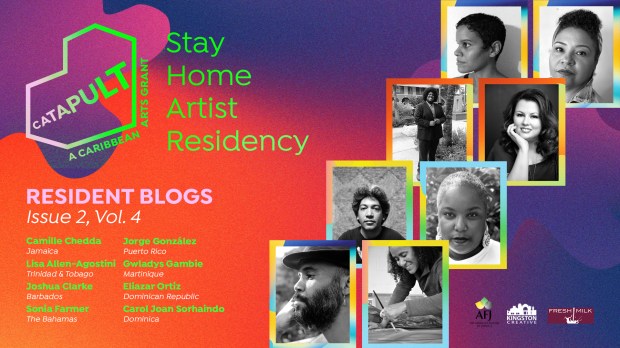
CATAPULT Stay Home Artist Residency Blogs – Issue 2, Vol. 1 & 2

The CATAPULT Stay Home Artist Residency (SHAR) provides opportunities for 24 cultural practitioners from the English, French, Spanish and Dutch speaking Caribbean to be supported while safely remaining in their studios/work-spaces, each of whom will receive a $3,000 USD stipend to produce work over a two-month period.

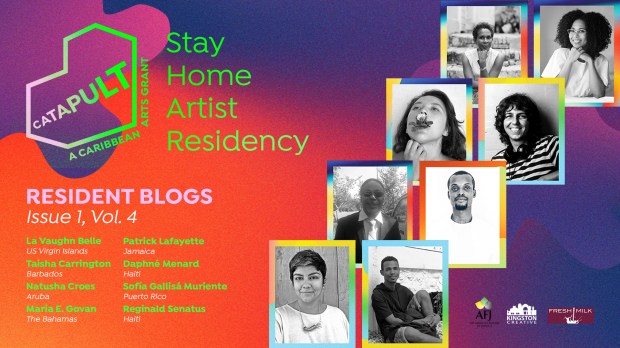
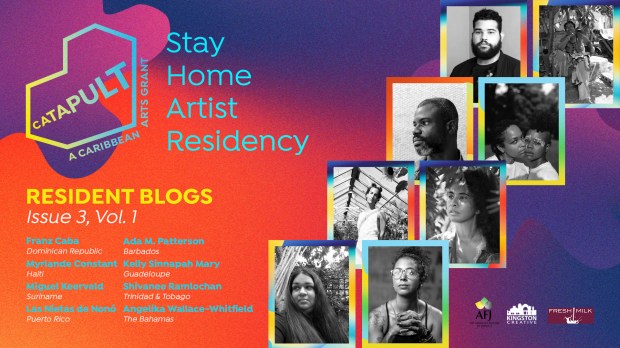
We are pleased to share Issue #2, Volume 1 and Volume 2 of the blog posts written by participating residents, documenting their experiences and processes during their residency. Issue #2 follows the journey of the second group of SHAR awardees: Camille Chedda (Jamaica), Lisa Allen-Agostini (Trinidad & Tobago), Joshua Clarke (Barbados), Sonia Farmer (The Bahamas), Jorge González (Puerto Rico), Gwladys Gambie (Martinique), Eliazar Ortiz (Dominican Republic) and Carol Joan Sorhaindo (Dominica).

Click on the images below to read these sets of resident blogs as e-zines!


Issue 2, Vol. 1

Issue 2, Vol. 2


ABOUT CATAPULT:

CATAPULT | A Caribbean Arts Grant is a COVID-19 relief programme conceptualised by Kingston Creative (Jamaica) and Fresh Milk (Barbados) and funded by the American Friends of Jamaica | The AFJ (USA). Designed as a capacity building initiative it will directly provide financial support to over 1,000 Caribbean artists, cultural practitioners and creative entrepreneurs impacted by the pandemic and working in the themes of culture, human rights, gender, LGBTQIA+, and climate justice.


ABOUT THE PARTNERS:

American Friends of Jamaica | The AFJ has a near 40 year history of funding charitable organizations in Jamaica in the fields of Education, Healthcare and Economic Development. A registered 501 c 3 nonprofit headquartered in New York City, AFJ relies on individual and corporate contributions made by donors who believe in our work and will advocate on our behalf. Part of the AFJ’s mission is to facilitate donor directed contributions which enables donors to support registered charitable organizations aligned with their own goals for philanthropy.


Kingston Creative is a registered non-profit organization founded in February 2017. Its mission is to enable creatives to succeed so that they can create economic and social value, gain access to global markets and have a positive impact on their community.


Fresh Milk is an organisation whose aim is to nurture, empower and connect Caribbean artists, raise regional awareness about contemporary arts and provide global opportunities for growth, excellence and success. Fresh Milk supports excellence in the visual arts through residencies and programmes that provide Caribbean artists with opportunities for development and foster a thriving art community.

Pascale Faublas’ Fresh Milk Residency – Week 1 Blog Post

Fresh Milk shares the first blog post by Haitian resident artist Pascale Faublas, who is joining us as part of an artist exchange programme with Le Centre d’Art, Haiti, to create opportunities for women arts practitioners. In her first week, Pascale introduces us to the experience of coming to Barbados during these challenging times, following travel protocols and transitioning into the start of her residency. This programme is supported by UNESCO’s International Fund for Cultural Diversity (IFDC) and the Foundation for Knowledge and Liberty (FOKAL). Read more below:


En français

Semaine 1

A année exceptionnelle, décisions exceptionnelles! En cette année 2020 marquée par la pandémie du Covid 19, ma résidence artistique a Fresh Milk en Barbades a été exceptionnellement coordonnée par Le Centre d’Art en Haïti et Fresh Milk en Barbades avec le support de l’Unesco et de la Fokal dans l’objectif de rapprocher les artistes de la Caraïbe et d’’offrir des opportunités aux femmes artistes en particulier.

Arrivée en Barbades le 1er Novembre, et suivant les mesures  imposées par le gouvernement, les 6 premiers jours de mon séjour seront conditionnés par ce virus, confinée dans une chambre d’hôtel désigné a cet effet , avec interdiction de prendre contact physique avec quiquonque pas avant les résultats négatifs d’un test Covid PCR pris au 2eme jour et un report de température tous les jours 2 fois par jour pendant 14 jours. 

Je serai donc accueillie a distance par Annalee Davis, qui généreusement me pourvoira en  livres provenant de la bibliothèque de Fresh Milk , traitant de la culture, de l’art dans la Caraïbe et la Barbades, me mettra en contact avec des personnes ressources telles que Dr. Tonya Haynes and Taitu Heron pour une mise en contexte de mon projet de résidence : Fanm se poto mitan.

C’est ainsi que,  le 6 Novembre, je suis reçue par Anna Lee Davis et Katherine Kennedy a Fresh Milk sur son site la  Walkers Dairy , une ancienne plantation coloniale aujourd’hui convertie en ferme ou se trouve l’atelier et la résidence d’artistes.


In ENGLISH

Week 1

In an exceptional year, exceptional actions! In this year, 2020, marked by the Covid-19 pandemic, my artistic residency at Fresh Milk in Barbados was exceptionally coordinated by Le Centre d’Art in Haiti and Fresh Milk in Barbados with the support of UNESCO and Fokal with the objective of bringing artists from the Caribbean closer together, and to offer opportunities to women artists in particular.

I arrived in Barbados on November 1, and following the measures imposed by the government, the first 6 days of my stay were conditioned by this virus. I was confined in a hotel room designated for this purpose, with a ban on making physical contact with anyone before the negative results of a Covid PCR test taken on the 2nd day and a temperature report every day twice a day for 14 days.

I was greeted at a distance by Annalee Davis, who generously provided me with books dealing with culture, art in the Caribbean and Barbados, all from the Colleen Lewis Reading Room at Fresh Milk. Fresh Milk put me in contact with Dr. Tonya Haynes (Institute for Gender & Development Studies at the University of the West Indies) and Taitu Heron (Director of the UWI Women and Development Unit, University of the West Indies) for me to contextualize my residency project: Fanm se poto mitan.

On November 6, I was received by Annalee Davis and Katherine Kennedy at Fresh Milk on their site at Walkers Dairy, a former colonial plantation now converted into a farm, which hosts workshops and artist residencies.


About Le Centre d’Art:

Le Centre d’Art in Port-au-Prince is an institution that works towards promoting artistic creations by Haitian practitioners on the basis of preserved heritage values. Since its creation in 1944, this atypical space with multiple missions has been at the heart of societal and artistic evolutions. As the major protagonist in the reconfiguration of the fine arts realm in Haiti, Le Centre d’Art has been paving the way for several schools and artistic movements.

Despite the destruction of the infrastructure during the earthquake of 2010, Le Centre d’Art managed to save more than 5000 works and 3000 archive files, which are today preserved and valued. Since the reopening in 2014, Le Centre d’Art has once again become an essential part of Haitian culture.

Its mission is to support artists and their creations, and to conserve and disseminate Haitian visual arts. It is a resource space for artists, art students, art lovers, collectors and researchers alike.

Announcing Fresh Milk’s November 2020 Artists in Residence!

Fresh Milk is delighted to welcome two creative practitioners to our International Artist Residency Programme from November 2nd – 28th, 2020! While our team made the decision to scale back our programming this year as we work to reconsider the future of the platform, Fresh Milk is honouring its previous commitments to pre-planned residencies.

As such, we are excited to introduce Haitian artist Pascale Faublas – who is joining us as part of an artist exchange programme with Le Centre d’Art, Haiti, to create opportunities for women arts practitioners, supported by UNESCO’s International Fund for Cultural Diversity (IFDC) – and UK-based writer and curator of Bajan and Jamaican heritage, Aliyah Hasinah.


About Pascale Faublas:

En français:

Pascale Faublas est née  à Port  au Prince en 1961, elle vit et travaille en Haïti. Après trois décennies d’une carrière artistique prolifique, PASKAL s’affirme comme  artiste plasticienne dans le paysage de l’art contemporain haïtien, développant une technique originale faite de collage de papier préalablement imprimés au moyen de techniques acquises en autodidacte : mixed media, encre et acrylique, batik, grattage, monotype, tout en se basant sur une recherche de matériaux issus de son environnement et sur les principes de l’art de la récupération.

In English:

Pascale Faublas was born in Port au Prince in 1961, and currently lives and works in Haiti. After three decades of a prolific artistic career, PASKAL is an established visual artist in the landscape of contemporary Haitian art, developing  original, self-taught techniques using collages of paper previously printed on, and working in mixed media, ink and acrylic, batik, scratching, and monotype. Their practice utilizes materials from from the environment, and is based and on the principles of the art of recovery.

FB: pascalefaublas
IG: @pascalefaublas

________

About Le Centre d’Art:

Le Centre d’Art in Port-au-Prince is an institution that works towards promoting artistic creations by Haitian practitioners on the basis of preserved heritage values. Since its creation in 1944, this atypical space with multiple missions has been at the heart of societal and artistic evolutions. As the major protagonist in the reconfiguration of the fine arts realm in Haiti, Le  Centre d’Art has been paving the way for several schools and artistic movements.

Despite the destruction of the infrastructure during the earthquake of 2010, Le Centre d’Art managed to save more than 5000 works and 3000 archive files, which are today preserved and valued. Since the reopening in 2014, Le Centre d’Art has once again become an essential part of Haitian culture.

Its mission is to support artists and their creations, and to conserve and disseminate Haitian visual arts. It is a resource space for artists, art students, art lovers, collectors and researchers alike.


About Aliyah Hasinah:

Aliyah Hasinah is a curator and writer of Bajan and Jamaican heritage, raised in Britain. Her practice focuses on decolonial approaches to amplifying nuanced Black storytelling through installation art, film and exhibition.

She has curated for Birmingham Museum & Art Gallery, Southbank Centre, Eastside Projects, Ort Gallery, Wolverhampton Museum and Art Gallery and more. In 2019 Arts Council funded her research in ‘Decolonising the Curatorial’ that took place in the UK, Barbados, New York & Bahia, Brazil.

Whilst on residency at Fresh Milk Aliyah aims to learn more about West Indian Art History and Black conceptual immersive art in the modern day.