Open Call: Tilting Axis Curatorial Fellowship Programme 2016

As a direct outcome of the Tilting Axis meetings in 2015 at Fresh Milk in Barbados and in 2016 at the Pérez Art Museum Miami, Scotland based cultural partners CCA Glasgow, David Dale Gallery, Hospitalfield and curatorial collective Mother Tongue have come together to offer structural long-term support to an emerging contemporary art practitioner living and working in the Caribbean. This is a new fellowship opportunity that focuses on the development of pragmatic and critical curatorial development hailing from the Caribbean region, and is research and practice-led, and mentor-based. The fellow will receive a maximum of £5,000 towards travel, accommodation, and living costs. The fellowship is co-developed in partnership with British Council.

Tilting Axis logo

Designed as a year-long programme between the Caribbean region and Scotland, the fellowship will have an open-ended outcome. It offers support for critical development of curatorial practice and gives a practical base in the partner institutions, connected with the successful candidate’s proposal.

We seek proposals that engage with the unique visual culture available in the Caribbean and what might be learned from its unexpected and innovative approaches. The successful candidate will be encouraged to travel throughout the Caribbean in search of such approaches and research. As part of this fellowship a trip to Scotland is essential, offering an opportunity to use the experience with the Scottish based partners as a form of mentorship. In collaboration with the partners, a realistic budget will be proposed, maximising the opportunities.

Within the Tilting Axis meetings, complexities of mobility, decolonisation, institutionalism, curatorial knowledge, pragmatics, and social realities have been surfacing as keywords of urgency within Caribbean cultural life. The mentorship element in the fellowship allows for a stable basis from which to draw and use spaces, libraries, individual knowledge, and other infrastructure, both in the Caribbean and Scotland) depending on the nature of the needs in the application.

For whom?

Curators, researchers, artists, or cultural producers based in the Caribbean region who want to make new links within the region as well as in Scotland and have a keen interest in developing their curatorial practice.

Goals

• Develop, stimulate, support, and visualise curatorial and artistic realities coming from the Caribbean region
• Facilitate face-to-face communication in Scotland as well as in the Caribbean region
• Offer a free and open access to knowledge
• Provide a stable platform for professional experiences
• Produce critical knowledge on educational tools as well as visual culture
• Focus on emerging practices
• Cross existing language barriers
• Utilise the existing Tilting Axis network
• Offer practical support and a trip to Scotland

Geography

The Caribbean is an active region. The definition of what is the Caribbean is not uniformed; Wikipedia provides a useful list that includes the islands and the continental countries.

Drawing on the specifics of the region through processes of decolonisation, language barriers, race, mobility, and digitalisation, your proposal might approach actively how people live and work and especially how contemporary art takes a responsibility to reflect and act on it. What are fears as well as potentials in these current times? Within such a complex geography, what are the challenges?

Mentorship and support

The fellowship offers a strong supportive framework and takes the model of a mentorship programme. Depending on the candidate’s interests and skills, several personal mentors are available for support throughout the programme. There is open access to infrastructure, curatorial and artistic ideas, exhibition spaces, archives, and libraries as well as personal stories and experiences within these institutions and individuals. Also online, Skype, and email support will be available from the mentors throughout the fellowship. A contribution to the public blogs of British Council and CCA Glasgow will be required along with a final report on the Fellowship and a presentation at Tilting Axis in April 2017 at the National Gallery of the Cayman Islands.

Application

Applicants for the fellowship are invited to develop an independent proposal outlining a clear interest in the issues highlighted. The proposal should include a realistic travel itinerary, carefully selected within budget restrictions, and content driven. The application can be based on already existing research or offer new projects. No outcome is expected from the outset, but a proposal that shows organisation of collateral events that allow for public access to the issues is appreciated.

Departing from a curatorial ambition, we expect to see strong proposals of maximum 1000 words. Please include a budget proposal (maximum of £5000), a CV and two references. The application should be submitted via e-mail to: jennifer@cca-glasgow.com.

Submission deadline: Monday 11 July 2016.

Emerging art practitioners are particularly encouraged to apply. The successful candidate will be living and working in the Caribbean region.
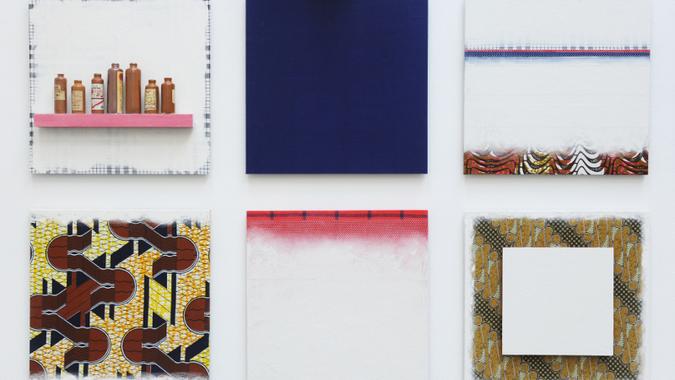
Remy Jungerman, Spirit Levels, CCA Glasgow 2014, Photography by Alan Dimmick.

Remy Jungerman, Spirit Levels, CCA Glasgow 2014, Photography by Alan Dimmick.

Summary

Aimed at curators, researchers, artists, or cultural producers focused on, or with a clear interest in, curatorial practice from the Caribbean region.

Fellowship period: mid 2016 – mid 2017, to be negotiated depending on proposal and personal/professional situations.

The Fellow will be assigned a mentor from the core partners depending on their needs and wishes. Throughout the year these mentors are accessible online or on location.

A total project budget of £5000 will be allotted for the duration of fellowship. The award shall be used exclusively to cover only the costs of travel, per diems, and other fees and living costs identified in the final budget approved by the selection committee.

The Fellow will be selected on the basis of a project proposal and a succinct motivation elaborating the candidate’s interest in developing a Caribbean curatorial practice. The deadline for submission will be Monday 11 July 2016.

The proposals will be judged by an international jury consisting of curators, academics, and museum professionals, after which shortlisted candidates will be invited for an interview via Skype.

The Curatorial Fellow will be appointed at the end of July 2016. Jurors will be:

Tiffany Boyle and Jessica Carden, Mother Tongue, UK
Holly Bynoe, ARC Magazine, The National Art Gallery of the Bahamas and Tilting Axis co-founder
Mario Caro, board member of Res Artis, Tilting Axis partner
Annalee Davis, British Council Caribbean, Fresh Milk Barbados, Tilting Axis co-founder
Francis McKee, CCA Glasgow, UK
Max Slaven, David Dale Gallery, UK
Laura Simpson, Hospitalfield, Arbroath, UK

Possible partners within the network include:

Alice Yard, Trinidad + Tobago
ARC Magazine
Fresh Milk Art Platform Inc., Barbados
Ateliers ‘89, Aruba
Bermuda National Gallery
Beta-Local, Puerto Rico
British Council Caribbean
espace d’art contemporain 14°N 61°W, Martinique
Ghetto Biennale, Haiti
Johanna Auguaic, Director, BIAC, Martinique
Instituto Buena Bista, Curacao
L’Artocarpe, Guadeloupe
National Art Gallery of The Bahamas
National Gallery of Jamaica
National Gallery of the Cayman Islands
NLS, Jamaica
Tembe Art Studio, Suriname

In partnership with CCA Glasgow, David Dale Gallery and Studios, Hospitalfield, Mother Tongue and Tilting Axis. Supported by British Council Scotland.

BC logo_720

Fresh Talk: Poland takes Haiti to Venice

Fresh Milk and Fresh Art International are collaborating to present Fresh Talk: Caribbean, a series of podcasts about creativity in the 21st century with a Caribbean focus.

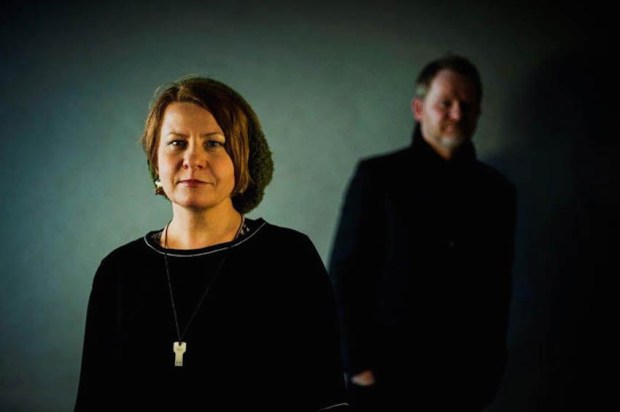
This week, we highlight a conversation with artist Joanna Malinowska, who talks about Halka/Haiti, the panoramic film project she and her partner CT Jasper produced for the Polish Pavilion at the 56th Venice Art Bienniale.

Click here to listen to the full podcast.

malinowska_joanna_portret_850_________________

About Fresh Art International & Fresh Talk:

Mission: To inform and inspire a world of followers, Fresh Art International’s team shares conversations, commentary, news, and views about contemporary art.

Launched in October 2011, Fresh Art International is an evolving independent media outlet with a global point of view. Our website is the virtual platform for Fresh Talk: Conversations About Creativity in the 21st Century, our signature audio podcast. The site welcomes up to 3,000 monthly visitors. Averaging more than 9,000 feed hits monthly, we welcome new friends and followers every day: Facebook (3,000+ Likes and Friends) and Twitter (5,000+ Followers).

For Fresh Talk, independent curator Cathy Byrd meets with contemporary artists, curators, designers, architects, composers, writers, filmmakers and other cultural producers. Listen to conversations directly on this website, download episodes, or subscribe to the series on iTunes and Stitcher. Fresh Talk is also accessible through Public Radio Exchange at prx.org.

Tilting Axis 2: Caribbean Strategies held at the Pérez Art Museum Miami

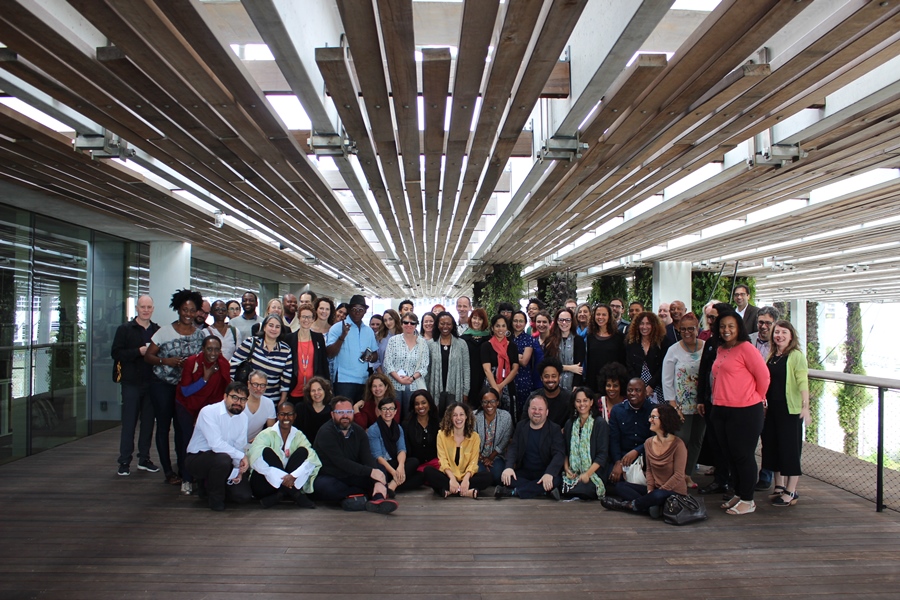
The inaugural edition of the Caribbean-driven visual arts conference Tilting Axis took place last year at The Fresh Milk Art Platform Inc. in Barbados. This initial encounter saw thirty-two arts professionals spanning the Anglophone, Francophone, Hispanic and Dutch Caribbean convene for the first time on Caribbean soil alongside a number of international participants. Building on this, Tilting Axis 2 took place at the Pérez Art Museum Miami (PAMM) on February 19 and 20, 2016, with more than double the previous number of attendees coming together to discuss this year’s topic ‘Caribbean Strategies’.

Tilting Axis was originally conceived by Fresh Milk and ARC Magazine, who have continued to collaborate with core partners Res Artis and PAMM for the second iteration in Miami. As a city that not only aspires to be a vital art centre in the 21st century, but that also acts as a hub between the Caribbean and the global North with a large diasporic population and, in many ways, a shared history, Miami was a strategic location for the conference to travel to.

The participants of Tilting Axis 2

The participants of Tilting Axis 2

In her introductory remarks, Annalee Davis, Founding Director of Fresh Milk, emphasized the value of the first meeting having taken place within the region: “This notion of ‘tilting the axis’ refers to shifting the focus of our gaze and harnessing our collective power to make this sector more visible and sustainable in ways that resonate with our lived realities in the Caribbean.”

Although this concurrent gathering happened physically in the USA, it is critical that the heart of Tilting Axis and the commitments made by all those in attendance continue to act “as a counterpoint to many decisions often made about the region from external locations.”

Holly Bynoe, Director and Editor-in-Chief of ARC, reiterated these sentiments, and expressed thanks to the team at PAMM for facilitating a larger conference and making the museum’s network and resources available to the region: “As we work to make new connections with individuals and entities who want to work with the creative Caribbean, figure out our best practices and become more regionally conscious, projects like Tilting Axis can become one of the fertile seeds of this transformation.”

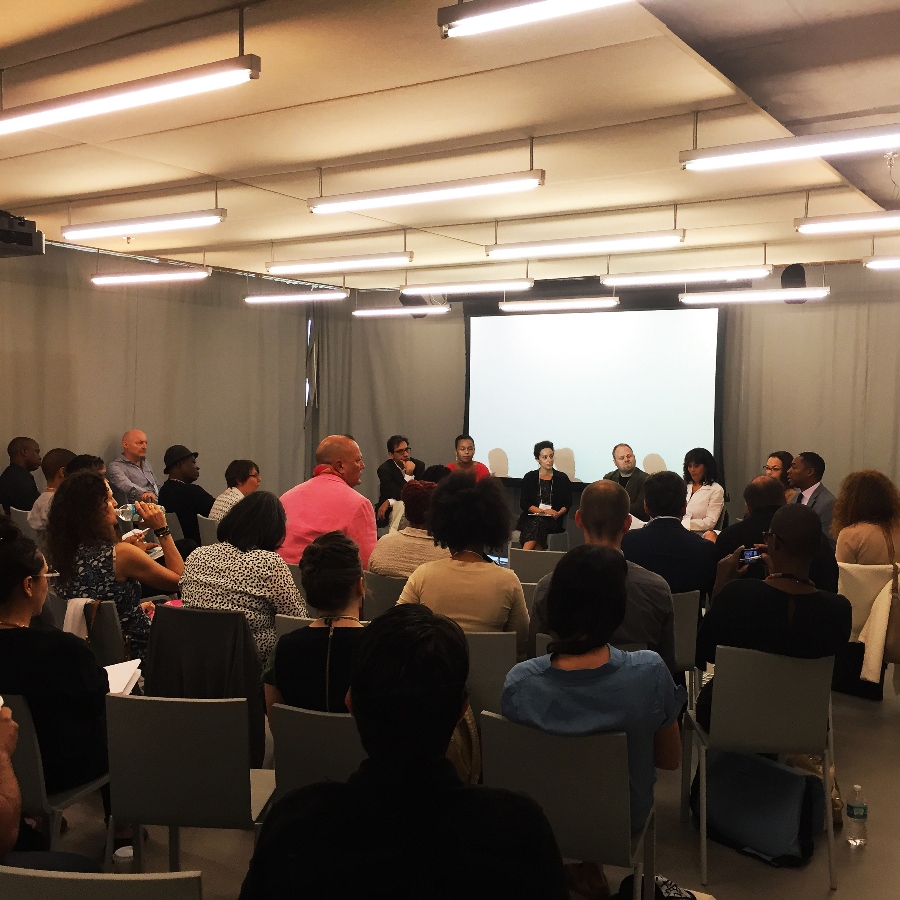
Introductory remarks at Tilting Axis 2

Introductory remarks at Tilting Axis 2

Tilting Axis 2 was anchored by three modules that emerged from the first meeting: exhibitions and programming, artists’ movement and mobility, and education. Table 1 on Exhibitions and Programming was moderated by Holly Bynoe, and looked at curatorial projects that reimagine tropes of the Caribbean. The three presenters were Veerle Poupeye, Director of the National Gallery of Jamaica (NGJ); Art Historian at Northwestern University Krista Thompson; and Johanna Auguiac-Célénice, Director of the Biennale Internationale d’Art Contemporain Martinique (BIAC-Martinique).

Poupeye highlighted the shift in the NGJ’s approach to curating from “teaching a lesson to encouraging conversations,” giving examples of exhibitions the gallery has held in recent years. Thompson spoke about the increasing interest in Caribbean art over the last decade, and how her curatorial projects seek to counter the often monolithic view of the region. Through her work at the BIAC, Auguiac-Célénice expressed the need for us to think about Caribbean culture differently, embracing our differences and favouring a rhizomatic system over hierarchy.

Veerle Poupeye’s presentation about the National Gallery of Jamaica

Veerle Poupeye’s presentation about the National Gallery of Jamaica

Table 2 addressed Artists’ Movement and Mobility, and was moderated by Tobias Ostrander, Chief Curator of PAMM. Presentations were given by Joëlle Ferly, Director of L’Artocarpe in Guadeloupe and Marcel Pinas, Founder of Tembe Art Studio in Suriname about their respective platforms, experimental approaches to residencies and issues in the mobility of artists working in and from the Caribbean. Both speakers see their organizations as fulfilling a necessary role in their countries, with Pinas’ sharing his strong stance on using the arts as a way to generate “awareness and value of ourselves and our culture,” and give back to the community.

Donette Francis, Rene Morales and Gean Moreno in a group discussion at Tilting Axis 2.

Donette Francis, Rene Morales and Gean Moreno in a group discussion at Tilting Axis 2.

Moderated by Annalee Davis, Table 3 looked at alternate models of arts education. Panelists included Gean Moreno, Curator of Programs at ICA, Miami; Pablo Guardiola, Co-director of Beta Local in Puerto Rico; and Paulo Miyada, Director of the Entropic School at Instituto Tomie Ohtake in São Paulo, Brazil.

Moreno discussed the alternate education programming of research.art.dialogue (r.a.d.) in terms of mapping a variety of learning structures and advocating for non-traditional methodologies of knowledge exchange. Guardiola spoke about the importance of alternate education in the arts co-existing alongside cultural institutions and schools to ensure a breadth of experience for students. Beginning his presentation by giving a background in Brazilian art, Miyada went on to outline the Entropic School’s vision of being a space of experimentation and addressed the gap between formal art education and professional placement in Brazil.

Group discussions at Tilting Axis 2

Group discussions at Tilting Axis 2

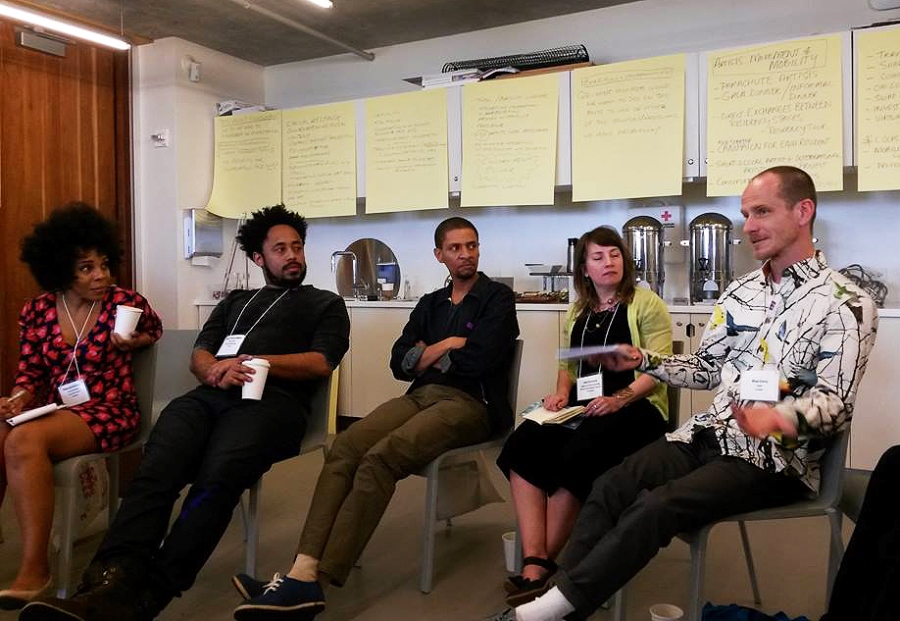
Deborah Anzinger, Jason Fitzroy Jeffers, Tumelo Mosaka, Deb Dormody and Blue Curry in a group discussion at Tilting Axis 2

Deborah Anzinger, Jason Fitzroy Jeffers, Tumelo Mosaka, Deb Dormody and Blue Curry in a group discussion at Tilting Axis 2

Open clinics were held to determine how attendees could realistically use the range of skills and knowledge at the conference to commit to a series of actions around the three target areas. Some of these included co-creating educational programmes; the potential of forming an advocacy group to liaise with governments on behalf of artists; initiating residencies and exchanges between a broad spectrum of cultural professionals; and designing an exhibition programme which could happen simultaneously in a number of territories, while having scholarship on the exhibitions written from within the region and disseminated widely.

Also built into the two-day conference were three ‘artist intermissions’, featuring short presentations by Haitian-born, Miami based artist Adler Guerrier, Bahamian-born, London-based artist Blue Curry and St. Martin-born, Martinique based artist David Gumbs. Interspersing the dialogues with opportunities to see what a few artists connected to the region are producing created a space for rejuvenation and inspiration. Along this same vein, a group visit was organized to Cannonball Studios, where Blue Curry and ARC Magazine’s Senior Arts Writer Marsha Pearce had been taking part in a residency leading up to the meeting.

Adler Guerrier presenting about his art practice at Tilting Axis 2

Adler Guerrier presenting about his art practice at Tilting Axis 2

Blue Curry’s studio at Cannonball studios, Miami. Photo courtesy of the artist

Blue Curry’s studio at Cannonball studios, Miami. Photo courtesy of the artist

The closing event of the conference was a public talk given by Pablo León de la Barra, a curator at the Solomon R. Guggenheim Museum for the Latin American phase of the Guggenheim UBS MAP Global Art Initiative. His presentation examined the structure and function of museums in contemporary society. León de la Barra discussed some of his curatorial work which explores different ways of creating agency and visibility for cultures that are often erased from the established canon of art history.

Overall, Tilting Axis 2: Caribbean Strategies made significant strides in its aims to fortify networks through knowledge transfer, provide avenues for critical conversation and form action plans to extend the reach of arts and culture throughout the Caribbean. The next edition of the meeting is slated to take place in early 2017, hosted by the National Gallery of the Cayman Islands (NGCI).

To find out more about the organising institutions and funders visit the ARC, Fresh Milk, PAMM and Res Artis websites.

Fresh Milk and Fresh Art International present Fresh Talk: Caribbean!

Fresh Milk and Fresh Art International are excited to share Fresh Talk: Caribbean, a series of podcasts about creativity in the 21st century with Caribbean artists & those engaging with Caribbean art around the world. This series of conversations is a curated selection from Fresh Art International’s signature project Fresh Talk, which features the platform’s Director/Producer  Cathy Byrd in conversation with more than 100 culture makers worldwide. We were pleased to have connected with Cathy at Tilting Axis 2 at the Pérez Art Museum Miami this year, and are happy to be able to highlight their Caribbean-focused content!

We will be releasing one conversation a week as a feature on our website, and the entire suite will be housed on our Projects Page. Stay tuned for more!

Fresh Talk Caribbean Flyer

About Fresh Art International & Fresh Talk:

Mission: To inform and inspire a world of followers, Fresh Art International’s team shares conversations, commentary, news, and views about contemporary art.

Launched in October 2011, Fresh Art International is an evolving independent media outlet with a global point of view. Our website is the virtual platform for Fresh Talk: Conversations About Creativity in the 21st Century, our signature audio podcast. The site welcomes up to 3,000 monthly visitors. Averaging more than 9,000 feed hits monthly, we welcome new friends and followers every day: Facebook (3,000+ Likes and Friends) and Twitter (5,000+ Followers).

For Fresh Talk, independent curator Cathy Byrd meets with contemporary artists, curators, designers, architects, composers, writers, filmmakers and other cultural producers. Listen to conversations directly on this website, download episodes, or subscribe to the series on iTunes and Stitcher. Fresh Talk is also accessible through Public Radio Exchange at prx.org.

Sonia Farmer’s Residency – Week 2 Blog Post

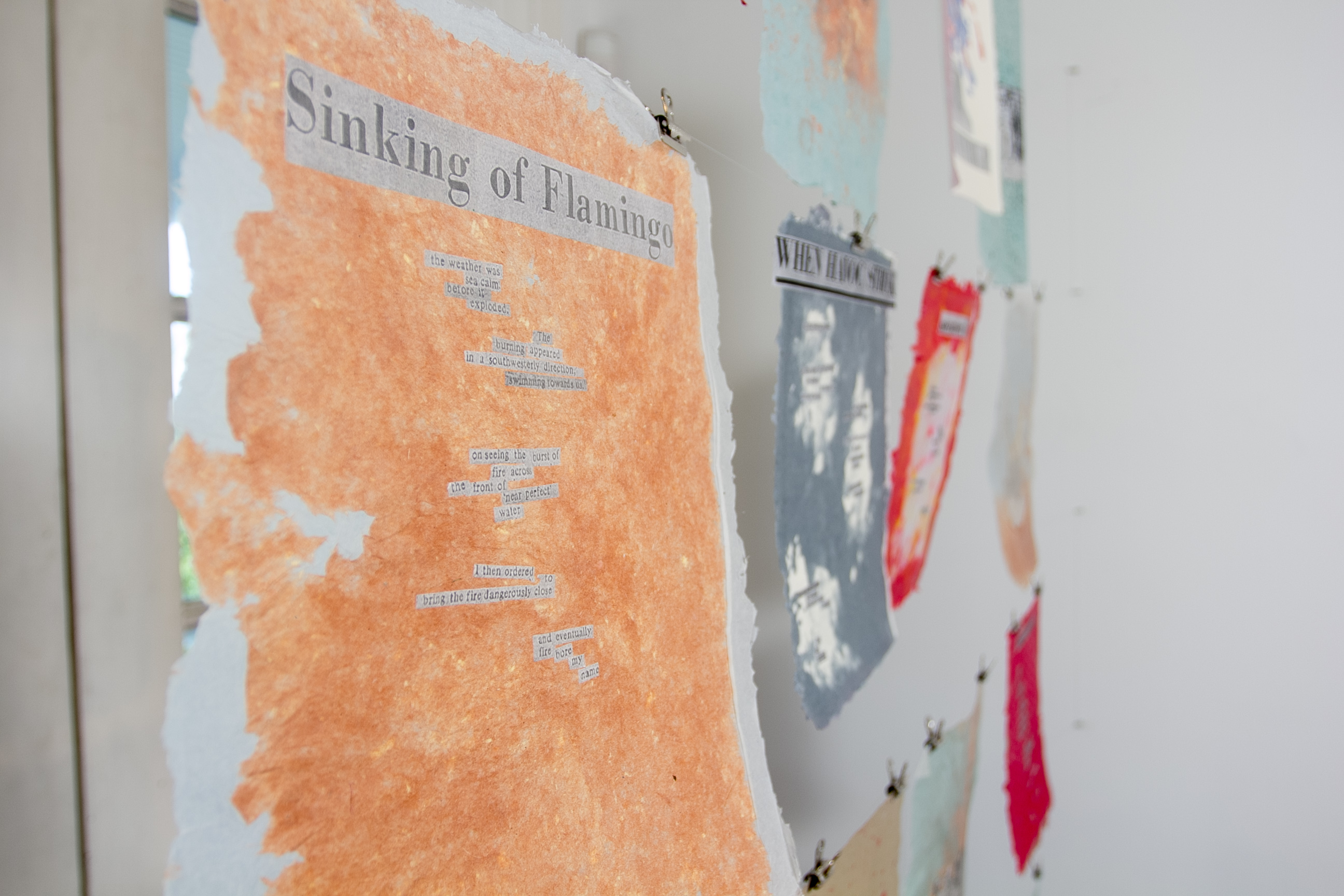
Fresh Milk resident artist & writer Sonia Farmer shares her second blog post. Although she came to Barbados with a specific project in mind, she has found herself drawn to a new idea based on a book in the Colleen Lewis Reading Room collection – ‘A True and Exact History of the Island of Barbadoes’ by Richard Ligon, originally published in 1657. Using a method of  found poetry called erasure, she is responding to the text by identifying words and phrases that stand out to her, changing the meaning and context to create an entirely new piece. She also hosted day two of her book-binding and design workshop ‘The Art of the Book‘. Read more below:

“I found myself a stranger in my own Countrey.”

That line jumped out at me as I combed through the book, A True and Exact History of the Island of Barbadoes by Richard Ligon pulled out of the Colleen Lewis Reading Room library by Annalee when I asked if she had any old local texts. I had planned to use it for an erasure exercise in my first class, which I did, but immediately became obsessed with creating my own response to the book. I could see a new poem emerging from the strange story told from an Englishman’s perspective in the 1600s. Putting aside the project I had planned to focus on in my time here, I’ve allowed this new endeavor to drive my inspiration for the time remaining: an erasure called A True and Exact History, gleaned from this delightful account.

An erasure, as I explained to my students, is the act of removing words from an existing piece of text in order to create a new poem. I’ve always admired the method, specifically in the brilliant ways writer and artist Jen Bervin has used it, but didn’t explore it much myself until a few years ago. I’ve found more and more that I enjoy using one part erasure, one part found language to drive the content of my work—not because I find it difficult to use my own words, but because I love the challenge of such an exercise, finding new narratives from often outdated accounts to construct a contemporary response. I also enjoy using language against itself and out of context to bring attention to its disparities and contradictions.

I used this method a few years ago to form the collection of poetry in ‘Clipping Feathers’, taken from newspaper stories surrounding a major event in Bahamian history shortly after our Independence. With the fantastical narratives I constructed out of sensationalized accounts, I found a way to address the lack of contemporary Bahamian history studies—since, like me, many young Bahamians may not even know about this groundbreaking event, we are left to create our own fictions, a dangerous place from which to glean our national identity.

5

I’m coming from a similar place of ignorance with A True and Exact History. Purposefully, I am not “reading” the text as I seek out its underlying narratives. I also don’t yet fathom how important it has been in Bajan history, though through informal conversations with Bajans, I am starting to get the picture. I did read a little bit into Ligon’s background, finding that he arrived in Barbados late in his life after political upheaval in his home, built a sugar plantation, and then wrote this book in jail upon returning to England from Barbados. I don’t want to research too far, however, holding myself back so as not to directly influence my exercise, not yet anyway. The reason is because I want to be an explorer here in an unknown territory—as I am in these new surroundings. I’d like the narrative to form organically out of that experience.

The resulting narrative so far has been exciting to me in its abstracted exploration of emotional landscapes. I had said before that as a person from the Caribbean, visiting other islands in the region is an exercise in magical realism. This new poem is helping me to explore that and deconstruct it. After all, what does it mean to write a “True and Exact History” of anywhere or anything or anyone? How conceited is that? Recognizing the importance of this text is necessary, but not without the lens of colonialism and privilege. With his own biased eye and with centuries between its inception to now, the text is strangely poetic even at its most problematic moments. It’s a gorgeous text to explore and consider, and I hope it yields an interesting result by the end of my stay.

Week two of my Art of the Book class found us exploring the wonderful world of chapbooks, small presses, and simple sewn binding structures. I gave everyone a crash course in chapbook history and highlighted the work of a number of small, independent presses. Then we reviewed some student projects completed at home using last weeks’ structures and writing challenges. All I can say is I’m one proud teacher! The books they’ve made are awesome, fully engaging with everything these structures have to offer to their individual narratives.

Then we got to work on sewn structures, including the Japanese stab-binding and pamphlet stitch. In order to register for the class, students had to submit a poem of their choice. I gathered these into a simple chapbook called “Fresh Verse” and also made us a special press name, “Fresh Chaps,” under which we made twelve copies—one for every contributor, and two for the Colleen Lewis Reading Room itself. So by the end of the class, everyone got to bind a limited edition anthology of class poems. Who knows, maybe there will be a volume two someday?