Matilde dos Santos writes on CATAPULT Awardee Réginald Sénatus for Madinin’Art

Martinique based historian, art critic and independent curator Matilde dos Santos, who was one of the guest curators/mentors selected to conduct studio visits with 6 of the 24 CATAPULT Stay Home Artist Residency participants, has generously offered to write features on each of the artists she engaged with during the programme. The second piece focuses on the practice of Haitian artist Réginald Sénatus!

Read the article, originally published in French on Madinin’Art: Critiques Culturelle de Martinique (November 29, 2020), in English below!


Last August, Fresh Milk, Kingston Creative and The American Friends of Jamaica, conceived and launched the program CATAPULT | A Caribbean Arts Grant; a set of six initiatives designed to support Caribbean creatives confronted with the COVID-19 pandemic. I had the honour of being invited by Fresh Milk to visit the artists’ studios as part of the “Stay Home Artist Residency.” Among the 24 candidates selected by the CATAPULT jury, I was able to virtually meet 6 young and talented artists from Aruba, Barbados, Haiti, Jamaica and Martinique. I wanted to share these moments of discovery with you. Here is the second episode in this series of studio visits.

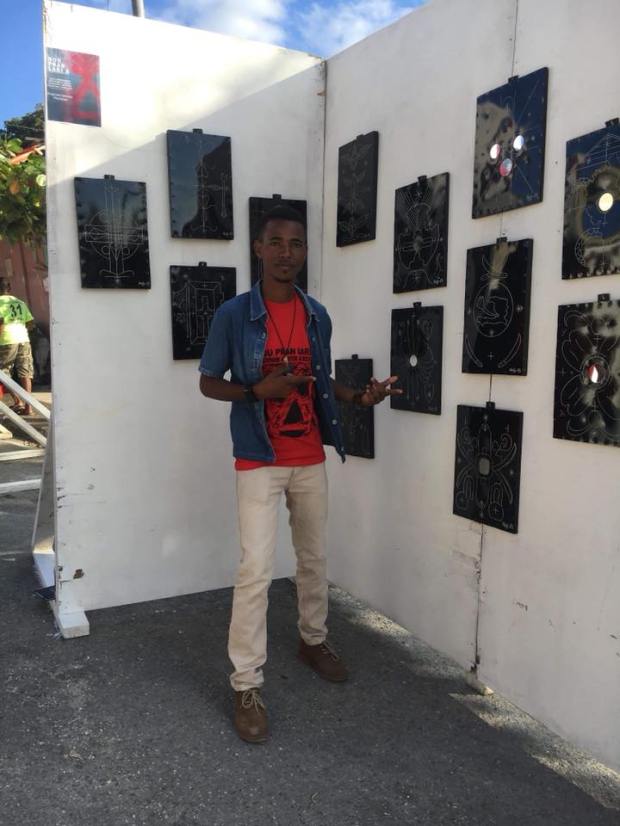
Réginald Sénatus was born in 1994 in Port au Prince, where he lives and works. Having grown up around artists’ workshops on the Grande Rue, and inspired by artists like Celeur and Casseus, he participated since 2010 in the Collective Atis Rezistans, comprised essentially of sculptors working with recovery materials. As of 2017, he is a founding member of Nou pran lari a, an artistic and social movement that invests urban space to exhibit artists outside of traditional spaces. Hanging out on the Grande Rue, he became exposed to practices where the border between crafts and art is vague, or even non-existent, as it is becoming more and more common in the world of contemporary art. Self-taught at the outset, he trained at the Art Centre by participating in workshops on engraving, sculpture, painting, ceramics… with artists such as Pasko, Mario Benjamin, Sébastien Jean, Patrick Villaire, Simil, Tessa Mars, Mafalda Mondestin and Pascale Faublas, among others. He also had the opportunity to collaborate with other artists such as Gina Cunningham in 2017 and Ernest Pignon-Ernest in 2019. Very active, he participated in various artistic events including several editions of the Ghetto Biennale in Port-au-Prince, receiving the 3rd  prize in 2015 and the 1st prize in 2017 and 2019. In January 2020, in a kind of national consecration, he exhibits at The Musée du Panthéon National Haïtien (MUPANAH).

Reginald Sénatus, Nou pran la ria

Réginald studied law, and that may be why his work reflects a constant concern for societal issues, namely social and environmental injustices. His work focusses on the country and its capital, adopting a benevolent but not complacent look at the ills of the city, revealing a particular interest in both the exclusions and the affirmation of life.

Technically his works from the Ghetto biennials of 2017 and 2019 and Mansuétude, which he produced in the SHAR-CATAPULT programme this year,  all belong to the same series. All three of them are composed of raw and smooth plywood, forming a surface on which the artist assembles pieces of square or rectangular wood, to serve as a support for a rubber plate, which is then engraved, painted, and inked. Up until 2017 Réginald used recycled rubber tires, which he cut into plates; since 2018 he uses rubber plates, that generally serve in Haiti to make shoe soles. He works with them like any other engraving material, such as linoleum blocks. First he draws on the plate and then digs out the patterns. Afterwards, he inks the hollows with acrylic auto paint.  The 2017 piece was painted white, while carefully avoiding the hollows, which remained naturally black. Other works, once ready, are rubbed with a fabric soaked in solvent to obtain a shiny finish. The plates do not constitute a step in an engraving process; they will not serve to print, but provide the support for cutting and painting, as a canvas. For a long time, he used a razor to dig out his motifs, but since 2018 he uses gouges. Once the plate is engraved and painted, he may add mirrors, plastic bottles, any kind of objects. A practice of recuperation, reuse and upcycling. A very contemporary painting practice through its use of non-traditional materials and supports, but also a practice that shares a great intimacy with popular art and Art brut. And if we want to refer to established movements in the history of art, we could relate his work to the Nouveau realisme or the Arte povera, for the use he makes of poor materials and recovered objects.

In 2017, he devoted six months to the creation of  Nan Benyen Potoprens Pa gen kache lonbrik,  literally, “when Port-au-Prince bathes, she does not hide her navel,” which reveals the city “without lying and without reserve” according to his words. The installation is an imagined cartography of the city, drawn with small wooden briquettes, each surmounted by a rubber plate, engraved and painted, often with religious symbols that the artist uses to represent historical and contemporary aspects of the city. The installation was interactive in a way, since the public was invited to invest one side of the work to record its thoughts, on the city, its problems, its hopes… A work that I see in pieces in the dim light of the studio, and that renders it all so beautiful in the photos.

In 2019, working on the theme of the Ghetto biennial “The Haitian Revolution and Beyond,”  Réginald chose to portray the Battle of Vertières, the last battle against slavery and colonization in Haiti. The work Murs et portes de Vertières is accompanied by a text that reveals the artist’s intention. At Vertières, he says, two men born as slaves, Jean Jacques Dessalines and Capois-La-Mort, defied the world order. Their victory led to the creation of the first black republic in the world. If Réginald has shown an interest in walls and doors, it is because these are ambivalent objects that can give passage or on the contrary, restrict access, to both good and evil.   Insurmountable, they protect or exclude. Crossed over, they can open up on dreams or nightmares.  In this work, we notice that the artist abandoned religious symbols for those of his own making. He also added mirrors and gave the work a finish so lustrous that the black surfaces shine like mirrors.

Mansuétude, the work produced in residence, bears the mark of the pandemic. He created it as a kind of exorcism: talking about the virus to keep it at bay, to cast out fear as well. Here, the artist approaches figuration, with more elaborate drawings, almost characters, depicting masked women. All the young artists I met at the SHAR residency told me how much they felt the impact of the pandemic; living most often in precarious situations even before confinement, they then suffered cancellations or postponements of projects, loss of income and above all, for Réginald, loneliness and alienation. The CATAPULT grant offered Réginald the possibility to focus on a project: the piece Mansuétude made entirely while in residence, yet another assemblage of rubber plates mounted on wood, engraved and inked. On almost all of the plates, a spiral or circle, that of the virus itself, that of the circle of humans.

On two smaller plates, there are plastic bottles and cutlery; on another, the symbol of the US dollar; in the end, comprising a whole series of recurrent concerns in the time of pandemic. The artist experiences the crisis as indicative of the fragilities and weaknesses of our societies on a global scale, affecting first of all the most vulnerable: the elders. He thinks that only mutual aid can overcome these fragilities, hence the figures of masked women discussing in a circle. In Haiti, as in Martinique, a woman is a poto mitan, fanm doubout, pillar of the family. Similarly, it is through them that we begin to heal the world. I find the plates very beautiful, taken individually;  but I can’t say why their assembly on the wooden support leaves me dubious, as if the installation was not yet finished.

The visit to Réginald’s studio was disrupted by technical glitches. One could not hear, the other could hardly see. He showed me around his studio with his phone, which was not ideal for visibility, especially since the workshop was rather dark. I wanted to see better what I was guessing in the dark. So we continued to talk the following days, via WhatsApp. Réginald also sent me photos and texts. I discovered a committed artist, socially engaged and concerned about the current state of his country. Proud of his story. Eager to meet people and learn from them. Undeniably gifted with his hands. An artist who seizes every opportunity to learn and enrich his practice; an artist focused on sharing, who intends to pass on the fruits of his experience in residency to his fellow artists in Haiti. A young artist to follow, no doubt.

– Matilde dos Santos – Historian, art critic and independent curator

Appreciation to the partners of the CATAPULT programme: The American Friends of Jamaica, Kingston Creative and Fresh Milk.

The SHAR participants described their experiences in blogs that you can read on the Fresh Milk platform here.

Matilde dos Santos writes on CATAPULT Awardee Natusha Croes for Madinin’Art

Martinique based historian, art critic and independent curator Matilde dos Santos, who was one of the guest curators/mentors selected to conduct studio visits with 6 of the 24 CATAPULT Stay Home Artist Residency participants, has generously offered to write features on each of the artists she engaged with during the programme. The first piece focuses on the practice of Aruban artist Natusha Croes!

Read the article, originally published in French on Madinin’Art: Critiques Culturelle de Martinique (November 25, 2020), in English below!

Recognizing the impact of COVID-19 on the arts sector, the American Friends of Jamaica facilitated a $320,000 fund in collaboration with Kingston Creative and The Fresh Milk Art Platform to support artists, creatives and cultural practitioners from the Caribbean region. These funds constitute the CATAPULT programme which, through six different initiatives over five months, provides direct financial support to more than 1000 Caribbean artists working on the themes of culture, human rights, gender, LGBTQIA+ and climate justice.

One such initiative is the Stay Home Artist Residency (SHAR). There are twenty-four award winning artists, spanning thirteen distinct territories and four linguistic areas of the region (English, Spanish, French and Dutch).  I had the honour of being a visiting curator for six of the resident artists.

My first virtual visit was to artist Natusha Croes’ studio.

Born in 1991, at Oranjestad, Aruba, Natusha Croes studied fine arts as a teenager at Ateliers ’89 in Aruba. After that, she continued her studies in Audio Visual Fine Arts at the Gerrit Rietveld academy in Amsterdam and she obtained a Master of Arts degree in Performance Making at Goldsmith College of London. She participated in residences in Aruba (2015, Caribbean Linked III) and in Berlin (2017, SomoS).

Her present work is a derivative of TACTUS, a creation in which she explored the possible acoustics of playing various shapes of cactus found in certain Aruban landscapes. Tapping on the thorns produced sounds, creating rhythms to which the artist sang and played. The performance was recorded in a short video. This particular attention given to the nature of a specific landscape, where she grew up, drives her current research

Natusha Croes – TACTUS screen shot video, courtesy of the artist.

Her maternal grand parents left Madeira island for Venezuela, and then left Venezuela for Aruba.  Natusha was born in Aruba to a Dutch father. Raised by her mother and her mother’s family, in a Luso-Spanish household, she discovered the Dutch language and culture at school. After college, she leaves to study in Amsterdam; comes back, leaves again, attends some residencies; after seven years of living abroad, she returns to her homeland guided by the need to reconnect with this space.

Strangely enough, she finds a representation of cultural diversity in the landscape, itself a hybrid between land and sea, with rock formations in layers to empathise with and relate to. Through her contact with the environment, Natusha stalks the memory of rocks, shells, leaves and water; a memory buried in the earth and which goes back for millions of years

Starting from the idea of touch, already present in TACTUS, Natusha creates CARICIA, a project to caress the earth, take care of it, honour it, as she says. The word is beautiful and accurate and, in keeping with the ancestral cultures, free of any colonial framework.

The situation in Aruba before the pandemic was already precarious, hers as an artist even more so, but grants such as those provided by Foundation FARPA or UNOCA allowed her to begin her project: find a studio, a team and film material.

COVID has put this project on hold. In confinement, she could no longer maintain the film crew and it was no longer possible to drive around the island looking for remote places where the connection with the earth seemed stronger to her. Having a studio, on the other hand, allowed her to gather material and bring it back there: leaves, fungus, earth, shells, rocks, a bit of everything, as if to bring the seaside home. It is at this moment that she receives the CATAPULT grant. At her studio, Natusha begins to develop “one on one” actions that she considers more like mutually healing exchanges than performances.
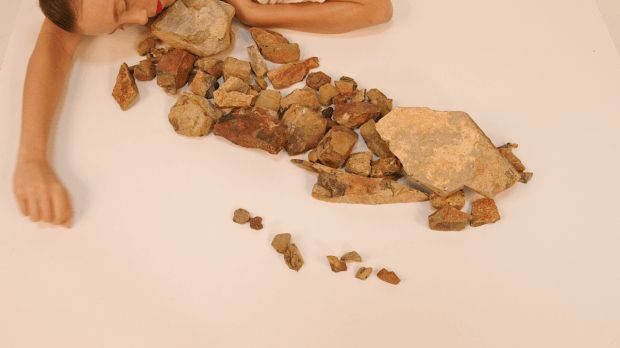
Natusha Croes, CARICIA, courtesy of the artist.

The simplicity of her artistic gestures and of her artefacts recalls Lygia Clark (Belo Horizonte, 1920 – Rio de Janeiro, 1988), precisely for her excitement in telling Hélio Oiticica (Rio de Janeiro, 1937-1980) about the little stone that she found on her path one day in the very middle of Paris (Lygia Clark e Hélio Oiticica, letters 1964-1974). A little stone that, once balanced atop a bag filled with air, became the creation Pedra e ar (1966) demonstrating the relationship between weight and movement. It was the beginning of a journey that brought Lygia to art therapy. A possible path for Natusha too, who considers well-being as an integral part of her practice and performs her artistic gestures as acts of healing.

When Natusha lays leaves and rocks on the workshop floor, I think of Favor quitarse los zapatos (1970), an installation by Margarita Azurdia (Antigua,1931- Guatemala City 1988), where the public had to cross barefoot over a room full of small irregular mounds of wet sand. Just like Natusha, Margarita mingled poetry, performance and sculpture with hybrid and sometimes fictional religious myths, as in Homenage à Guatemala (1971-1974). The idea of homage resonates with the reverence Natusha gives to space.

She reclaims a “state of reverence”, which brings her closer to Ana Mendieta (La Havane, 1948- New York, 1985). Ana is, understandably, the most evident reference in Natusha’s performances, especially the series Siluetas; same need to reconnect with the earth, her homeland. The underwater video of Natusha reminds one evidently of the short Super-8mm film by Ana Mendieta, Creek filmed in 1974, but also of performances Still dance by Anna Halprin (Winnetka, 1920) surrounded by nature.

Natusha Croes, CARICIA research video, screenshot, courtesy of the artist.

The study period in Europe was experienced by the artist as a rupture. It seems to be the same story for many young people from the Caribbean. At a given moment they must leave; once over there, why return? Those who return want to give back the love they received from their birthplace, and understand the rejection while back in the place too. Natusha is surprised: “I really did want to come back, and now I have to fight to stay.”

Because she wants to be in close communion with her island, Natusha swims against the current until she’s grounded, and the gap between her and her island gently fills.

While she draws, installs, performs, dances, feels, writes a story, her manner is just the opposite of spectacular, and that’s what draws me to her work. Natusha sings in Spanish and in English, caressing the land in all her languages. And it is of love that she speaks when she tells of her return to her birth land – “I was everywhere like a fool in love.” Right now as she caresses the rocks, I imagine her touching the bottom of time with the tip of her fingers.

Ana Mendieta made love to her homeland as well. She also started from a precise point, places she thought were charged with power, to finish with the understanding that a connection to the universe is possible everywhere, because the universe is one. To speak of her work Natusha uses the expression ‘Create from a state of reverence’. Eloquent,  and to the point. Also radically decolonial.

– Matilde dos Santos – Historian, art critic and independent curator

Appreciation to the partners of the CATAPULT programme: The American Friends of Jamaica, Kingston Creative and Fresh Milk.

The SHAR participants described their experiences in blogs that you can read on the Fresh Milk platform here.


For further information:

Lygia CLARK et Helio OITICICA, organised by Luciano FIGUEIREDO, Cartas 1964-74 edited by UFRJ, Rio de Janeiro, 1996.

Cecilia Fajardo-Hill e Andrea Giunta, Mulheres radicais: arte latino-americana, 1960-1985, Pinacoteca de Sao Paulo, Sao Paulo , 2018. (see Azurdia p.60)

Ana Mendieta. Le temps et l’histoire me recouvrent, catalogue of the exhibit, Jeu de Paume, Paris, 2018

Anna Halprin Still Dance (1998–2002) – Anna was photographed by Eeo Stubblefield when she performed the score of Stubblefield,  Still dance. These actions and other performances in nature were documented by Andy Abrahams Wilson in the film Returning home
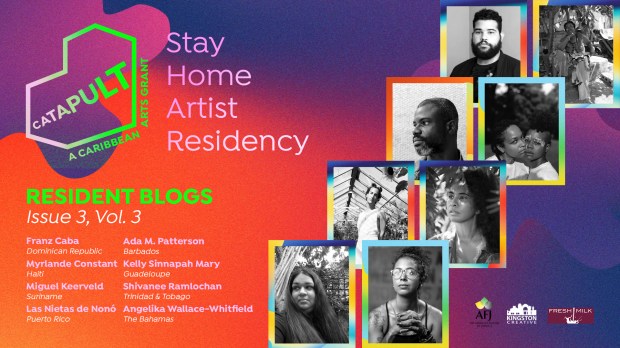
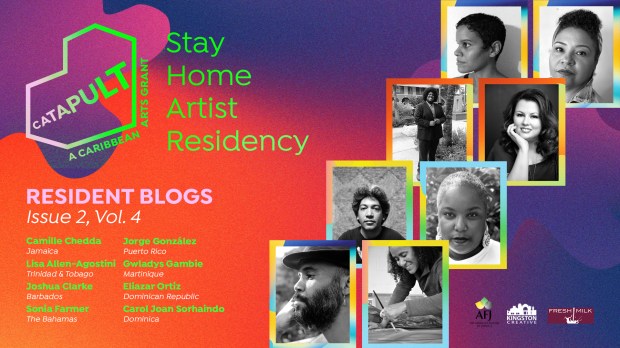
CATAPULT Stay Home Artist Residency Blogs – Issue 2, Vol. 3 & 4

The CATAPULT Stay Home Artist Residency (SHAR) provides opportunities for 24 cultural practitioners from the English, French, Spanish and Dutch speaking Caribbean to be supported while safely remaining in their studios/work-spaces, each of whom will receive a $3,000 USD stipend to produce work over a two-month period.

We are pleased to share Issue #2, Volume 3 and Volume 4 of the blog posts written by participating residents, documenting their experiences and processes during their residency. Issue #2 follows the journey of the second group of SHAR awardees: Camille Chedda (Jamaica), Lisa Allen-Agostini (Trinidad & Tobago), Joshua Clarke (Barbados), Sonia Farmer (The Bahamas), Jorge González (Puerto Rico), Gwladys Gambie (Martinique), Eliazar Ortiz (Dominican Republic) and Carol Joan Sorhaindo (Dominica).

Click on the images below to read these sets of resident blogs as e-zines!


Issue 2, Vol. 3

Issue 2, Vol. 4


ABOUT CATAPULT:

CATAPULT | A Caribbean Arts Grant is a COVID-19 relief programme conceptualised by Kingston Creative (Jamaica) and Fresh Milk (Barbados) and funded by the American Friends of Jamaica | The AFJ (USA). Designed as a capacity building initiative it will directly provide financial support to over 1,000 Caribbean artists, cultural practitioners and creative entrepreneurs impacted by the pandemic and working in the themes of culture, human rights, gender, LGBTQIA+, and climate justice.


ABOUT THE PARTNERS:

American Friends of Jamaica | The AFJ has a near 40 year history of funding charitable organizations in Jamaica in the fields of Education, Healthcare and Economic Development. A registered 501 c 3 nonprofit headquartered in New York City, AFJ relies on individual and corporate contributions made by donors who believe in our work and will advocate on our behalf. Part of the AFJ’s mission is to facilitate donor directed contributions which enables donors to support registered charitable organizations aligned with their own goals for philanthropy.


Kingston Creative is a registered non-profit organization founded in February 2017. Its mission is to enable creatives to succeed so that they can create economic and social value, gain access to global markets and have a positive impact on their community.


Fresh Milk is an organisation whose aim is to nurture, empower and connect Caribbean artists, raise regional awareness about contemporary arts and provide global opportunities for growth, excellence and success. Fresh Milk supports excellence in the visual arts through residencies and programmes that provide Caribbean artists with opportunities for development and foster a thriving art community.
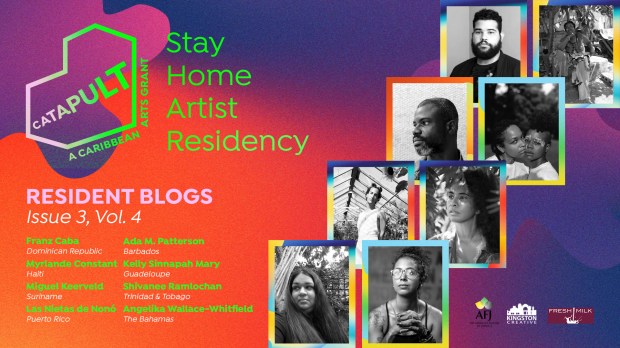
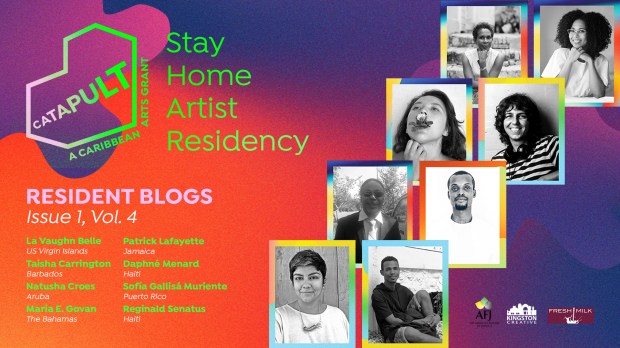
CATAPULT Stay Home Artist Residency Blogs – Issue 1, Vol. 3 & 4

The CATAPULT Stay Home Artist Residency (SHAR) provides opportunities for 24 cultural practitioners from the English, French, Spanish and Dutch speaking Caribbean to be supported while safely remaining in their studios/work-spaces, each of whom will receive a $3,000 USD stipend to produce work over a two-month period.

We are pleased to share Issue #1, Volume 3 and Volume 4 of the blog posts written by participating residents, documenting their experiences and processes during their residency. Issue #1 follows the journey of the first group of SHAR awardees: La Vaughn Belle (US Virgin Islands), Taisha Carrington (Barbados), Natusha Croes (Aruba), Maria E. Govan (The Bahamas), Patrick Jerome Lafayette (Jamaica), Daphné Menard (Haiti), Sofía Gallisá Muriente (Puerto Rico) and Reginald Senatus (Haiti).

Click on the images below to read these sets of resident blogs as e-zines!


Issue 1, Vol. 3

Issue 1, Vol. 4


ABOUT CATAPULT:

CATAPULT | A Caribbean Arts Grant is a COVID-19 relief programme conceptualised by Kingston Creative (Jamaica) and Fresh Milk (Barbados) and funded by the American Friends of Jamaica | The AFJ (USA). Designed as a capacity building initiative it will directly provide financial support to over 1,000 Caribbean artists, cultural practitioners and creative entrepreneurs impacted by the pandemic and working in the themes of culture, human rights, gender, LGBTQIA+, and climate justice.


ABOUT THE PARTNERS:

American Friends of Jamaica | The AFJ has a near 40 year history of funding charitable organizations in Jamaica in the fields of Education, Healthcare and Economic Development. A registered 501 c 3 nonprofit headquartered in New York City, AFJ relies on individual and corporate contributions made by donors who believe in our work and will advocate on our behalf. Part of the AFJ’s mission is to facilitate donor directed contributions which enables donors to support registered charitable organizations aligned with their own goals for philanthropy.


Kingston Creative is a registered non-profit organization founded in February 2017. Its mission is to enable creatives to succeed so that they can create economic and social value, gain access to global markets and have a positive impact on their community.


Fresh Milk is an organisation whose aim is to nurture, empower and connect Caribbean artists, raise regional awareness about contemporary arts and provide global opportunities for growth, excellence and success. Fresh Milk supports excellence in the visual arts through residencies and programmes that provide Caribbean artists with opportunities for development and foster a thriving art community.

Aliyah Hasinah’s Fresh Milk Residency – Week 4 Blog Post

UK-based writer and curator of Bajan and Jamaican heritage, Aliyah Hasinah, shares her final blog post about her Fresh Milk international residency. Aliyah speaks about her last round of studio visits, trips to exhibitions and conversations with cultural workers in Barbados, ending her account of the residency experience with a series of questions to reflect on upon her return home. Read more below:


For the last 4 years, every time I travelled I collected a postcard. Postcards specifically featuring Black People portrayed in interesting (often racist) ways or of histories we may have assumed. When in Barbados, this trip I failed to do so. Having read excerpts of Krista Thompson’s ‘An Eye for the Tropics’, I felt the impact that the postcards I’d collected on my travels actually had. They continue the romanticism and acceptance of racism in these spaces, and it was profound for me to completely disengage from this practice on this particular land.

Barbados in November 2020, changed me. It chemically and spiritually altered me and gave a new clarity to my ambitions. A big thank you to my co-resident Pascale for being an incredible force and inspiration throughout this residency.

So the 4 weeks have really flown by. I’m not quite sure how the residency is over but it is. To say the experience was transformative is an understatement. My last week saw me preparing for Independence Day with many visits, including a preview of the Flower Forest’s new installations as well as meeting with Janice Whittle at Queen’s Park Gallery to discuss the NCF’s role in Barbados’ visual arts landscape and plans for the future..

I also had the honour of meeting Ras Ishi and Ras Akyem this week as well as talking to Winston Kellman. All of whom have been great inspirations of mine.

I could talk forever about these experiences but I will keep it short and full of photos instead. I also visited The Brighton Storeroom gallery to see their latest group exhibition..

I have a lot of questions (as always) brewing, these include:

  • How does the NCF get better at engaging with post-emerging artists and dissolving bureaucracy in their processes?

  • Who holds the White elites of Barbados accountable for the continued coloniality on the island and stringent segregation?

  • Why are some Slave Codes in Barbados still within the legal constitution? Why is drumming banned late at night ?

  • What does republic status mean for working class Bajans?

  • How can curators, artists and strategists work together to continue building artistic infrastructure in Barbados?

  • What does investing in Barbados’ art community look like for the art industries across the Caribbean and globe?

  • How do we amplify artists’ dreams into a reality? What needs to be understood and what knowledge shared?

  • Who will hail up and support the Black Visual Artists who involve a more radical praxis in Barbados?

Thanks again to everyone who’s been reading my blogs and feel free to connect with me on Instagram or Twitter @aliyahhasinah.

Nuff love and take care

Aliyah Hasinah x